Attention Focused on Possible Disqualification from Candidacy
Supreme Court Ruling Could Come as Early as June
The Seoul High Court Criminal Division 6-2 (Presiding Judges Choi Eun-jung, Lee Ye-seul, and Jung Jae-oh) will deliver the second trial verdict on the case of Lee Jae-myung, leader of the Democratic Party of Korea, for violation of the Public Official Election Act at 2 p.m. on the 26th. This comes 131 days after the first trial on November 15 last year, where he was sentenced to one year in prison with a two-year probation, a penalty that includes disqualification from candidacy.
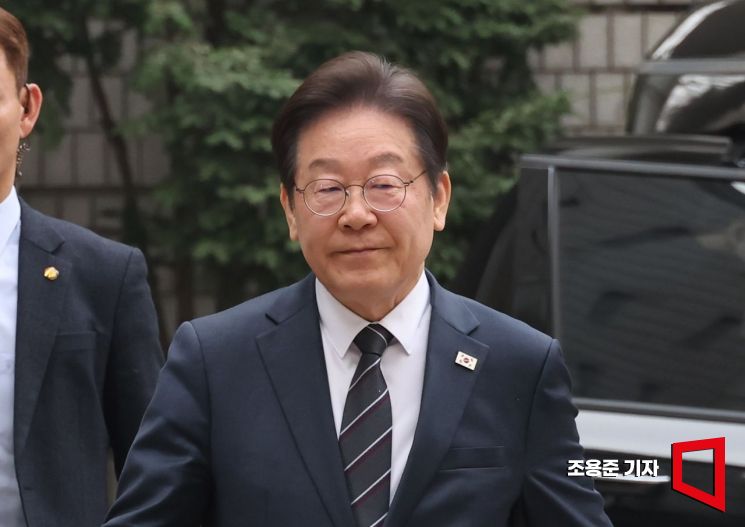 Lee Jae-myung, leader of the Democratic Party of Korea, is attending the first trial hearing of the Wirye, Daejang-dong, Baekhyeon-dong, and Seongnam FC cases held at the Seoul Central District Court on the 25th. 2025.3.25 Photo by Jo Yong-jun
This verdict is considered a key variable that will influence the future political landscape alongside the impeachment ruling of President Yoon Seok-youl. If Lee receives a guilty verdict with a fine of 1 million won or more in the second trial and this sentence is upheld by the Supreme Court, he will be barred from running in the next presidential election. If he is fined less than 1 million won or acquitted, there will be no impact on his candidacy, potentially strengthening his position.
Lee faces two main charges. The first concerns his statement during a broadcast interview in December 2021, when he was a presidential candidate, where he implied that he did not know the late Kim Moon-gi, former Head of Development Division 1 at Seongnam Urban Development Corporation. The second relates to his remarks suggesting that the Ministry of Land, Infrastructure and Transport exerted pressure regarding the change of land use for the Baekhyeon-dong site of the Korea Food Research Institute, which may constitute false information disclosure under election law.
In the first trial, only the statements "I did not play golf with Kim Moon-gi" and "there was pressure from the Ministry of Land regarding the Baekhyeon-dong land use change" were deemed guilty. Statements such as "I did not know Kim Moon-gi during my tenure as mayor of Seongnam" were judged not guilty. In the second trial, the main issues are whether Lee's statements constitute false information and whether he intentionally disclosed them.
If Lee is sentenced to a fine of 1 million won or more in the second trial, it is expected that he will appeal to the Supreme Court. In that case, the Supreme Court's final ruling could come as early as June. Previously, the Supreme Court requested lower courts to adhere to the so-called "6·3·3 rule," which mandates sentencing within six months for the first trial, three months for the second trial, and three months for the third trial in election law cases. The Supreme Court's request indicates its intention to comply with this rule as well.
Besides this case, Lee is undergoing criminal trials in four other cases: the so-called perjury coaching case, the Daejang-dong, Baekhyeon-dong, and Seongnam FC cases, the Ssangbangwool North Korea remittance case, and the corporate card misuse case. According to our constitution, a sitting president cannot be criminally prosecuted except for crimes of rebellion or treason. However, there is debate among legal and academic circles about whether "criminal prosecution" includes the trial process itself.
© The Asia Business Daily(www.asiae.co.kr). All rights reserved.

![Clutching a Stolen Dior Bag, Saying "I Hate Being Poor but Real"... The Grotesque Con of a "Human Knockoff" [Slate]](https://cwcontent.asiae.co.kr/asiaresize/183/2026021902243444107_1771435474.jpg)















