Wildfire Risk Rises with Temperature Increases: Year-Round and Larger Blazes
Climate Change Significantly Impacts Everyday Economy
With the Earth's average temperature rising 1.5 degrees higher than the pre-industrial era, many secondary damages are occurring due to climate change. Recently, large-scale wildfires have been increasing not only in Korea but also around the world, including the United States, while heavy rains and typhoons are becoming stronger. Above all, climate change is affecting everyday life.
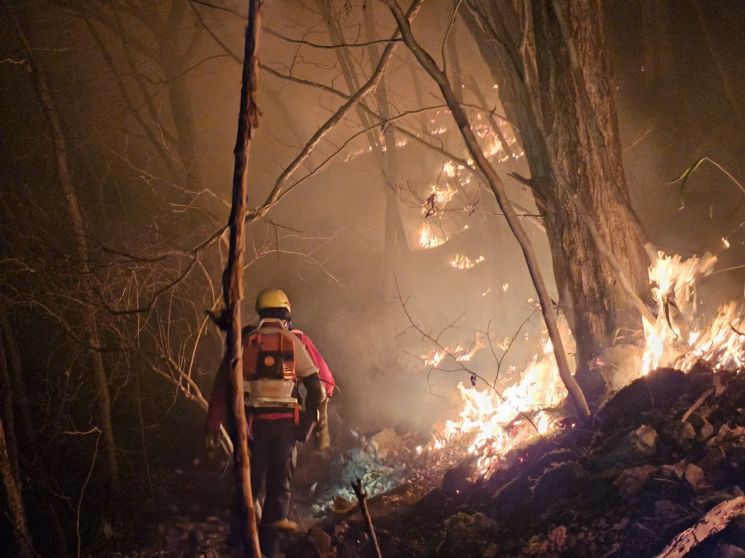 The average global temperature has risen by 1.5 degrees compared to the pre-industrial era, causing numerous secondary damages due to climate change. Recently, large wildfires have increased not only in Korea but also around the world, including the United States, while heavy rains and typhoons are becoming more intense. Provided by the Korea Forest Service
On the 24th, Yonhap News reported that climate change is cited as the cause of the recent frequent large wildfires and that climate change is threatening everyday food supplies. According to the Korea Forest Service and others, a wildfire that started on the 21st in Sancheong, Gyeongnam, and spread to Uiseong, Gyeongbuk, and Ulju, Ulsan on the 22nd, has not yet been extinguished. Among these, the large wildfires in Uiseong, Gyeongbuk; Sancheong, Gyeongnam; and Ulju, Ulsan were analyzed to have occurred due to a combination of residents' carelessness, drier weather than before, strong winds, and 'climate change.'
Most importantly, the reason wildfires are lasting longer and their suppression is delayed is due to the combination of dry spring weather, less precipitation than usual, high temperatures, and strong winds. According to the Korea Meteorological Administration, the average January precipitation at Wondang-ri, Uiseong-eup, Uiseong-gun, a representative observation point in Uiseong, is 15.5 mm, but this January's precipitation was only 7.4 mm, about half the usual amount. The average February precipitation is 22.6 mm, but this February's was only 4.8 mm, about 21% of the usual level. Dry weather warnings have already been issued continuously in the Gyeongnam and Gyeongbuk regions. The highest temperatures in Uiseong were 25.2 degrees on the 22nd and 26.4 degrees on the 23rd, showing weather more like early summer than spring. In this situation where spring dryness and summer-level high temperatures met, wildfires broke out, accompanied by strong winds reaching a maximum instantaneous speed of 17.9 m/s. Because of this, the wildfires spread uncontrollably.
Wildfire Scale Increasing and Duration Lengthening Worldwide
It has already become a consensus in related academic fields that climate change promotes large wildfires. According to the National Institute of Forest Science, rising sea surface temperatures worldwide affect atmospheric circulation, causing dry and strong winds. Hot weather and dry meteorological conditions have been identified as factors promoting wildfire occurrence. The research team of the Climate Physics Research Group at the Institute for Basic Science (IBS) published in the international journal Science Advances in February a supercomputer analysis showing that for every 1-degree increase in Earth's temperature due to climate change, the area of Earth lost to wildfires annually will increase by 14%. Climate change increases wildfire risk through rising temperatures. Moreover, the carbon dioxide released by wildfires accelerates climate change, creating a vicious cycle.
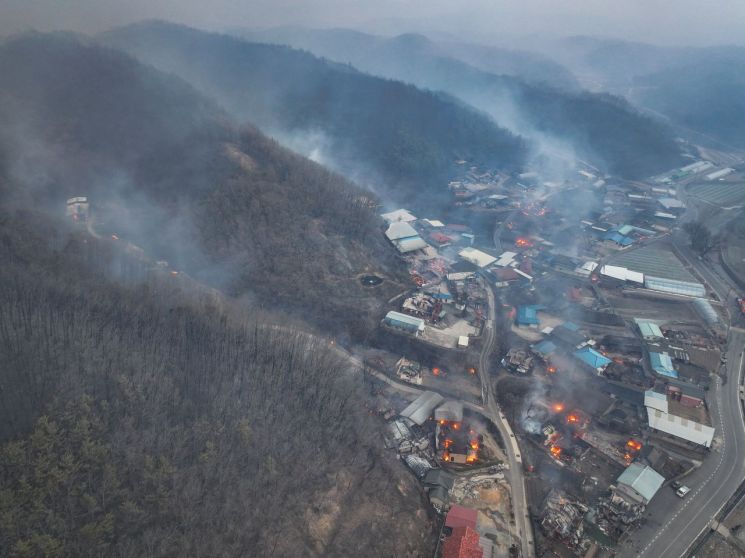 A fire caused by embers carried by strong winds from a wildfire in Uiseong-gun, Gyeongbuk, is burning in Hawha 1-ri, Danchon-myeon, Uiseong-gun on the 25th, the fourth day since the wildfire started. Photo by Yonhap News
This vicious cycle is also reflected in related statistics. According to the Korea Forest Service's analysis of wildfire trends, the annual average number of wildfires, which was 238 in the 1980s, has increased to an average of 580 in the 2020s (2020?2023). The area damaged by wildfires has dramatically expanded from an average of 1,112 hectares annually in the 1980s to 8,369 hectares annually in the 2020s. The Korea Forest Service pointed out, "Due to causes such as climate change, ultra-large wildfires are frequently occurring worldwide, highlighting wildfires as an international disaster."
Abnormal Climate Reduces Agricultural and Fishery Production, Causing 'Climateflation'
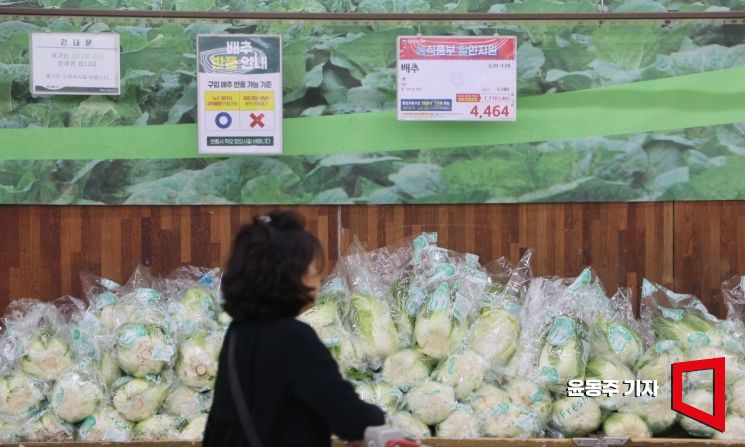 Prices of vegetables such as cabbage, radish, and carrots are rising one after another, making concerns about food prices a reality. On the 24th, cabbages were displayed at Yangjae Hanaro Mart in Seoul. The selling price of cabbage is about 4,500 won, approximately 50% higher than last year. Photo by Yoon Dong-joo
Furthermore, climate change is affecting the prices of globally demanded commodities such as coffee and chocolate. Coffee bean prices recently hit record highs, and the price of cocoa, the raw material for chocolate, also reached an all-time high. The rise in international raw material prices has influenced domestic consumer prices, leading major coffee chains to raise their prices simultaneously. Confectionery companies have also increased prices of products containing chocolate, increasing the burden on consumers.
© The Asia Business Daily(www.asiae.co.kr). All rights reserved.














