Movement Restrictions and Enhanced Disinfection to Block Horizontal Transmission
Penalties Including Reduced Compensation for Violations
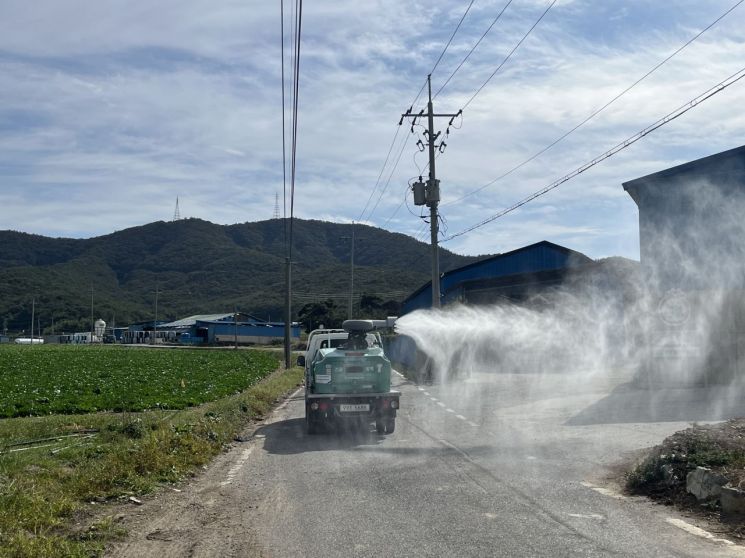 Jeonnam Province implements various quarantine policies to prevent the spread of foot-and-mouth disease. Photo by Jeonnam Province
Jeollanam-do has strengthened quarantine management to prevent the horizontal transmission of foot-and-mouth disease (FMD) by implementing special management of affected farms and regions, enhancing disinfection measures for livestock vehicles, expanding the operation of disinfection facilities, and reducing compensation in case of quarantine violations.
According to Jeollanam-do officials, although vaccination was completed in all cities and counties by the 22nd, it takes about one to two more weeks for antibodies to form, and there is a possibility of virus circulation within high-risk areas.
Accordingly, Jeollanam-do, together with local governments, will implement special management for affected farms and regions.
The movement of live cattle, livestock market shipments, and transactions between farms in the affected farms and Yeongam-gun have been banned until the end of this month. Only animals without clinical symptoms are allowed to be sent for slaughter.
In addition, all cloven-hoofed livestock vehicles in the Yeongam area are subject to a designated area system, allowing movement only within the designated region. Vehicles entering affected farms must be separately designated and operated, must pass through disinfection facilities before and after arrival, and are not allowed to enter the farm premises.
Quarantine measures for livestock vehicles have also been strengthened. All vehicles entering livestock farms in Jeollanam-do must pass through designated disinfection facilities and receive a disinfection certificate before entering the farm. Unnecessary vehicles and people are strictly controlled from entering the farm, and a second disinfection using a high-pressure sprayer or similar equipment is mandatory at the entrance.
Vehicles epidemiologically related to affected farms are restricted from movement for seven days and must undergo thorough disinfection and cleaning. If virus tests confirm no abnormality, the vehicles may resume movement. Feed trucks are required to undergo a six-step disinfection process from departure at the feed factory, visiting the farm, and returning.
To block horizontal transmission, the number of disinfection facilities and control posts has been increased. On major roads within 3 km of the affected area, 31 control posts (26 in Yeongam, 5 in Muan) have been installed, and within 10 km, 5 control posts (2 in Yeongam, 3 in Naju) have been set up to prevent unnecessary livestock vehicles from entering. Only vehicles with a disinfection certificate from a designated facility are allowed to pass.
Twenty-three designated disinfection facilities are in operation in the region, requiring all livestock vehicles to pass through them. Jeollanam-do has organized inspection teams (four teams, 19 members) to intensively inspect whether disinfection facilities are operating properly and whether vehicles are being disinfected thoroughly inside.
If quarantine violations are found, compensation for culling will be reduced and fines will be imposed.
To strengthen quarantine responsibility, affected farms will have their culling compensation reduced by a basic 20%, receiving only 80%. Additional reductions of 5-35% will be applied depending on the type of violation, such as inadequate quarantine facilities or failure to disinfect.
However, even with strict reductions, 20% of the compensation will be guaranteed to ensure basic livelihood. In addition to culling compensation, farms violating quarantine rules, such as not installing shoe disinfection mats, will be fined between 1 million and 5 million KRW.
As of the 24th, there have been a total of 14 FMD cases: 13 in Yeongam and 1 in Muan.
© The Asia Business Daily(www.asiae.co.kr). All rights reserved.

















