One in Five Citizens Feels 'Lonely'
Number of Crimes per 100,000 People on the Rise
Last year, the biggest social conflict perceived by the public was the political conflict between 'conservatives and progressives.' As in previous years, the National Assembly was identified as the government institution with the lowest public trust, and with continued enthusiasm for education, both participation rates in private education and private education expenses showed an upward trend.
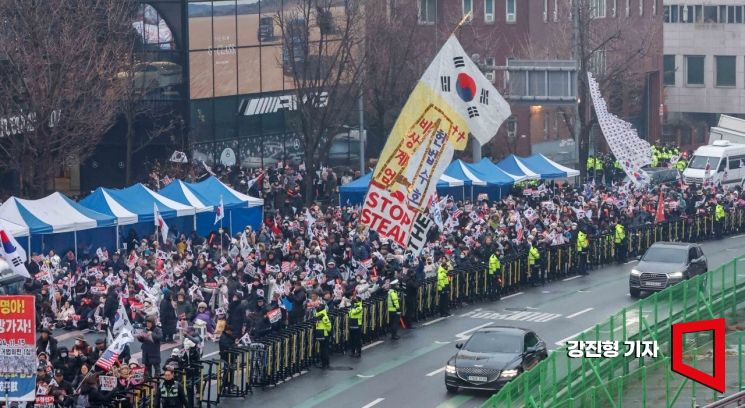 Conservative group members protesting near the Presidential Residence in Yongsan-gu, Seoul, last January.
According to the '2024 Social Indicators of Korea' released by Statistics Korea on the 25th, the major social conflicts felt by people last year were ▲conservatives and progressives (77.5%) ▲the poor and the upper-middle class (74.8%) ▲workers and employers (66.4%) ▲development and environmental preservation (61.9%) ▲the metropolitan area and provinces (58.6%) ▲the elderly and the young (58.3%) in that order.
Among the eight survey items, the conflict between conservatives and progressives showed the highest proportion, but the figure declined compared to the same survey last year (82.9%). However, since the survey last year was conducted between August and September, the political situation after the December emergency martial law incident was not reflected.
Among citizens aged 19 and older last year, 21.1% felt 'lonely,' and 16.2% felt that 'no one really knows me,' both increasing compared to the previous year. By age group, the highest proportion feeling lonely was those aged 60 and above, while the feeling that no one really knows them was most prominent among people in their 40s.
The percentage of respondents satisfied with their lives was 75.6%, up 1.5 percentage points from the previous year. The proportion of respondents who considered their work valuable increased by 7.9 percentage points to 76.3%. Higher income levels correlated with greater life satisfaction, and younger age groups tended to have a higher perception of the value of their work.
Last year, the government institutions trusted by the public were ranked as follows: ▲local governments (55.3%) ▲military (51.3%) ▲police (50.8%) ▲courts (46.1%) ▲central government (44.0%) ▲prosecutors (43.0%) ▲National Assembly (26.0%). Although trust in the National Assembly rose by 1.3 percentage points compared to the previous year, all other institutions showed a decline. The central government saw a relatively large drop of 9.8 percentage points.
By age group, trust in all government institutions was highest among those aged 60 and above. For the central government, local governments, and the National Assembly, people in their 40s had the next highest trust levels. Except for the National Assembly and police, the 19-20 age group showed the lowest trust in all government institutions. The lowest trust in the National Assembly and police was found among people in their 50s and 40s, respectively.
As of 2023, the price-to-income ratio (PIR) of housing prices relative to annual income was 6.3 times, unchanged from the previous year. In the metropolitan area, the PIR was 8.5 times, down 0.8 points from the previous year. By income level, the PIR for the lower class decreased by 1.3 points, and for the upper class by 0.7 points, while the middle class remained the same. The rent-to-income ratio (RIR) relative to monthly income in 2023 was 15.8%, down 0.2 percentage points.
Both participation rates in private education and private education expenses showed an upward trend. Last year, the private education participation rate was 80.0%, up 1.5 percentage points from the previous year. Particularly, households with higher monthly incomes showed a notable increase in private education expenses. The average monthly private education expense per student was 474,000 KRW, an increase of 9.3%. It was found that households with higher incomes spent more on private education.
As of 2023, the number of crimes per 100,000 people was 3,121, an increase of 2.4% (73 cases) compared to the previous year. Both special law crimes (1,135 cases) and criminal law crimes (1,986 cases) per 100,000 people showed an increasing trend. By region, the highest numbers were in Jeju (4,286 cases), Jeonnam (3,839 cases), Busan (3,657 cases), Gyeongnam (3,493 cases), and Chungnam (3,201 cases), in that order.
© The Asia Business Daily(www.asiae.co.kr). All rights reserved.












