Maintains Performance Even After 10,000 Charge-Discharge Cycles
A domestic research team consisting of Professor Min Sung-wook from the Department of Energy and New Materials Engineering at Dongguk University, Professor Kim Byung-hyun from the Department of Energy Bio at Hanyang University ERICA, and Dr. Kim Young-yong from the Pohang Accelerator Laboratory has developed a new vanadium(V)-based cathode material for implementing aqueous zinc-ion batteries (AZIBs) with high capacity and long lifespan.
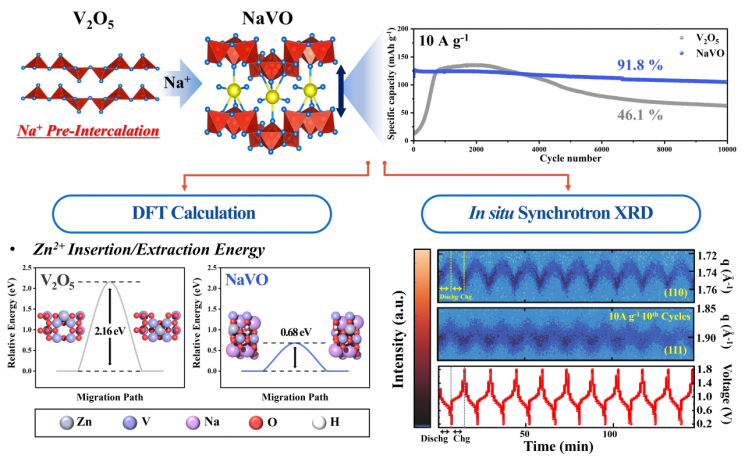 A joint research team from Dongguk University, Hanyang University ERICA, and Pohang Accelerator Laboratory has developed a new cathode material that overcomes the structural limitations of aqueous zinc-ion batteries.
 The research team introduced a novel method of pre-inserting sodium ions into the existing vanadium pentoxide structure. They also succeeded in realizing a new cathode material called NaVO through a single-step sonochemical synthesis process based on ultrasound.
Sodium ions act as a kind of ‘structural support’ that stabilizes the vanadium interlayer structure, expanding the interlayer spacing up to 8.4 nm while maintaining structural stability. As a result, zinc ions can be inserted and extracted more smoothly, enabling both long-term structural stability and high performance simultaneously.
The NaVO//Zn battery cell developed by the research team recorded a capacity of 126.3 mAh even under high current density conditions and showed a capacity retention rate of 91.8% after more than 10,000 charge-discharge cycles. This represents an improvement of 1.68 times (high-rate characteristics) and 1.99 times (long lifespan) compared to conventional vanadium pentoxide-based batteries.
This achievement was verified through experimental analysis as well as DFT (density functional theory) simulations. It was revealed that the oxidation state of vanadium flexibly changes during the insertion and extraction of zinc ions, and the sodium pre-treatment-enhanced interlayer structure produces a synergistic effect, achieving both high-rate charge-discharge and excellent long-term durability.
Professor Min Sung-wook, who led the research, stated, “The strategy of pre-stabilizing the internal structure of vanadium-based materials using sodium ions is an innovative method that compensates for the shortcomings of conventional V2O5. By realizing high-performance aqueous zinc-ion batteries, we can increase the potential for applications in various fields such as energy storage systems (ESS), electric vehicles, and IoT devices.”
Meanwhile, this research was conducted with the support of the Nano and Materials Technology Development Program of the National Research Foundation of Korea, and the research results are scheduled to be published on the 28th in the internationally renowned journal Journal of Materials Chemistry A.
© The Asia Business Daily(www.asiae.co.kr). All rights reserved.

![Clutching a Stolen Dior Bag, Saying "I Hate Being Poor but Real"... The Grotesque Con of a "Human Knockoff" [Slate]](https://cwcontent.asiae.co.kr/asiaresize/183/2026021902243444107_1771435474.jpg)















