Partial Recognition of "Withholding Judicial Appointments Is Unconstitutional"
"No Evidence of Active Involvement During Martial Law"
"National Assembly's Impeachment Procedure Is Lawful"... Jeong Hyeong-sik and Jo Han-chang Dissent as "Improper"
On the 24th, the Constitutional Court dismissed the impeachment case against Prime Minister Han Deok-su by a majority opinion. Prime Minister Han immediately resumed his duties and will perform the role of acting president after 87 days.
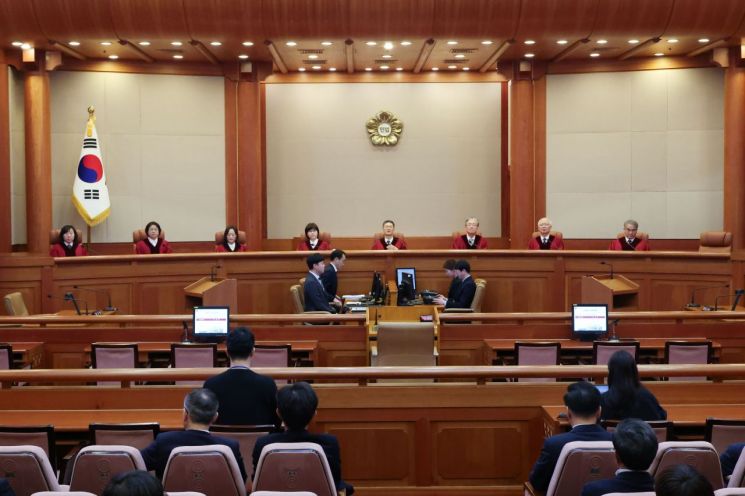 On the 24th, the day of the impeachment trial verdict for Prime Minister Han Duck-soo, the justices, including Moon Hyung-bae, Acting Chief Justice of the Constitutional Court, were seated in the courtroom of the Constitutional Court in Jongno-gu, Seoul. Photo by Yonhap News
On the morning of the same day, the Constitutional Court held a hearing for the impeachment trial of Prime Minister Han and announced, "The impeachment petition against Prime Minister Han Deok-su is dismissed." Five justices expressed opinions for dismissal, two justices for rejection, and one justice for acceptance.
Among the five justices who voted for dismissal, four (Justices Moon Hyung-bae, Lee Mi-seon, Kim Hyung-doo, and Jung Jung-mi) judged that Prime Minister Han’s withholding of appointments for judicial candidates Jo Han-chang, Jung Kye-seon, and Ma Eun-hyuk, who were elected by the National Assembly, violated the Constitution and laws. However, they stated, "It cannot be definitively concluded that this constitutes a betrayal of the people's trust, so there is no reason to justify dismissal."
Justice Kim Bok-hyung, while joining the dismissal opinion, also viewed that withholding the appointment of judicial candidates does not constitute an unconstitutional or illegal act since there is no 'immediate obligation to appoint.'
Furthermore, the Constitutional Court did not accept the National Assembly’s claim that Prime Minister Han should be dismissed for conspiring with or tacitly allowing President Yoon Seok-youl’s declaration of emergency martial law on December 3. The five justices who voted for dismissal and Justice Jung Kye-seon, who voted for acceptance, totaling six justices, judged that "there is no evidence or objective data to recognize that the respondent actively acted, such as proposing the convening of the State Council to legitimize the procedural validity of the emergency martial law declaration."
Additionally, the impeachment grounds alleging that Han Dong-hoon, then leader of the People Power Party, attempted to establish a 'joint government operation system' and that Prime Minister Han encouraged or neglected to veto the special prosecutor law related to President Yoon were also not recognized.
The only justice who voted for acceptance, Jung Kye-seon, stated, "The refusal to appoint constitutional court justices and the delay in requesting the recommendation of special prosecutor candidates constitute serious violations of the Special Prosecutor Act, the Constitution, and the State Public Officials Act. The constitutional protection benefit gained by indirectly depriving the people's trust granted through the appointing authority, the president, overwhelmingly outweighs the national loss caused by the respondent’s dismissal."
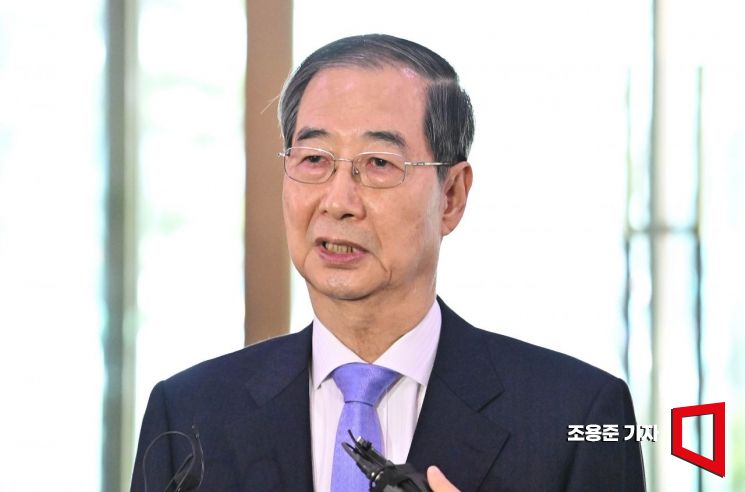 Acting President and Prime Minister Han Duck-soo, who returned to duty after the Constitutional Court dismissed the impeachment motion, is speaking to the press as he arrives at the Government Seoul Office in Jongno-gu, Seoul on March 24, 2025. Photo by Jo Yong-jun
The Constitutional Court did not acknowledge the issue raised by Prime Minister Han’s side regarding the quorum for the impeachment resolution. The Court stated, "It is appropriate to apply the quorum based on the original status for the impeachment of the Prime Minister acting on behalf of the president." However, Justices Jeong Hyeong-sik and Jo Han-chang dissented, arguing, "The impeachment of the Prime Minister acting on behalf of the president should be interpreted to be exercised as cautiously as that of the president, and thus the quorum should be judged by the president’s standard, so the National Assembly’s impeachment petition should be dismissed."
Thus, Prime Minister Han returned to his duties 87 days after the National Assembly’s impeachment petition on December 27 of last year. This is the first time that a high-ranking public official involved in the emergency martial law incident has received a substantive judgment from the judiciary, including criminal trials and impeachment petitions.
© The Asia Business Daily(www.asiae.co.kr). All rights reserved.













