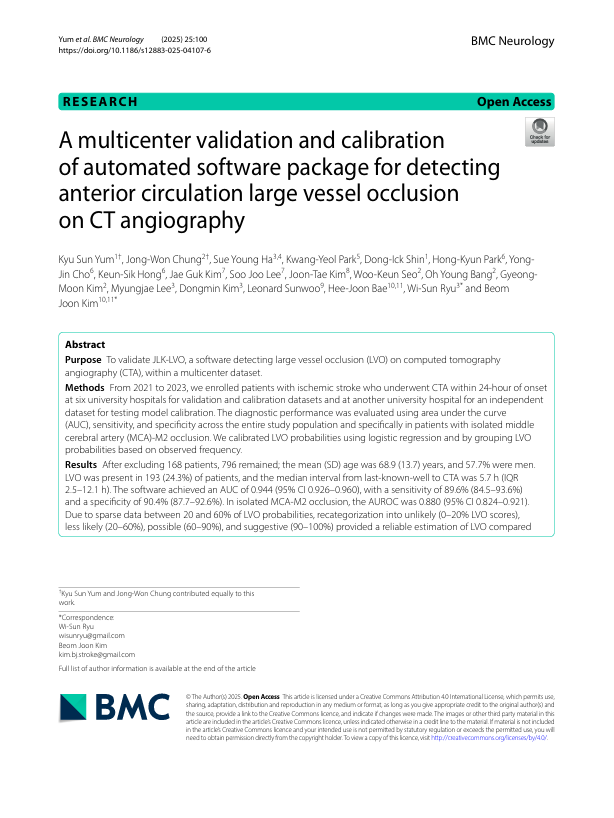
Medical AI specialist JLK (CEO Dongmin Kim) announced on the 24th that it has published a research paper proving the clinical efficacy of its large vessel occlusion (LVO) detection solution in the international academic journal 'BMC Neurology.'
This study was a multicenter research involving six university hospitals in Korea, including Seoul National University Bundang Hospital and Samsung Medical Center. It confirmed that JLK-LVO detects large vessel occlusions requiring intervention with high accuracy and can provide practical assistance in the diagnosis and treatment of stroke.
The research team evaluated the performance of JLK-LVO on 796 ischemic stroke patients from 2021 to 2023. The results showed that JLK-LVO demonstrated excellent diagnostic performance with an AUC (area under the curve, AUROC) of 0.944, sensitivity of 89.6%, and specificity of 90.4%, proving its ability to detect LVOs accurately regardless of imaging conditions.
In particular, it showed high performance with an AUC of 0.880 even in detecting occlusions in the middle cerebral artery (MCA)-M2 segment, which was previously difficult to interpret through imaging, suggesting it could contribute to expanding indications for stroke treatment.
Based on this study, the predictive score of JLK-LVO was reclassified into four risk levels of large vessel occlusion to improve clinical usability, allowing medical staff to use it more intuitively in clinical settings.
Additionally, it was demonstrated that the automatically generated large vessel occlusion score from JLK-LVO correlates with the size of cerebral infarction and the patient's recovery potential at three months, further enhancing its clinical utility.
Professor Beomjun Kim, head of the Cerebrovascular Center at Seoul National University Bundang Hospital and the lead author of the study, stated, “In many small-scale hospitals where more than half of stroke patients first visit, CT angiography to confirm large vessel occlusion is often not performed due to the absence of specialists, which is a major cause of missed treatment windows. JLK-LVO will play a crucial role in treatment decisions for patients in hospitals without experts, and the expansion of AI solutions to small and medium-sized hospitals is urgent,” he emphasized.
Notably, the study's results are also significant as they are likely to serve as important evidence for the registration of JLK-LVO in domestic and international insurance reimbursement systems. High-level clinical evidence is required for AI-based medical solutions to be used in actual clinical practice, and publication through multicenter studies is a key factor in determining insurance coverage.
A JLK representative said, “Through this study, the performance and clinical utility of JLK-LVO have been validated with multicenter data. We plan to actively pursue additional research for insurance reimbursement registration and expand clinical applications.”
© The Asia Business Daily(www.asiae.co.kr). All rights reserved.

















