The financial authorities will fully resume short selling as scheduled on the 31st. Since there are concerns that excessive shocks may occur in individual stocks, the ‘Short Selling Overheated Stocks Designation System’ will also be expanded and operated for two months until the end of May.
The Financial Services Commission announced on the 21st at an emergency financial committee meeting that it has decided to fully resume short selling at the end of this month as planned. Short selling is an investment method where stocks are borrowed and sold, and if the stock price falls, they are repurchased to return the borrowed stocks, thereby earning a price difference profit. The scope of short selling, which was limited to 350 stocks before the ban, will be expanded to all stocks as previously announced. The full resumption of all stocks is the first time in about five years since March 2020, when the pandemic (global outbreak) initially spread.
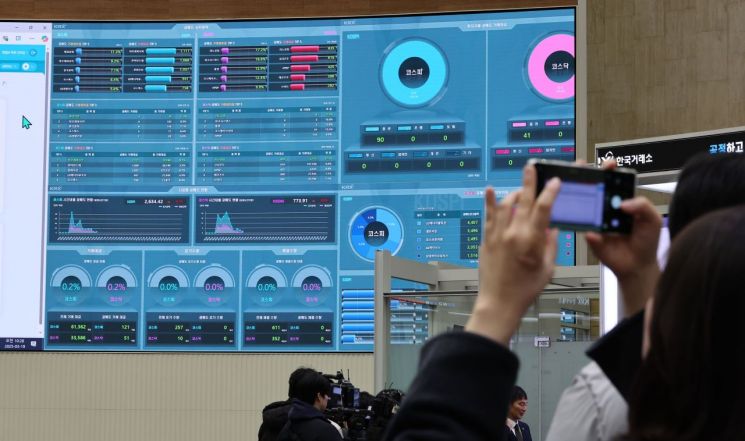 On the 19th, at the Korea Exchange in Yeouido, Yeongdeungpo-gu, Seoul, NSDS Audit Team 1 and KB Securities officials demonstrated the detection of illegal short selling using simulated data during the short selling electronic system construction demonstration. 2025.3.19 Photo by Yonhap News
86% Have Completed Measures to Prevent Naked Short Selling
From the 31st, institutional investors must establish a computerized system to prevent naked short selling, and institutional and corporate investors can only short sell if they have established internal control standards. Securities firms must submit short selling orders only for institutional and corporate investors who have confirmed this in advance. As of this day, the Financial Services Commission expects that 83 provisional institutional investors, accounting for 85.6% of past short selling volume, have completed measures to prevent naked short selling and will be able to resume short selling from the 31st.
The current Korea Exchange’s central inspection system (NSDS) has been developed and is undergoing trial operation this month. As of this day, 21 institutional investors, including major global investment banks such as Morgan Stanley and large domestic securities firms, have completed building their own computerized systems aiming to resume short selling on the 31st and are participating in the trial operation. This corresponds to about 81% of the short selling volume before the ban. Additionally, 62 provisional institutional investors (accounting for 4.6% of short selling volume) have adopted a pre-deposit method, where borrowed securities are deposited into accounts before placing short selling orders, fundamentally blocking the possibility of naked short selling. The Financial Services Commission explained, "So far, test results show that the function to detect violation trades (simulated cases) is operating normally."
Shock Mitigation Buffer... Expansion of Overheated Stocks Designation for Two Months
However, since there are concerns that volatility may increase in some individual stocks due to the resumption of short selling, the Financial Services Commission has decided to expand and operate the short selling overheated stocks designation system step-by-step and temporarily for two months until May 31 to buffer this impact. This system restricts short selling the next day for individual stocks where short selling has surged compared to normal times.
Accordingly, the Financial Services Commission will expand the overheated stock designation criteria for April to cases where the daily short selling amount doubles and the short selling transaction amount ratio is 20% or more, and for May to 25% or more. Previously, it was 30%. The requirement for the increase rate of short selling transaction amount for KOSDAQ stocks will also be relaxed from the previous 5 times to 3 times in April and 4 times in May.
In this case, the monthly average number of short selling overheated stock designations is expected to increase from the previous 17.8 cases for KOSPI and 52.8 cases for KOSDAQ to about twice as many in April (KOSPI 35.9 cases, KOSDAQ 112.3 cases) and about 1.3 times in May (KOSPI 23.8 cases, KOSDAQ 71.2 cases).
Review of System Improvements... Strengthening Punishment for Intentional Naked Short Selling
Before the resumption of short selling, the Financial Services Commission has unified the short selling trading conditions for securities lending transactions mainly used by institutional investors and margin loan services for individual investors. The repayment period for securities lending transactions for short selling purposes is 90 days, with a maximum of 12 months including extensions. The collateral ratio for margin loan services for individual investors will also be lowered to the same level as securities lending transactions, which is 105%.
Along with this, criminal penalties for intentional naked short selling occurring after the resumption of short selling have been strengthened. Fines have been increased from 3 to 5 times the amount of unfair gains to 4 to 6 times. Imprisonment with aggravated punishment will be introduced if the unfair gains amount to 500 million KRW or 5 billion KRW or more. Also, similar to paid-in capital increases, convertible bonds (CB) and bonds with warrants (BW) will restrict investors from acquiring stocks through short selling from the time the issuance plan is disclosed until the conversion price or exercise price is determined.
In addition, from April 23, sanctions such as restrictions on trading financial investment products, restrictions on executive appointments, and account payment suspensions will be introduced as diversified disciplinary measures against naked short selling and unfair trading. Related subordinate laws are currently undergoing amendment procedures, including legislative notice.
The Financial Services Commission stated, "We will make every effort to thoroughly establish measures to prevent naked short selling during the remaining period until the resumption of short selling. After the resumption, we will closely monitor market trends and strengthen market surveillance to block unfair trading."
© The Asia Business Daily(www.asiae.co.kr). All rights reserved.












