Stress and Space Environment Seem to Have Taken a Toll
"Maintaining Health in Space Is a Difficult Task"
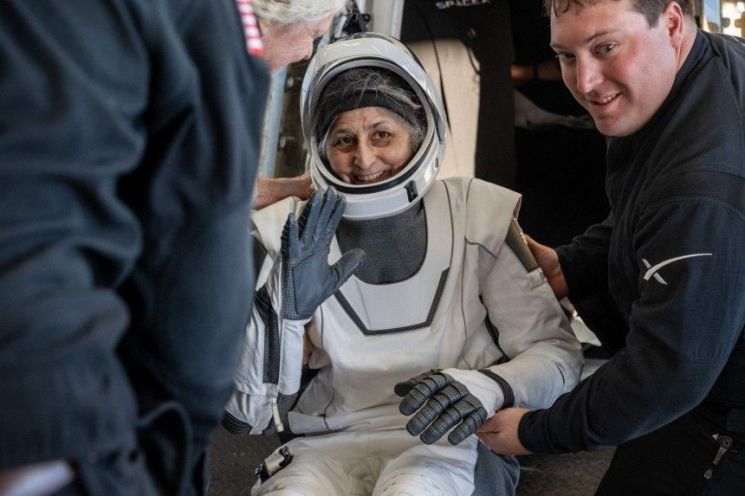
Two astronauts who were stranded for nine months after a test flight to the International Space Station (ISS) last year have finally returned to Earth. The two astronauts are currently undergoing medical examinations, and their gaunt appearance, which looks as if they have aged ten years in just nine months, has attracted global attention.
British daily newspaper Daily Mail and others reported that astronauts Butch Wilmore and Suni Williams, who returned to Earth after 287 days, are currently receiving health checkups at NASA's Johnson Space Center in Houston, Texas.
They appeared on camera looking completely different from nine months ago. Williams, 59, looked as if he had aged ten years in less than a year. When he left Earth last June wearing a spacesuit, he had dark brown hair, but now it has turned completely white. His face has lost fat, making his jawline sharper, and the wrinkles on his skin have deepened.
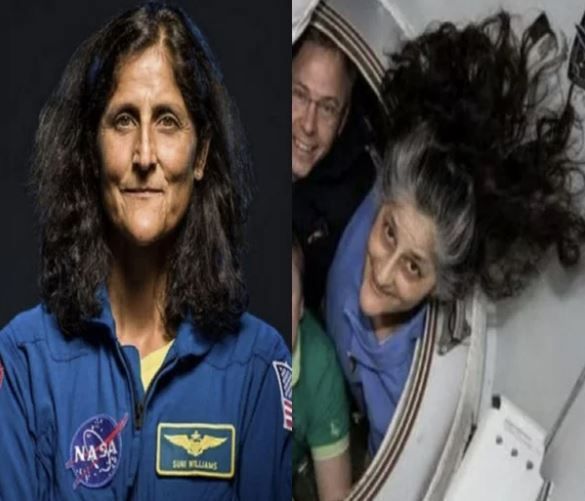 The image of Sunita Williams (59) before her test flight to the International Space Station (ISS) in June last year, and Williams' photo taken at the ISS in February this year. AFP, AP Yonhap News Agency
Why did the astronauts' faces change so rapidly? Experts speculate that stress and the unique microgravity environment of space may have affected the astronauts' bodies. When the human body is under stress, it produces cortisol and adrenaline, which are known to deplete melanin-producing cells that keep hair dark.
Professor Damian Bailey, a physiology expert at the University of South Wales in the UK, told the BBC, "Space is the most extreme environment humans have ever experienced," adding, "Humans have not yet evolved to adapt to such extreme conditions."
Professor Bailey also suggested that astronauts may have experienced weight loss during their extended stay in space, saying, "Maintaining a healthy weight in space is a difficult task." He added, "NASA tries to ensure astronauts consume nutritious food, but changes in their bodies are still likely to occur."
NASA astronaut Scott Kelly, who stayed on the ISS for 340 days, returned with a 7% loss in body weight. Additionally, his gut microbiome was found to have changed compared to before his spaceflight.
Professor Bailey also noted, "Research conducted on 10 astronauts showed that telomeres lengthened during their time in space but shortened rapidly after their return." Telomeres protect the chromosomes in our bodies and are generally known to shorten gradually with aging. However, the exact reason why the space environment affects telomeres in this way remains unknown.
Meanwhile, Wilmore and Williams boarded the 'Starliner,' a space capsule manufactured by Boeing, for their test flight to the ISS. Their original planned stay in space was eight days. However, due to multiple defects found in the Starliner, they had to spend much longer on the ISS than scheduled. Eventually, they were able to land on Earth on the 18th after the arrival of the ISS crew rotation team, 'Crew-10.'
© The Asia Business Daily(www.asiae.co.kr). All rights reserved.













