Hyundai Motor Group Invests 1.8 Trillion Won Over Four Years
Supernal Aims for Air Taxi Commercialization by 2028
AAM Market Led by U.S. and China, South Korea in Close Pursuit
"Market Winner Will Be Determined by Safety and Efficiency"
Hyundai Motor Group is targeting the Indian market, the world's most populous country following the United States, the largest market, to seize leadership in Advanced Air Mobility (AAM). Globally, with the commercialization of air taxi services imminent, the group appears to be preparing to secure market dominance. Despite underwhelming AAM performance, Hyundai Motor Group has invested over 1.8 trillion won in Supernal, an independent corporation established in the U.S., over the past four years.
Jaewon Shin, President of Hyundai Motor's AAM Division and CEO of Supernal, told reporters at Hyundai Motor's shareholders meeting on the 20th, "We are steadily preparing for commercialization by 2028," adding, "We are considering expansion not only into the U.S. market but also into India." He further stated, "AAM is a very important business for Hyundai Motor Group's future, so we expect continuous investment."
Hyundai Motor Group is considering entering the Indian market due to its significant growth potential. India has a vast territory but poor road conditions, making aerial mobility more suitable than ground transportation. Especially since air taxis require high initial service costs and massive infrastructure investments, early adoption is expected in countries with high gross domestic product (GDP). This is why the U.S., China, and India are considered promising markets.
The government’s regulatory framework and infrastructure development commitment are also strong. The Indian government has announced plans to establish over 200 airports and heliports by 2050 to support air taxi operations. U.S.-based AAM startup Archer Aviation is also actively pursuing entry into the Indian market.
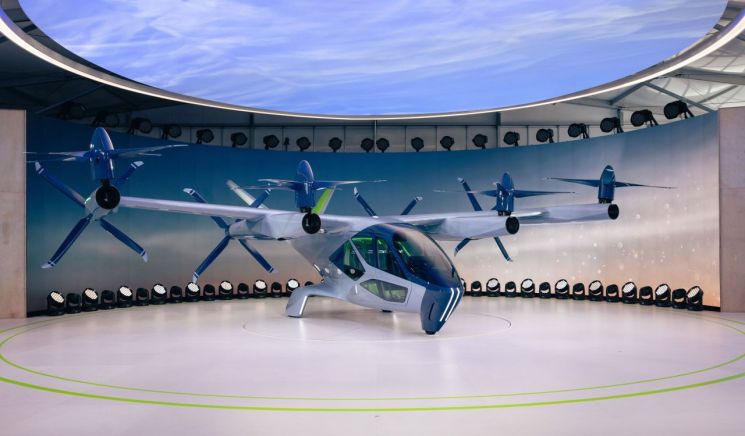 A full-scale model of the S-A2 aircraft developed by Supernal, an independent subsidiary of Hyundai Motor Group's Future Air Mobility (FAM). Provided by Hyundai Motor Group
1.8 Trillion Won... Jeong Eui-seon’s 'Steadfast' Investment in AAM
Hyundai Motor Group has poured nearly 2 trillion won into the AAM business over the past four years. According to business reports from Hyundai Motor, Kia, and Hyundai Mobis, the three companies invested a total of 1.8866 trillion won in Supernal from 2021 to 2024. This amount corresponds to 6% of the three companies’ research and development (R&D) expenses during the same period. By year, the largest investment was 713.2 billion won last year.
Investment increased annually from 249.7 billion won in 2021, the year Supernal was established, to 437.9 billion won in 2022, and 485.7 billion won in 2023. Industry experts consider it unusual for Hyundai Motor to invest such a large sum in a specific new business rather than in its finished vehicle division. Notably, Supernal has recorded net losses for four consecutive years since its establishment. Last year alone, its net loss reached 653 billion won.
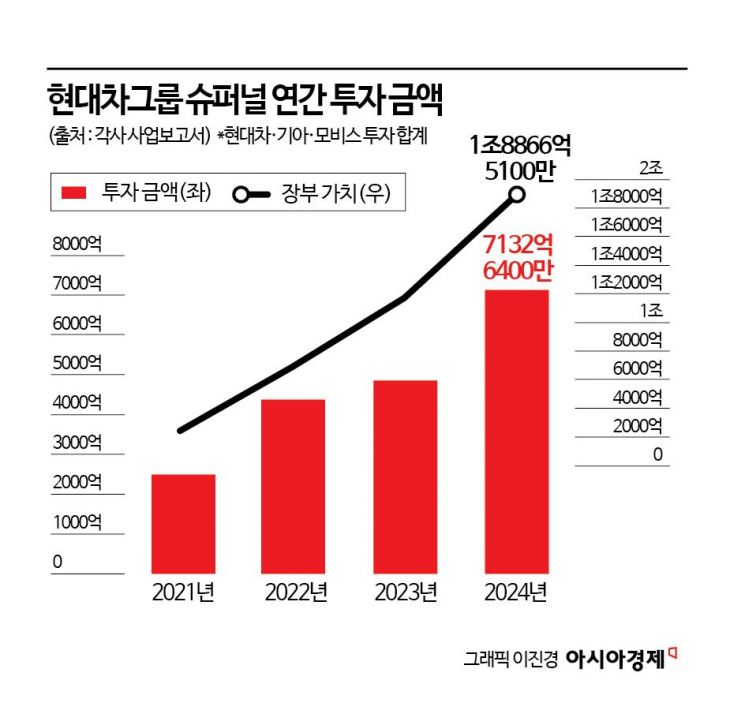
Hyundai Motor Group’s continued investment in AAM is largely influenced by its designation as a core future industry for the group. According to Global Market Insights, the AAM market is expected to grow steadily at an average annual rate of 20% from 2024 to 2032, expanding to a market size of $55 billion (approximately 80 trillion won) by 2032.
The background for sustained investment in this capital-intensive business is interpreted as reflecting the determination of Hyundai Motor Group Chairman Jeong Eui-seon to dominate future mobility.
In 2019, Chairman Jeong revealed a blueprint to structure Hyundai Motor Group’s future revenue composition as 50% from automobiles, 30% from Urban Air Mobility (UAM), and 20% from robotics. Following this vision, Hyundai Motor Group recruited Shin, a former NASA official, as head of the division in 2019, and at the 2020 Consumer Electronics Show (CES), Chairman Jeong personally took the stage to unveil the personal air vehicle (PAV) 'S-A1.'
At that time, Chairman Jeong emphasized, "With investments and recruitment of excellent partners and talent in the UAM field, Hyundai Motor’s position in the future mobility market will change." After establishing the independent AAM corporation Supernal in the U.S. in 2021, the group steadily developed aircraft and showcased a full-scale model of the 15-meter-long 'S-A2' at CES 2024.
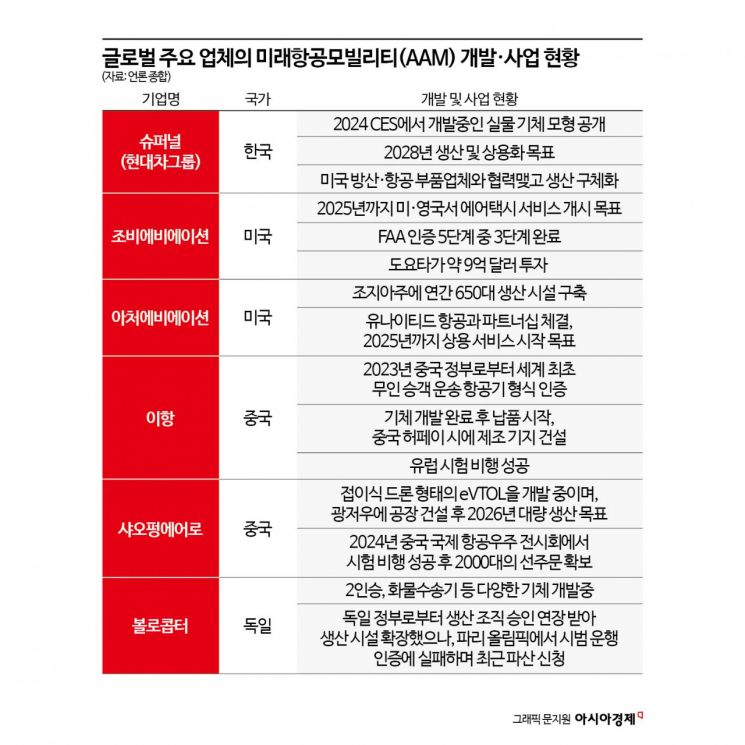
Hyundai Motor Group plans to begin independent AAM production in 2028 and aims to lead the air taxi market. Supernal intends to start initial pilot production of around 100 units in the U.S. in 2028, with mass production planned thereafter. Once full-scale production begins, the company envisions not only commercial passenger transport but also specialized services such as maritime transport and search and rescue operations. To this end, it is currently advancing strategic collaborations with global defense and aerospace parts companies such as Honeywell, BAE Systems, and CHC Helicopter to concretize production and operation plans.
Certification and regulatory issues in the U.S. are also progressing rapidly. The U.S. Federal Aviation Administration (FAA) announced final regulations for 'powered-lift' aircraft, including electric vertical takeoff and landing (eVTOL) vehicles, in October last year. This defined a new aircraft category since the introduction of helicopters in 1940. These regulations establish standards for AAM (long-range) and UAM (short-range) operations. Shin said, "The FAA and major companies are discussing and creating new norms together," adding, "Details are currently under active discussion among companies."
U.S. and China Lead, South Korea in Hot Pursuit
Currently, the U.S. and China hold the lead in AAM development and commercialization. The fastest company preparing commercial air taxi services is the U.S. firm Joby Aviation. Joby has completed three of the five FAA certification stages required to launch service. Its goal is to complete all certification work and start commercial service by the end of this year. Certification procedures are also underway in the U.K. and Dubai. Joby’s air taxi can carry up to five people including the pilot and can travel at speeds up to 320 km/h. It can cover distances that take over 45 minutes by car in just 10 minutes.
China is making strides in unmanned aerial vehicle technology. Chinese drone company EHang’s air taxi received type certification from the Chinese government in October 2023. This was the world’s first type certification for a vertical electric takeoff and landing aircraft certified by the government. The aircraft can carry up to two passengers and is equipped with an autonomous driving system. Its maximum speed is 130 km/h, and it can travel approximately 30 to 35 km per flight. The price is $410,000 (about 600 million won). Earlier this year, EHang successfully conducted demonstration flights for commercial service in Shanghai, China, as well as in Spain and Mexico.
Regarding criticism that Supernal’s development, certification, and service introduction are slow, Shin stated, "Commercialization requires not only the aircraft but also the formation of various supporting infrastructures," adding, "Ultimately, the market winner will be determined by efficiency and safety."
© The Asia Business Daily(www.asiae.co.kr). All rights reserved.
![Clutching a Stolen Dior Bag, Saying "I Hate Being Poor but Real"... The Grotesque Con of a "Human Knockoff" [Slate]](https://cwcontent.asiae.co.kr/asiaresize/183/2026021902243444107_1771435474.jpg)













