Bipartisan Agreement Reached
Special Pension Committee for Structural Reform Also Approved
On the 20th, the National Assembly held a plenary session and passed the amendment to the National Pension Act, which includes the national pension reform plan to raise the contribution rate (amount paid) from 9% to 13% and the income replacement rate (amount received) from 40% to 43%.
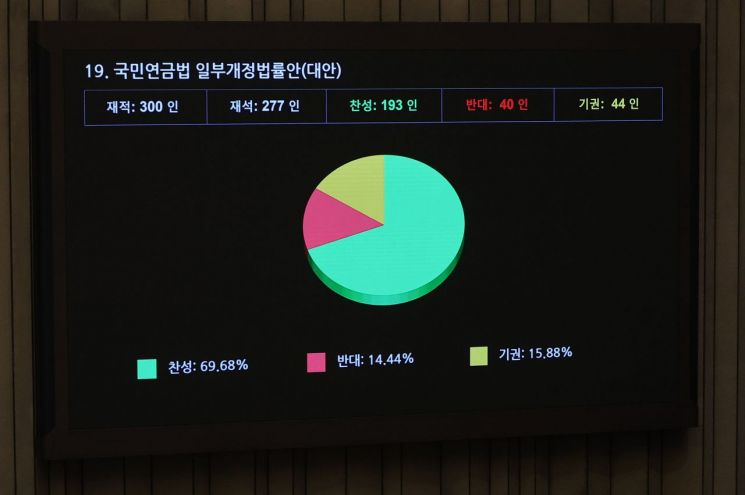
During the plenary session, the National Assembly approved the amendment to the National Pension Act with 193 votes in favor, 40 against, and 44 abstentions out of 277 members present. This national pension reform is the first in 18 years based on the income replacement rate since 2007, but it is the first in 27 years based on the contribution rate, which is the amount paid.
The amended contribution rate will increase by 4 percentage points from the current 9%. Starting next year, it will rise by 0.5 percentage points annually for eight years. The income replacement rate, which determines the amount received, will increase to 43% starting next year.
Regarding pension reform, the ruling and opposition parties showed differing views on whether to proceed with structural reform simultaneously or to prioritize parametric reform first. With the passage of this pension reform plan, parametric reform will begin first, followed by discussions on structural reform through a special pension committee.
The pension reform passed this time includes improvements not only to the contribution rate and income replacement rate but also to military service and childbirth credits. The credit applied to those who have completed military service will be increased from the current 6 months to a maximum of 12 months, and the childbirth credit, which currently applies additional subscription periods from the second child onward, will be expanded to include the first child. For low-income regional subscribers, the reform also includes a provision to support 50% of their contributions for 12 months.
Additionally, the reform plan includes a provision that the state guarantees the stable and continuous payment of the national pension.
The ruling and opposition parties agreed to form a special pension committee to discuss structural reform as a follow-up to this parametric reform of the National Pension Act. Structural reform is expected to include multi-layered measures such as the introduction of an automatic stabilizer and reforms of the national, basic, retirement, and private pensions.
Woo Won-sik, Speaker of the National Assembly, said immediately after the passage of the National Pension Act, "Despite severe political conflicts and confusion, I deeply thank the ruling and opposition parties for their concessions and decisions that led to the conclusion of negotiations on issues affecting the lives of the people."
© The Asia Business Daily(www.asiae.co.kr). All rights reserved.

















