Producer Price Index Stays Flat in February After Three Months of Gains
Smartphones and Flash Memory Lead Decline
Last month, the producer price index (PPI) halted its three-month upward trend and remained flat. Although computer, electronic, and optical equipment, including smartphones and memory semiconductors, declined, agricultural products rose, resulting in this outcome. This month also faces strong downward pressure, drawing attention to whether it will support the stabilization of consumer prices, which lag behind with a time delay.
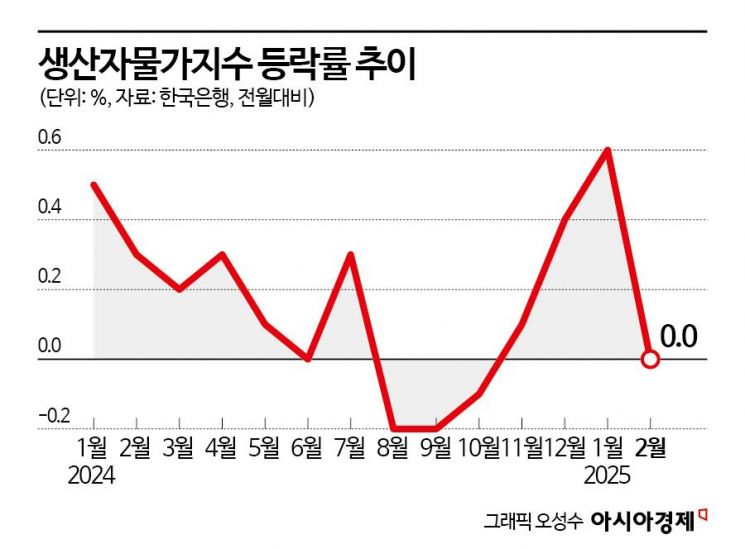
According to the 'February 2025 Producer Price Index (Provisional)' released by the Bank of Korea on the 21st, last month's producer price index recorded no change (0.0%) compared to the previous month. It slightly increased from 120.27 in January to 120.33 last month when viewed to the second decimal place. After a 0.1% decline in October last year, the producer price index had been rising by 0.1% in November, 0.4% in December, and 0.6% in January this year, but it remained flat last month.
The overall index was significantly influenced by manufactured goods, which have the highest weighting and recorded no change. Within manufactured goods, computer, electronic, and optical equipment fell by 0.7%, while chemical products (0.3%) and primary metal products (0.3%) rose. Lee Moon-hee, head of the Price Statistics Team at the Bank of Korea's Economic Statistics Department 1, explained, "The main declining items in computer, electronic, and optical equipment were portable phones (smartphones) and semiconductors such as flash memory. Smartphone prices were affected by the release of new models, which led to price reductions of existing products, and semiconductors saw a demand slowdown mainly in memory semiconductors for general-purpose products."
Last month, agricultural, forestry, and fishery products rose 0.4% month-on-month, with livestock products falling by 4.4%, but agricultural products increasing by 3.6% and fishery products by 1.0%. In the electricity, gas, water, and waste sectors, sewage treatment (0.5%) rose, but industrial city gas (-1.4%) declined, resulting in no change compared to the previous month. Services also recorded no change, with transportation services (-0.1%) falling but real estate services (0.2%) rising. Compared to the same month last year, the index rose 1.5%, mainly driven by industrial electricity, information and communication, and broadcasting services.
By special classification, food, which includes edible agricultural, forestry, and fishery products and processed foods, rose 0.2% month-on-month, while fresh foods increased by 3.9%. Energy, which includes petroleum products, fell 0.1% month-on-month, and IT declined by 0.2%. Items other than food and energy remained flat compared to the previous month.
Producer prices in March are also under downward pressure, raising attention to whether consumer prices, which lag behind producer prices, will stabilize in the future. Producer prices are reflected in final consumer goods prices with a time lag, making them a leading indicator of consumer prices. Lee said, "So far this month, the monthly average price of Dubai crude oil has fallen about 8% compared to the previous month, and the won-dollar exchange rate has slightly risen but remains at a flat level, which are downward factors for producer prices." However, it is necessary to observe whether these trends will continue, and also to monitor movements in services and public utility charges, which have a significant impact on domestic demand.

Meanwhile, the domestic supply price index, which measures price changes including imported goods, rose 0.2% month-on-month. By production stage, raw materials, mainly imports, increased by 2.4%, intermediate goods remained flat, and final goods fell by 0.2%. Compared to the same month last year, it rose 2.4%.
To understand overall price changes of domestically produced goods, the total output price index, which measures price changes of goods and services based on total output including exports as well as domestic shipments, fell 0.2% month-on-month last month due to a decline in exports. Agricultural, forestry, and fishery products rose 0.3%, but manufactured goods fell by 0.3%. Compared to the same month last year, it rose 2.7%.
© The Asia Business Daily(www.asiae.co.kr). All rights reserved.


















