Supreme Court En Banc Maintains Existing Precedent by 10 to 2
Confirms: "Attempt Does Not Apply When Consequential Result Occurs"
The Supreme Court has decided to uphold the existing legal principle that even if a sexual assault ultimately results in an attempt, if the victim is injured during the process, the accused should be severely punished under the charge of rape causing injury.
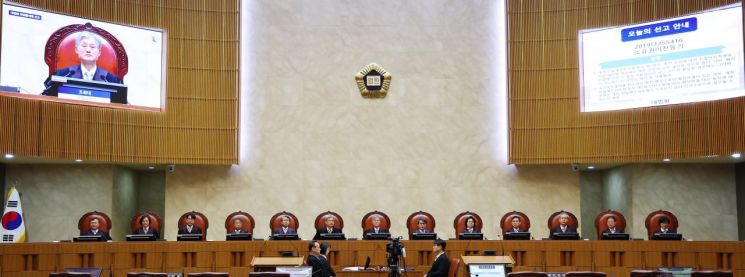
On the 20th, the Supreme Court en banc (Presiding Justice Kwon Young-jun) affirmed the original court rulings that sentenced A and B to five and six years in prison respectively, on charges including violation of the Sexual Violence Punishment Act.
A and B were indicted on charges of attempting to sexually assault a victim after drinking with the victim and others in March 2020. When the other companions left first, they put psychotropic drugs into a hangover cure drink and made the victim drink it. They then attempted to sexually assault the victim. They took the unconscious victim to a hotel, but the attempt was unsuccessful as the victim’s family kept calling and the companions checked on the victim’s condition.
The prosecution applied the charge of special rape causing injury, which carries heavier penalties than ordinary crimes, on the grounds that the two caused injury by putting the victim into a "temporary state of sleep or unconsciousness." The defendants argued that since the rape was only attempted, the charge of rape causing injury should also be considered an attempt, and their sentences should be reduced accordingly.
However, both the first and second instance courts rejected this argument based on existing Supreme Court precedents and sentenced them to imprisonment.
The Supreme Court referred the case to the en banc panel, and with 10 out of 12 justices agreeing, decided to maintain the existing precedent and dismissed the defendants’ appeals.
Article 8, Paragraph 1 of the Sexual Violence Punishment Act, which provides for aggravated punishment for rape causing injury, states that "both completed and attempted rape that causes injury to another person" shall be punished severely. Therefore, if the victim is injured, all objective elements of the special rape causing injury charge are met, and the crime is established regardless of whether the rape was completed or attempted, according to the Supreme Court’s judgment.
The justices stated, "The basis for aggravated punishment for consequential crimes (where the penalty is increased due to a severe outcome) lies in the realization of the typical risk inherent in the basic crime," and added, "Even if the execution act is not completed, if a result that increases the penalty occurs, it is a natural conclusion consistent with the principle of responsibility to punish it as a completed consequential crime."
However, Justices Kwon Young-jun and Seo Kyung-hwan dissented, arguing that the existing precedent denying the establishment of attempted special rape causing injury should be changed. Justice Seo and others stated, "It is reasonable to consider the charge of rape causing injury as an attempt and reduce the sentence when the sexual assault is only attempted," and added, "Applying the attempt to the special rape causing injury charge is a faithful interpretation of the general principles of criminal law and the fundamental idea of criminal law that 'in case of doubt, favor the defendant.'"
A Supreme Court official explained, "This ruling expresses the position that it is difficult to recognize attempted special rape causing injury solely through interpretation of the current law without separate legislation."
The Supreme Court en banc is originally composed of 13 justices excluding the Chief of the Judicial Administration Office (including the Chief Justice), but on this day, the Supreme Court issued the ruling with only 12 justices. Justice Kim Sang-hwan retired on December 27 last year, and although the nomination for Justice Ma Yong-joo was passed by the National Assembly plenary session, Acting Prime Minister and Minister of Economy and Finance Choi Sang-mok has not exercised the appointment authority.
© The Asia Business Daily(www.asiae.co.kr). All rights reserved.

















