Fed Holds Benchmark Rate at 4.25-4.5%
Maintains Outlook for Two Rate Cuts This Year
Powell Strikes a Dovish Tone, but... Growth Down, Inflation Up
Fed Hints at Possibility of Stagflation
Wall Street: "Inflation Risks Reduced" "Cautious of Trump Factor"
The U.S. central bank, the Federal Reserve (Fed), maintained its existing forecast of holding the benchmark interest rate steady and cutting rates twice this year. Fed Chair Jerome Powell stated that concerns about a tariff-induced recession are growing, but the resulting inflation is temporary, and the economy remains strong. Powell's more dovish-than-expected remarks were welcomed by the New York stock market, and the market's expectations for three rate cuts within the year increased.
However, as the Fed lowered its growth forecast for this year and raised its inflation outlook, confirming some concerns about stagflation (rising prices amid economic slowdown), and with the scheduled imposition of reciprocal tariffs in the U.S. next month, some analysts on Wall Street caution that vigilance should not be relaxed.
U.S. Fed Maintains Forecast of Two Rate Cuts This Year...Lowers Growth, Raises Inflation Outlook
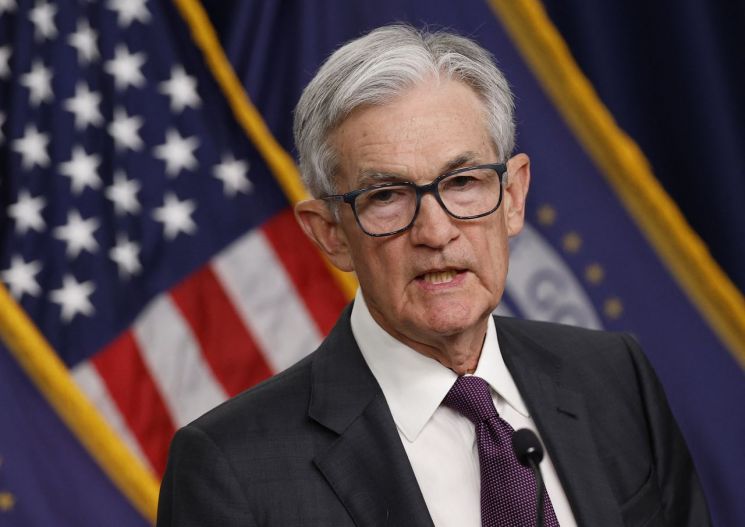
On the 19th (local time), following the Federal Open Market Committee (FOMC) regular meeting, the Fed announced in its policy statement that it had unanimously decided to keep the federal funds rate at 4.25?4.5% per annum. This marks the second consecutive hold following January. As a result, the interest rate differential with South Korea remains at 1.75 percentage points at the upper bound. For the first time, the Fed added the phrase "uncertainty surrounding the economic outlook has increased" to the policy statement, noting that "the Committee is paying attention to risks on both sides of its dual mandate (price stability and maximum employment)."
The economic outlook was significantly revised. In the updated Summary of Economic Projections (SEP) released that day, the Fed lowered its GDP growth forecast for this year from 2.1% to 1.7%. Conversely, the inflation rate was raised from 2.5% to 2.8% based on the core Personal Consumption Expenditures (PCE) price index, which the Fed prioritizes. This partially reflects concerns about stagflation due to President Donald Trump's tariff policies.
Although the inflation forecast was raised, the growth forecast was lowered, and the expected interest rate path for this year was maintained. In the new dot plot, the median year-end rate forecast remains at 3.9%, unchanged from before. Given the current rate of 4.25?4.5%, this implies that members expect two 0.25 percentage point rate cuts this year. However, three months ago, 15 of the 19 Fed officials anticipated two or more cuts, whereas now only 11 do. This suggests that concerns about a rebound in inflation have made the Fed's internal rate outlook somewhat more hawkish. The median year-end rate forecasts for 2026 and 2027 remain at 3.4% and 3.1%, respectively, also unchanged.
Additionally, the Fed decided to slow the pace of quantitative tightening. Currently, the Fed is conducting quantitative tightening by not reinvesting up to $25 billion of maturing Treasury securities monthly, but starting next month, the cap on Treasury quantitative tightening will be reduced to $5 billion per month.
Powell: "Tariff-Induced Inflation Is Temporary"...Wall Street: "Mood Will Change After Reciprocal Tariffs Imposed in May"
At the press conference following the FOMC meeting, Chair Powell's message was distinctly dovish. Powell stated that inflation caused by tariffs being temporary (transitory) is "our baseline scenario." He said, "If inflation is temporary and can fade quickly without our intervention, it may be appropriate to wait and see," adding, "The same could apply to tariff inflation." He explained that price increases due to tariff policies are one-off and the shock will be limited. He also noted that, unlike short-term inflation forecasts, long-term inflation expectations have not risen significantly.
Powell emphasized that the U.S. economy is currently "strong." He said, "The risk of recession has increased but is not high," and assessed that the current situation is not stagflation. He added, "Our policy is well positioned to respond to upcoming developments."
However, during the press conference, Powell also expressed concerns about the economic impact of tariff policies. He said, "Inflation has partially started to rise due to tariff responses, and further progress may be delayed throughout this year," and "(The economy) is generally solid, but household and business surveys show increased uncertainty and significant concerns about downside risks."
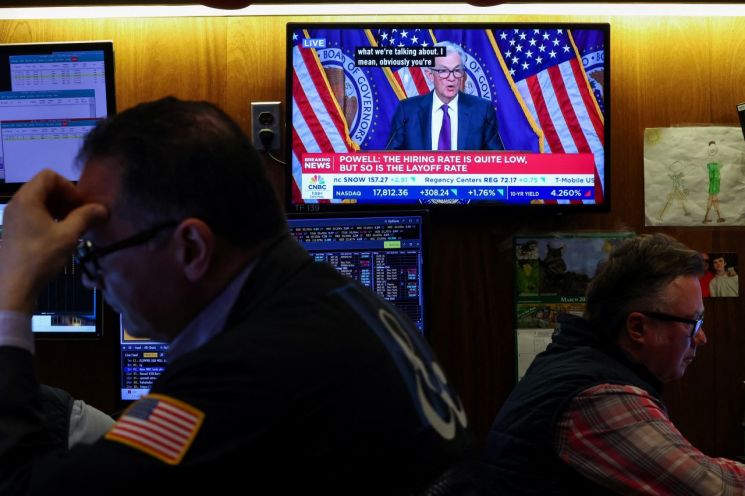
The Fed's maintenance of its rate forecast and Powell's tariff remarks reassured the market, which responded positively. On that day, the Dow Jones Industrial Average rose 0.92%, while the S&P 500 and Nasdaq indices climbed 1.08% and 1.41%, respectively. The market's expectations have risen from two rate cuts this year to three. According to the Chicago Mercantile Exchange (CME) FedWatch tool, the futures market currently prices a 54.8% probability that the Fed will cut rates three or more times this year, up about 10 percentage points from 44.3% the previous day. Allison Ausenbaugh, Head of Investment Strategy at JP Morgan, said, "The word 'transitory' has returned," and analyzed, "Judging by the market reaction, investors seem to believe that tariffs and other policies will not create persistent inflationary pressures and that the Fed can maintain control."
On the other hand, some on Wall Street believe Powell is deliberately downplaying the aftereffects of tariff policies. Aditya Bhave, an economist at Bank of America (BoA), pointed out, "I was surprised they (the Fed) downplayed expected inflation." Derek Tang, an economist at LH Mayer, said, "Powell is walking on eggshells," adding, "He does not want the Fed to become a target of the White House right now." There are also concerns that Powell's statement that tariff-induced inflation is temporary could be a d?j? vu of the 2021 misjudgment when inflation was also deemed temporary.
There is also a forecast that after the U.S. launches its announced reciprocal tariff barrage worldwide on April 2, the FOMC meeting in May, about a month later, will be a critical turning point for cautious monetary policy. Jim Curran, Chief Investment Officer of the Portfolio Solutions Group at Morgan Stanley, said, "The importance of the April (reciprocal tariff) event cannot be overstated," and predicted, "At the May 7 FOMC meeting, Powell's tone will change."
© The Asia Business Daily(www.asiae.co.kr). All rights reserved.
![Clutching a Stolen Dior Bag, Saying "I Hate Being Poor but Real"... The Grotesque Con of a "Human Knockoff" [Slate]](https://cwcontent.asiae.co.kr/asiaresize/183/2026021902243444107_1771435474.jpg)

















