Jensen Huang Highly Praises Samsung's Technological Capabilities... Expects Expanded Cooperation with NVIDIA
Hints at Possibility of Combining Samsung's Custom Semiconductors and Memory
Samsung's High Bandwidth Memory (HBM) 3E Likely to Supply NVIDIA's Next-Generation Chips
Jensen Huang, CEO of NVIDIA, highly praised Samsung Electronics' technological capabilities and expressed expectations for expanded cooperation between the two companies.
On the 19th (local time), at a global press conference held in San Jose, California, where NVIDIA's annual developer conference (GTC 2025) is taking place, CEO Jensen Huang stated, "Combining Samsung's application-specific integrated circuit (ASIC) design capabilities with its memory manufacturing capabilities will yield very good results."
This statement implies the possibility that Samsung Electronics will produce high-performance 'package-type products' that integrate NVIDIA's AI semiconductor chips and the essential memory chips required to operate these chips into one.
Currently, in the AI semiconductor market, technology that combines multiple components to enhance performance and efficiency is becoming increasingly important. It is explained that the combination of NVIDIA's AI semiconductors and Samsung Electronics' outstanding memory technology can increase competitiveness in this market.
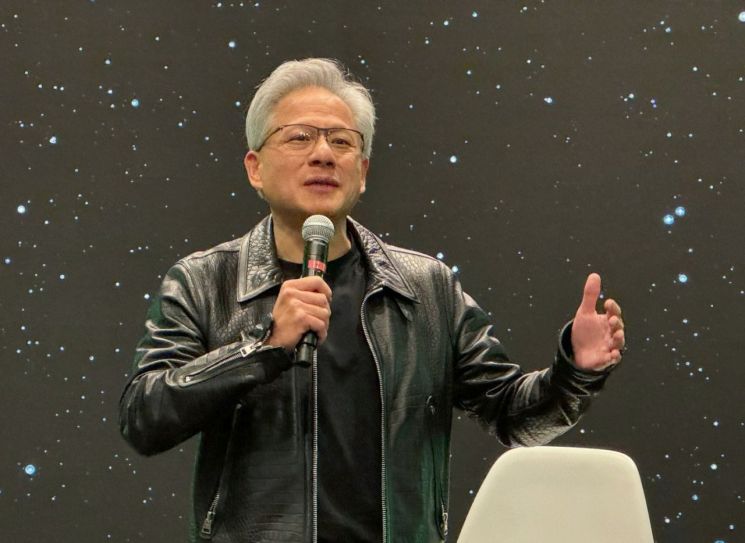
CEO Jensen Huang further said, "Samsung's capability in producing semi-custom base dies will be very excellent." Here, 'semi-custom base die' refers to a method where the basic semiconductor structure is commonly maintained, but some parts are slightly customized according to the customer's special requests. For example, the basic framework is the same, but specific functions or performance requirements desired by each customer are added to supply customized products.
Regarding the possibility of Samsung's High Bandwidth Memory (HBM) 3E being supplied to NVIDIA's 'Blackwell Ultra,' Huang said, "Samsung is doing well, and we fully expect to cooperate."
He also emphasized the need for onshoring production facilities to the United States with partner companies to avoid the impact of tariff policies under the second Trump administration. He stated, "In the short term, it will not have a significant impact on outlook and finances," but added, "In the long term, relocating manufacturing facilities to the U.S. will be very important to maintain competitiveness and agility." He further added, "If we expand the manufacturing ratio within the U.S. by the end of this year, we can secure a favorable position."
During the Q&A session that day, CEO Huang said that NVIDIA has become not just a single company but a company providing infrastructure. This means helping customers generate profits through cooperation with more companies. He repeatedly emphasized, "We are a company providing foundational AI factory infrastructure for the world and serve as the foundation for countless companies." He also explained that the reason for revealing the AI development roadmap for the next 3-4 years during the keynote speech the previous day was to communicate with companies and further expand the domain.
Regarding the current situation where companies worldwide are jumping into the AI boom, he said, "We will not fight for competition," and added, "If other companies make something great, we will use it. It does not matter which company." He also emphasized that NVIDIA has partnerships with big tech companies such as AMD, Intel, Broadcom, and Marvell.
He stated that while the world is investing $50 billion (about 50 trillion won) in capital expenditures for AI development, NVIDIA will invest more in the future and build as many AI data centers and computers as possible. CEO Huang projected that the investment scale in the AI industry will reach $1 trillion by 2030 and emphasized, "100% of the $1 trillion must be invested in AI-native systems."
He also explained that the potential for advancement in physical AI robot technology is limitless. He said that NVIDIA integrates its core AI technologies into various industrial solutions to help companies apply robot technology to the market. He said, "We have been developing physical AI robot systems for over 10 years. The robotics business has already reached $5 billion (about 6.7 trillion won) in scale," and added, "Physical AI robot technology will become NVIDIA's largest business."
© The Asia Business Daily(www.asiae.co.kr). All rights reserved.


















