Only Victims Leave Due to Lenient Responses
"Repeated Violations of Service Codes
Public Institutions Fail to Set an Example"
"I am a Seonggol, and an intern (employee) like you is a Yukdu-pum."
"The most (profanity) thing here is probably me. I swear the most. But I won’t change my personality. If you don’t like me, don’t come."
Korea Expressway Corporation is suffering from workplace power harassment. The problem stems from a vertical organizational culture so severe that complaints like "even the term 'military culture' is insufficient (Blind)" are voiced within the corporation. Despite internal audits confirming verbal abuse, threats, and personnel power harassment, only minor disciplinary actions have been repeatedly taken, showing no will to resolve the issue. As cases of employees’ mental damage increase, concerns about safety accidents are also growing.
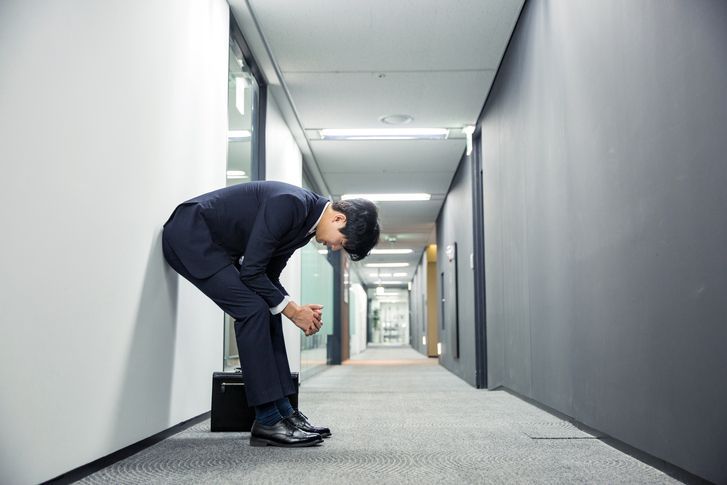 Korea Expressway Corporation is suffering from workplace power harassment. The complaint that "even the term 'military culture' is insufficient (Blind)" reflects the problems arising from a vertical organizational culture within the corporation. Getty Images
On the 21st, according to the 'Audit Result Disposition Request' released last month after a special inspection of public service discipline in December last year, the corporation’s audit office requested the personnel department head to impose a salary reduction on Director A, who is working at an overseas branch, for workplace harassment. The audit office took this action after an internal audit conducted from December 16 to 27 last year targeting A, who has been working at the overseas branch since April 2023 until the audit date.
◆To an intern employee: "Answer 'yes' at the end of every sentence"= The disposition request stated, "Using the rank as a mentor to a trial-type intern and the only superior at ㅇㅇ branch, A made remarks emphasizing personal superiority beyond positional superiority," and "This exceeded the appropriate scope of work and caused mental distress, constituting workplace harassment."
The request also cited remarks A made to the intern. A said, "When a superior gives an order, the subordinate must comply, and if not, there are many ways for the superior to harass the subordinate." He added, "I am a Seonggol, and an intern like you is a Yukdu-pum," or "Do you know when a star instructor gets annoyed? When you don’t react like you do. From now on, answer 'yes' at the end of every sentence I say. It’s no fun teaching otherwise. Go."
When A found out the intern was recording his remarks, he checked the phone and laptop to see if the recording files were deleted. Then he forced the intern to write a pledge not to disclose their interactions externally. When the intern refused, A said, "Do you think there’s nothing I can do? I will find a way to damage your reputation, and if someone asks about your employment or intern record at Korea Expressway Corporation, you’ll be the talk of the town." He pressured further, "After I get disciplined, I’ll consider how I can harm you." Two days later, he again forced the intern to write a pledge not to record in the future. The intern appealed to an internal employee, was separated and returned home, then worked at headquarters but resigned three weeks before the contract expired.
◆Verbal abuse to a 70-year-old contract worker= B, a site work supervisor at a regional branch of Korea Expressway Corporation, has verbally abused and threatened many contract workers for over 20 years. B, who performs highway maintenance in the area, said in a waiting room where snow removal contract road workers gathered, "I will yell and (profanity) if I get upset while working," and "I told you not to rent water trucks, but you did. Only those who didn’t follow get (profanity)." B made these remarks while instructing not to connect brine hoses to snow removal drivers’ vehicles. At that time, over 87% of the approximately 30 road workers in the waiting room were aged 50 or older, older than B. B also said, "If I keep hearing strange things about me, I’ll bring you a resignation letter, so write one."
The corporation’s audit office concluded, "As a site work supervisor with authority to give work instructions to snow removal contract road workers, B used his rank to verbally abuse with profanity and threatened personnel, causing mental distress." However, after the audit, the audit office requested the regional branch head to issue a reprimand to B.

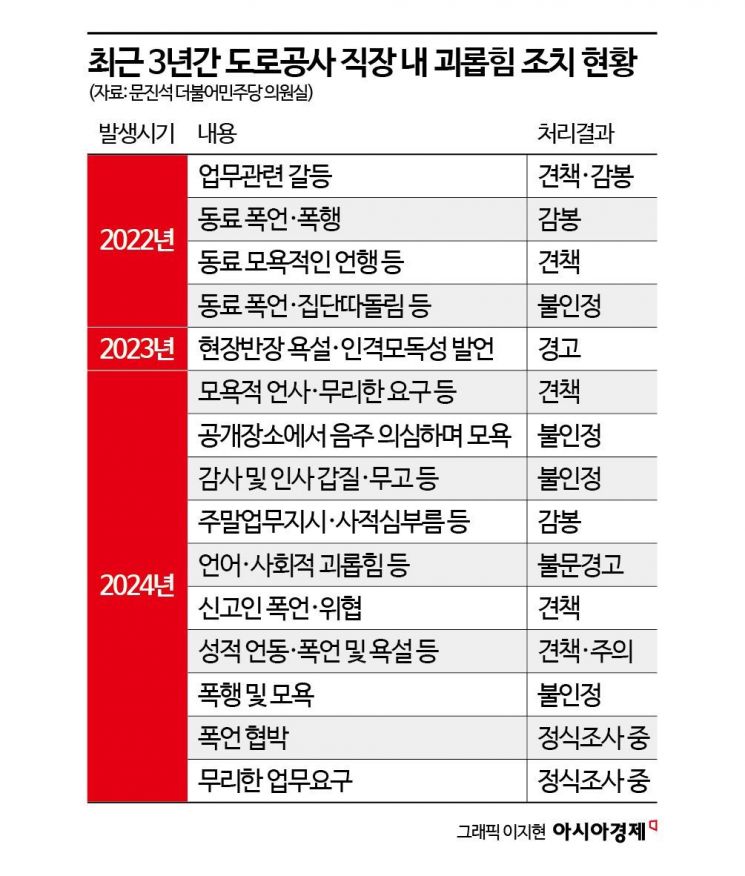
◆Power harassment culture remains unchanged despite National Assembly criticism= The power harassment culture at Korea Expressway Corporation is not new. It has been pointed out multiple times in past National Assembly audits. According to data submitted by the corporation to the office of Moon Jin-seok, a member of the National Assembly Land, Infrastructure and Transport Committee from the Democratic Party, among 15 formal investigations into workplace harassment reports from 2022 to last year, most resulted only in minor disciplinary actions such as reprimands, salary reductions, or warnings. Cases involving sexual misconduct, verbal abuse, and profanity were also closed with reprimands or warnings. Four cases of group bullying and personnel power harassment were not recognized as workplace harassment. The corporation is currently investigating two cases involving verbal abuse, threats, and unreasonable work demands.
Criticism arises that the low disciplinary levels prevent cultural change. Last year, some suspensions were reduced to salary cuts. When a workplace harassment report is received, the corporation forms a subcommittee including external labor attorneys, the audit office, labor union, and in-house lawyers to review the case. If harassment is confirmed, the audit office interviews the reporter, accused, and witnesses, reviews materials, and consults an external labor law firm for disciplinary advice. Then, an internal committee finalizes the disciplinary level and submits it to the personnel department for final review. Disciplinary actions are generally divided into minor (reprimand, salary reduction) and major (suspension, demotion, dismissal, expulsion). The audit office determines the level, but the personnel committee finalizes it, sometimes by anonymous vote.
Rep. Moon said, "It is concerning that public institutions, which should set an example for the public, continue to have violations of service codes such as workplace harassment," adding, "Prevention is most important, but for habitual harassers, stronger punishments and other practical measures to reduce workplace harassment should be considered."
A Korea Expressway Corporation official said, "Disciplinary actions by the audit office are decided by a personnel committee composed of internal and external members," and "We are continuously improving internal systems to prevent workplace harassment and strengthen victim protection."
© The Asia Business Daily(www.asiae.co.kr). All rights reserved.













