Heroic Sacrifice in the Final Battle Before the Armistice
Sergeant First Class Jeong In-hak, who enlisted at the age of 18 during the Korean War and heroically died in battle at the age of 20 just two days before the armistice, has returned to his family after 73 years.
The Ministry of National Defense's Remains Recovery and Identification Team announced on the 19th that the identity of the complete remains excavated last November in the Jupari area of Wonnam-myeon, Cheorwon-gun, Gangwon Province, was confirmed as the late Sergeant First Class Jeong In-hak of the Republic of Korea Army's 7th Division.
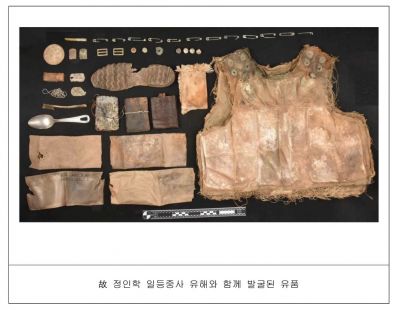
The decisive clue for this identification was the ‘dog tag’ engraved with the deceased’s name, which was found together with the remains. The team verified the service records based on the name on the dog tag, then collaborated with administrative offices to locate the family. Within two days of finding the family, they located his younger sister and collected a genetic sample. Subsequent genetic comparison and analysis between the remains and the family confirmed a sibling relationship (older brother-younger sister).
The deceased is the first identified national hero this year and the 249th national hero whose identity has been confirmed since the remains recovery project began. The discovery of his remains was made possible thanks to the efforts of the battalion commander and the soldiers participating in the excavation who did not overlook even the smallest clues.
Lieutenant Colonel Jeong Jun-hyeok, battalion commander under the 7th Division, discovered a bulletproof helmet and canteen exposed on the surface during a terrain reconnaissance mission in the operational area last October and reported the location of the remains to the recovery team. Since the unit he commanded had participated in remains recovery earlier that year, he did not overlook the find.
Upon receiving the report, the recovery team’s remains record officer discovered the remains during an on-site survey. Considering the excavation of personal effects such as an M1 rifle found together, the site excavation team leader expanded the excavation area, resulting in the discovery of seven additional remains. The deceased was buried in a crouched, prone position wearing a bulletproof vest and was anatomically a complete set of remains. The recovery team explained that while complete remains are rarely excavated, it is extremely rare to find eight remains at a single site.
Born in December 1932 in Jeongeup-si, Jeollabuk-do, as the eldest son among four brothers and six sisters, the deceased helped his father’s agricultural retail business before enlisting. He enlisted at the age of 18 in September 1951, after the Korean War had somewhat stabilized, and participated in numerous battles over two years as a member of the ROK Army’s 7th Division.
In July 1953, during the final stages of armistice negotiations, he fought in the ‘Jeokgeunsan-Samhyeon District Battle (July 15?23, 1953)’ and died in action two days before the armistice. The battle was a fierce engagement where the ROK Army’s 7th and 1st Divisions repelled attacks by four Chinese divisions in the Geumseong area (Jupari, Wonnam-myeon, Cheorwon-gun, Gangwon Province) and launched a counterattack to stabilize the front line. The deceased fought fiercely against the enemy at a time when not an inch of land could be conceded and died heroically.
The ‘Return of the National Hero’ event was held on Wednesday the 19th at the family home in Cheonan-si, Chungcheongnam-do, at the request of the family. Jeong Byeong-sook (69), the younger sister who provided the genetic sample, was born after her brother’s death and did not know his appearance during his lifetime. However, their parents took her to the annual memorial ceremony held at Chungmugong Park in Jeongeup-si every Memorial Day, so she often imagined her brother’s image.
Jeong said, “When the recovery team’s investigator said they would come to collect the sample last November, my mother appeared in my dream. The day before they said they had found the remains and would visit, my father appeared in my dream. I think they appeared to tell me to receive my brother’s remains,” she shared her feelings.
Meanwhile, the recovery team continues to collect genetic samples to identify the identities of Korean War fallen soldiers (national heroes). Genetic sample collection is available nationwide and can be requested by relatives up to the eighth degree, including both paternal and maternal sides, as family members of the fallen soldiers. If the identity of a fallen soldier is confirmed through the provided genetic information, a reward of 10 million KRW is given. For family members who wish to provide genetic samples but have difficulty visiting due to mobility issues or livelihood concerns, the team will visit them directly upon contacting the representative number.
© The Asia Business Daily(www.asiae.co.kr). All rights reserved.

















