The 17th Infantry Division of the Army announced on the 19th that it has been conducting the 'ROK-US Combined Combat Command Training' as part of the 2025 Freedom Shield (FS) exercise for five days since the 16th, in the Incheon area and at the Mugeon-ri Training Ground in Paju, Gyeonggi Province. The training involved 1,200 personnel from the 17th Division, the Republic of Korea Chemical, Biological, Radiological, and Nuclear Defense Command, the U.S. 2nd Infantry Division/ROK-US Combined Division's Stryker Brigade, Combat Aviation Brigade, and Chemical Battalion.
The combat command training refers to training using a computer-based virtual simulation system aimed at enhancing the practical combat command and control capabilities of corps- and division-level commanders and staff. The Combat Command Training Group, which controls the training, provides corps- and division-level command and control headquarters with scenarios similar to real combat situations and evaluates the success, failure, and areas for improvement of the operations they plan and execute.
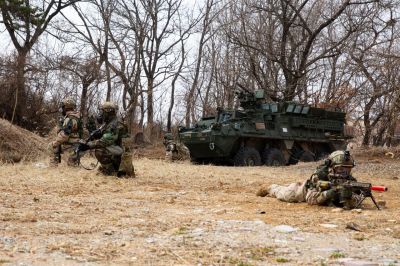
The 17th Division is the only division-level unit in the entire army that conducts ROK-US combined combat command training and has been conducting training together with the Combined Division since 2013. This year, the Korean side's 17th Division commander is tactically controlling two brigades under the U.S. Combined Division, strengthening the ROK-led combined operational capabilities.
Notably, this training broke away from the conventional concept of combat command training that solely uses computer-based virtual simulation systems. The 17th Division maximized the realism of the combined training by linking the key phases of combat command training?air mobility operations and countering weapons of mass destruction (CWMD) operations?with field maneuver training.
The first major phase combining combat command training and field maneuver training, the CWMD operation, was conducted on the 17th at the urban area combat training ground in Seo-gu, Incheon. The 17th Division headquarters received orders from the U.S. Eighth Army to deploy the CWMD Task Force (CWMD-TF) to search and clear suspected weapons of mass destruction facilities secured by the ISTF and to secure and analyze hazardous materials.
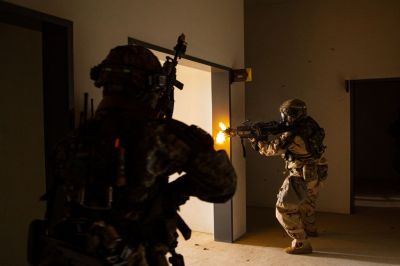
The 17th Division, in cooperation with the U.S. side, formed a CWMD-TF tactically controlled by the Korean battalion commander, deploying about 430 personnel including the 17th Division Baekseung Brigade (one battalion), the Combined Division Stryker Brigade (one company), the ROK Chemical Corps (chemical response team), and the 17th Division engineer platoon. Additionally, the force was reinforced with over 100 pieces of equipment, including Korean chemical reconnaissance robots, chemical reconnaissance vehicles, reconnaissance drones, chemical detection devices, and U.S. Stryker armored vehicles, chemical reconnaissance vehicles, and internal viewing devices.
Upon arrival at the site, the CWMD-TF received information from the ISTF regarding the size and characteristics of the suspected facility and planned their entry. Meanwhile, the 17th Division headquarters was also receiving related reports and deciding on additional support. The CWMD-TF operated drones to identify enemy positions while deploying the engineer platoon to forcibly open entry doors with cutters and remove improvised explosive devices and obstacles on the access routes. Subsequently, a maneuver unit centered on the Combined Division Stryker Brigade company and the 17th Division infantry platoon entered to clear the enemy, while the ROK-US combined chemical response team led by chemical reconnaissance robots collected and analyzed evidence and samples related to weapons of mass destruction.
Yoo Chan-wook, Operations Planning Staff Officer (Lieutenant Colonel) of the 17th Division stated, “Through this BCTP, which linked simulated and actual training, we were able to elevate the ROK-US combined operational capabilities to the next level,” adding, “We will continue to train diligently so that the ROK and U.S. forces can conduct combined operations as one body.”
The second major phase, the 'air mobility operation,' was conducted on the same day at Jangdo Training Ground in Seo-gu, Incheon, and Mugeon-ri Training Ground in Paju, Gyeonggi Province. Tasked with quickly securing the objective, the 17th Division headquarters planned the air mobility operation and requested support from the U.S. Eighth Army.
According to the operational plan, about 400 personnel centered on the 17th Division reconnaissance battalion and 16 U.S. aircraft, including Black Hawk (UH-60) and Chinook (CH-47) helicopters, gathered at the pickup zone (PZ) and conducted air mobility toward the objective. Infantry units securing the landing zone (LZ) area under the 17th Division headquarters' orders provided security to ensure the helicopters landed safely. The troops who landed quickly disembarked and captured the objective, successfully completing the operation.
Song Ji-hwan, commander of the 17th Division reconnaissance battalion (Lieutenant Colonel), said, “From the preparation stage of the training, ROK and U.S. soldiers worked hard together and communicated, which allowed us to feel a special camaraderie,” adding, “Based on mutual trust, I am confident that we can always stand back-to-back and fight together.”
Joseph Dent, pilot (Warrant Officer) of the Combined Division 2nd Combat Aviation Brigade, emphasized, “During this training, we learned each other's doctrines and tactics and were able to build an efficient combat partnership,” adding, “I am confident that today's combined training will become mutual assurance and trust on future battlefields.”
© The Asia Business Daily(www.asiae.co.kr). All rights reserved.













