Jensen Huang: "We Will Scale Up and Scale Up Again"
Blackwell Ultra Delivers 1.5 Times the Performance of Blackwell
Emphasizing AI's 'Inference Capabilities', Introducing Dynamo Software
First Unveiling of the Open-Source Robot Engine 'Newton'
Jensen Huang, CEO of NVIDIA, expressed optimism about the growth prospects of AI chips on the 18th (local time), stating that "at least 100 times more computing power than now is required for artificial intelligence (AI) to evolve into agents for humans." The controversy over the high price of AI chips was triggered after the emergence of China's DeepSeek, but CEO Huang emphasized that computing power will become even more important in the era of inference AI. On the same day, SK Hynix announced that it had delivered the world's first enhanced performance High Bandwidth Memory (HBM)4 12-stack samples to its customers.
During his keynote speech at GTC 2025 held at the SAP Center in San Jose, California, Huang stated that repeating "Scale Up" is essential for AI to acquire inference and action capabilities, requiring much more powerful computing performance than now.
NVIDIA presented a roadmap to maintain its technological superiority in the AI chip market by consecutively launching high-performance next-generation AI chip series such as Blackwell (2025), Rubin (2026), and Feynman (2028). NVIDIA will release the AI chip 'Blackwell Ultra' this year. It offers more than three times the performance of the existing Blackwell while significantly reducing data processing costs. It is designed to perform data training and inference processes quickly and efficiently. Blackwell Ultra is expected to be installed in servers and personal AI supercomputers through major customers starting in the second half of this year.
NVIDIA plans to launch the next-generation AI chip 'Vera Rubin' in the second half of 2026. Rubin is a product that further enhances performance and efficiency compared to NVIDIA's current flagship chip, Blackwell. A more advanced 'Rubin Ultra' is expected to appear after 2027, and in the long term, NVIDIA also plans to develop an AI chip named 'Feynman' after the American physicist.
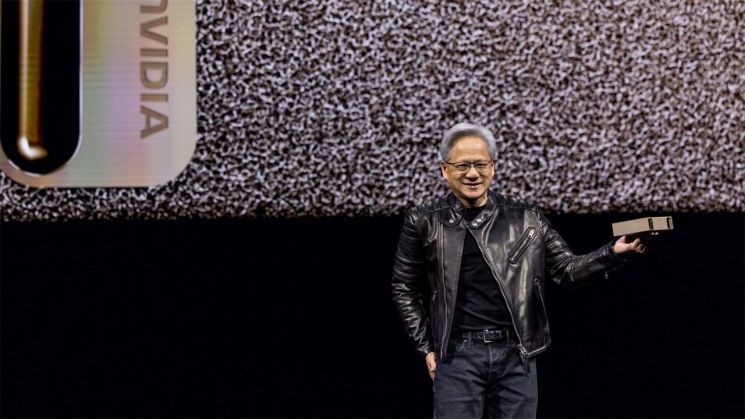 Jensen Huang, CEO of NVIDIA, is holding the company's DGX personal artificial intelligence (AI) supercomputer during his keynote speech at 10 a.m. local time on the 18th at the SAP Center in San Jose, USA. Photo by NVIDIA
NVIDIA unveiled personal AI supercomputers 'DGX Spark' and 'DGX Station' that individuals can directly connect to laptops to perform AI tasks, along with new AI-dedicated software called 'Dynamo' for these devices.
CEO Huang also mentioned collaboration with Alphabet's (Google's) AI subsidiary DeepMind to help AI better understand the real world and generate data. He introduced a new physics engine called 'Newton,' developed with DeepMind. Newton is a simulation technology that allows robots to operate exactly like they do in real environments.
The reason NVIDIA is rapidly expanding its high-performance AI chip and software ecosystem is to clearly differentiate itself in the technological competition with rivals, including China's AI company DeepSeek. As DeepSeek rapidly encroaches on the AI market by emphasizing low cost and high performance, NVIDIA believes that computing power will become an even more critical factor in the AI agent era. Accordingly, NVIDIA plans to counter with next-generation chips that increase performance by hundreds of times while lowering costs.
Competition is also intensifying in the AI memory market in line with NVIDIA's strategy. SK Hynix once again took the lead over competitors by supplying the world's first 'HBM4 12-stack' samples to customers to lead the next-generation HBM market.
The HBM4 12-stack product boasts world-class speed and capacity, with speeds more than 60% faster than the current HBM3E. SK Hynix plans to complete preparations for mass production of this HBM4 product within the second half of this year and actively respond to the construction of next-generation AI infrastructure.
Since NVIDIA plans to increase speeds up to 14 times compared to Blackwell Ultra through the AI chip 'Rubin Ultra' equipped with HBM4, the role of domestic memory companies such as Samsung Electronics and SK Hynix is expected to grow further. As demand for NVIDIA's high-performance AI chips increases, domestic memory companies like Samsung Electronics and SK Hynix are also expected to benefit more.
Kim Ju-seon, Vice President and Head of AI Business Division at SK Hynix, emphasized, "As the first in the industry to supply HBM4 samples, we will smoothly proceed with certification and mass production preparations to lead the next-generation AI memory market."
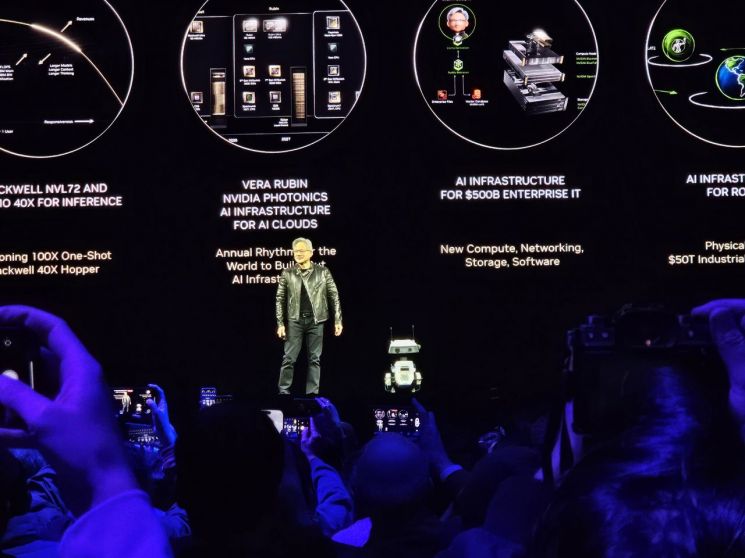 Jensen Huang, CEO of NVIDIA, appeared with the company's new robot model 'Newton' at 10 a.m. local time on the 18th at the SAP Center in San Jose, USA. Photo by Junyi Park
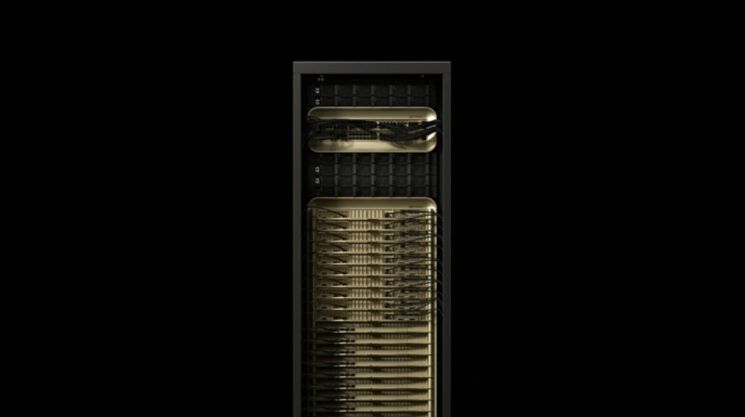 The AI Factory platform of 'Blackwell Ultra' to be released by Nvidia in the second half of this year. Provided by Nvidia
© The Asia Business Daily(www.asiae.co.kr). All rights reserved.

![Clutching a Stolen Dior Bag, Saying "I Hate Being Poor but Real"... The Grotesque Con of a "Human Knockoff" [Slate]](https://cwcontent.asiae.co.kr/asiaresize/183/2026021902243444107_1771435474.jpg)

















