Trump and Putin Hold 90-Minute Call
Agree to Halt Attacks on Energy Facilities
Putin Demands U.S. and Allies Suspend Military Aid to Ukraine
Russian President Vladimir Putin has promised to halt attacks on Ukrainian energy facilities for one month. However, he rejected the '30-day full ceasefire plan' that U.S. President Donald Trump pressured Russia to accept after an agreement between the U.S. and Ukraine. Instead, President Putin set the suspension of foreign military and intelligence support to Ukraine, including from the U.S., as a key condition for a full ceasefire, signaling a difficult path ahead for complete peace negotiations.
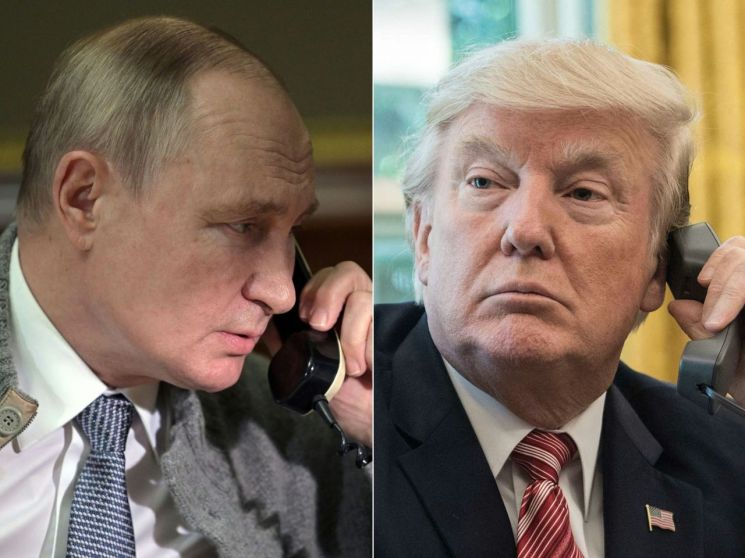
On the 18th (local time), the White House announced in a statement that the two leaders agreed on a ceasefire for energy and infrastructure after a 90-minute phone call. It added, "The two leaders agreed that the move toward peace would begin with a ceasefire on energy and infrastructure, a ceasefire in the Black Sea, and technical negotiations to implement a full ceasefire and permanent peace," and that "such negotiations will begin immediately in the Middle East."
President Trump also said on his social media platform Truth Social after the call with President Putin, "The call with President Putin was very good and productive," adding, "We agreed on an immediate ceasefire on energy and infrastructure. We will work quickly toward a full ceasefire and ultimately end this terrible war between Russia and Ukraine."
On the 19th, President Putin informed President Trump that Russia and Ukraine would exchange 175 prisoners each.
The partial ceasefire agreement between the two leaders on that day falls far short of the 30-day full ceasefire plan agreed upon by the U.S. and Ukraine on the 11th in Saudi Arabia. On the 13th, President Trump sent Special Envoy Steve Witkoff to Russia to pressure acceptance of the ceasefire plan, but President Putin only agreed to a limited ceasefire on energy facilities. This is even far below Ukraine's proposal earlier this month to halt air and sea attacks, which the U.S. had rejected as insufficient. There are also concerns about the unclear scope of the ceasefire. President Trump and the White House stated that Russia agreed to a ceasefire on "energy and infrastructure," which can be interpreted as a halt to attacks not only on energy facilities but also on major infrastructure such as bridges and roads. In contrast, the Kremlin described it as a ceasefire on "energy infrastructure."
Furthermore, President Putin rejected immediate acceptance of the 30-day full ceasefire plan and instead presented several conditions for the ceasefire. These demands included the cessation of foreign military and intelligence support to Ukraine and a halt to Ukraine's recruitment of new soldiers. The Kremlin stated after the call that "the most important condition to prevent escalation of the conflict and to find a solution through political and diplomatic means is the complete cessation of foreign military support and intelligence provision to Kyiv (the capital of Ukraine)." Meanwhile, Ukraine agreed to the 30-day ceasefire plan with the U.S. without imposing any conditions.
Some express concerns that President Trump, in his haste to conclude peace negotiations, might unilaterally sacrifice Ukraine's interests. Especially as the U.S. and Russian leaders reaffirmed their willingness to improve bilateral relations during their call about a month after their previous conversation on the 12th of last month, there are prospects that Ukraine could again be sidelined in the peace process. The White House stated, "The U.S. and Russia agreed that there are significant benefits in a future where relations improve," including "massive economic agreements and geopolitical stability when peace is achieved."
Bloomberg News reported, "Russia's demands will force President Trump to make a difficult choice," noting that "President Trump must decide whether to continue sending weapons that can protect Ukraine from Russia's invasion, which has lasted four years." It also analyzed, "Ukraine and European allies are concerned that President Putin might leverage the U.S.'s interest in concluding peace to weaken Ukraine or make additional demands that threaten Europe's future security."
Meanwhile, the two leaders also discussed halting the proliferation of strategic weapons, referring to nuclear arms. They reached a consensus on expanding the involvement of other parties, which is interpreted as reflecting an intention to include China in U.S.-Russia strategic arms reduction talks.
© The Asia Business Daily(www.asiae.co.kr). All rights reserved.












