BOK and FSS Hold "Climate Finance Conference" on the 18th
45.7 Trillion KRW in Losses Projected by 2100 Without Climate Action
Credit, Market, and Insurance Losses Estimated for 14 Financial Firms
Early Climate Policy Adoption Eases Losses After Initial High-Carbon Industry Impact
Delayed or No Response May Lead to Nonlinear Expansion of Losses
"If no response is made to climate risks, the scale of losses for financial institutions will reach 45.7 trillion KRW."
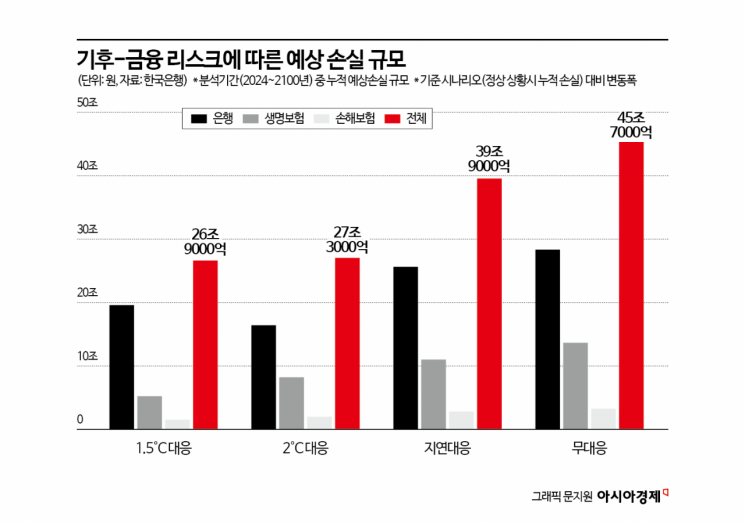
On the 18th, the Bank of Korea (BOK) held a joint climate finance conference with the Financial Supervisory Service (FSS) at the BOK in Jung-gu, Seoul, announcing this. They set four scenarios for South Korea's greenhouse gas reduction pathways from 2024 to 2100: ▲1.5℃ response (achieving carbon neutrality by 2050), ▲2℃ response (reducing carbon emissions by 80% compared to current levels by 2050), ▲delayed response (no action until 2030, then late implementation of carbon neutrality policies), and ▲no response (no climate policy adoption), and analyzed the real economy ripple effects by pathway targeting 14 financial companies participating in the climate stress test task force.
Kim Jaeyoon, head of the BOK’s Sustainability Growth Office, who presented the topic, explained, "Under the delayed response scenario, the expected financial sector losses due to increased transition risks from rapid carbon reduction were about 39.9 trillion KRW, but under the 2℃ response, losses were limited to 27.3 trillion KRW, and under the 1.5℃ response, to 26.9 trillion KRW." He added, "In the case of the 1.5℃ response, the loss scale peaks around 2050 and then decreases, whereas under the no response scenario, losses continue to expand over time."
Regarding risk types, credit losses accounted for more than 95% of total expected losses for banks, while insurance companies experienced higher market losses?76% for life insurers and 48% for non-life insurers. When climate response policies are implemented, banks showed high losses concentrated in so-called smokestack industries such as steel, metal processing products, and cement. Under the no response scenario, losses expanded in climate-vulnerable sectors such as food products, restaurants, construction, and real estate. Insurance companies showed high losses mostly in the electronic components manufacturing sector, where investment proportions are relatively high, across most pathways.
Bank soundness deteriorated as credit risk increased, with some or all banks’ Bank for International Settlements (BIS) capital adequacy ratios potentially falling below the regulatory threshold (11.5%) depending on the scenario. Kim explained, "Especially under the 1.5℃ response and delayed response pathways, the BIS ratio decline shock is likely to intensify around 2050, while under the no response pathway, the shock may worsen after 2080."
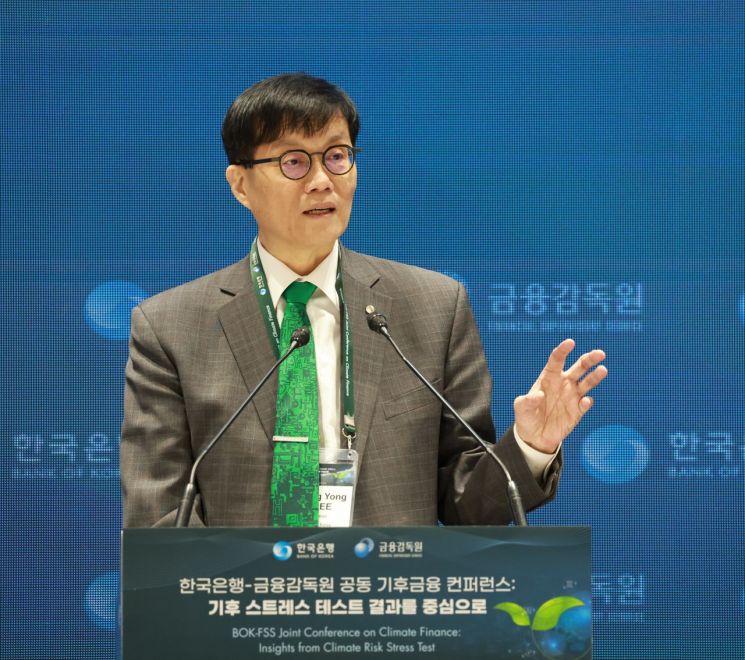 Lee Chang-yong, Governor of the Bank of Korea, is delivering a welcome speech after jointly hosting a climate finance conference with the Financial Supervisory Service at the Bank of Korea in Jung-gu, Seoul, on the 18th. Bank of Korea
The FSS’s subsequent announcement of climate stress test results aligned with the BOK’s findings. The FSS investigated credit risk primarily for 36 financial companies with corporate loans exceeding 1 trillion KRW. Hwang Jaehak, senior researcher at the FSS Financial Market Stability Bureau, estimated, "Under the no response scenario, credit losses will amount to 25.1 trillion KRW by 2100."
He explained that the estimated loss scale was smaller than the BOK’s because the amount of risk included in the test was relatively limited. Under the 1.5℃ response, losses were projected at 19.5 trillion KRW.
The panel discussion focused intensively on what financial institutions and authorities should do going forward. Lee Byungyoon, senior research fellow at the Korea Institute of Finance, said, "Financial companies that have reviewed the results need to change their asset and loan portfolios. However, since reducing high-carbon emission sectors that are currently profitable is not an easy decision, the decision-making system must be changed to grant the authority to reflect this."
Financial authorities diagnosed that it is necessary to improve systems such as establishing a carbon risk premium imposition framework and applying incentives like easing supervisory regulations on loans and investments in low-carbon projects. The BOK and FSS plan to expand the scope of financial institutions subject to climate stress tests to include smaller firms more vulnerable to climate risks and to specify items reflecting changes in their asset portfolios.
Meanwhile, at the conference, BOK Governor Lee Changyong emphasized in his welcoming remarks that climate risks could impact the financial system through physical damages caused by heatwaves and extreme rainfall, as well as increased corporate production costs and asset value declines during the carbon reduction process. He expressed hope that this conference would serve as an opportunity to promote structural transformation efforts across the Korean economy. FSS Governor Lee Bokhyun stated in his opening remarks, "We will prepare low-carbon transition financial guidelines within the year and provide incentives for green loans."
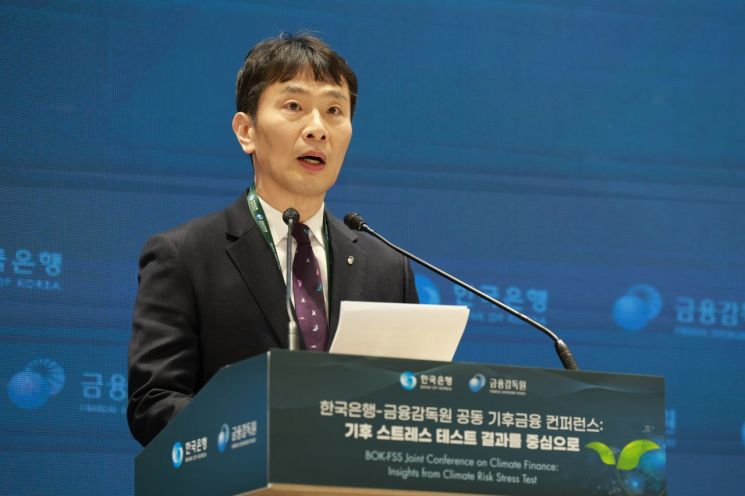 Lee Bok-hyun, Governor of the Financial Supervisory Service, is delivering the opening remarks at the Climate Finance Conference held on the 18th at the Bank of Korea in Jung-gu, Seoul. Bank of Korea
© The Asia Business Daily(www.asiae.co.kr). All rights reserved.














