About 17 Million People Estimated to Grow Companion Plants
Industry Size Reaches About 2.4 Trillion Won
Flower Markets Bustling with People as Spring Arrives
"If the plant had died from overwatering (excessive humidity), the roots wouldn't be this white; it's not bad."
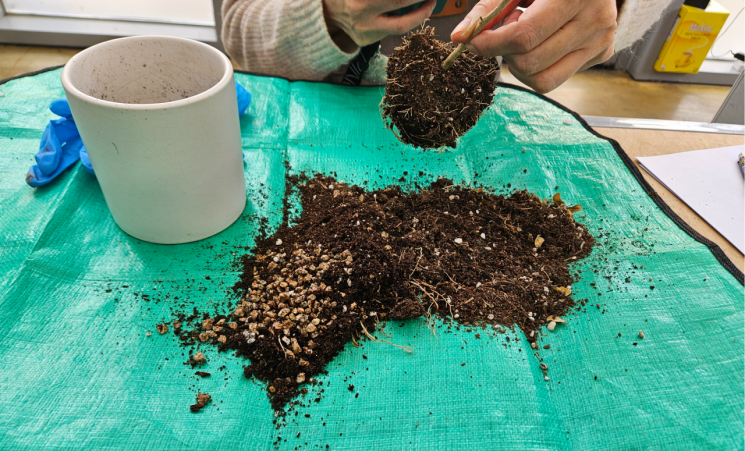 On the 17th, a professional therapist is examining an 'Orange Jasmine' at a companion plant clinic in Jongno-gu, Seoul. Photo by Youngchan Choi
On the afternoon of the 17th, the reporter visited a companion plant clinic in Jongno-gu, Seoul, and received a diagnosis for the plants they were growing. The procedure was similar to visiting a hospital for people. The reporter had to fill out a companion plant treatment consent form and provide detailed information about when and what symptoms the plant had been showing. Yoon Shinhye, a professional therapist working at this clinic, examined the documents filled out by the reporter and the appearance of the companion plant, then carefully asked and recorded questions such as "How often do you water it?" and "Is it grown in a place with good sunlight?" The reporter received a diagnosis from Yoon that "Since the plant's roots are still alive, observe it further and water it frequently."
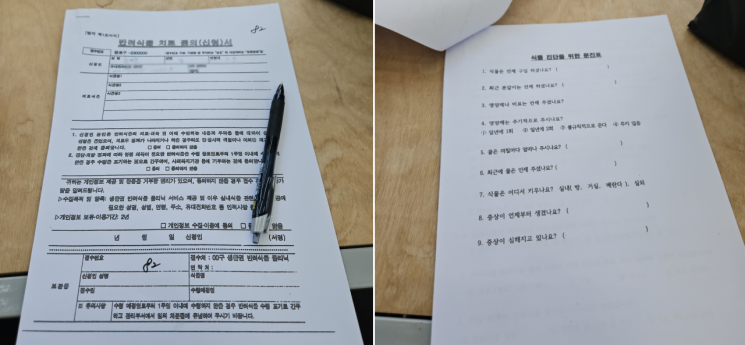 Treatment consent form and medical questionnaire to be completed for companion plant therapy. Photo by Choi Young-chan
There is a survey result showing that about one-third of our population grows companion plants. According to a survey conducted by the Rural Development Administration (RDA) in September last year targeting 500 adult men and women, 34% of respondents said they were growing companion plants. The RDA estimated that, when scaled to the population, about 17.45 million people in Korea are growing companion plants. By age group, those in their 30s and younger had the highest percentage of companion plant growers at 37.2%, followed by those aged 60 and above (34.6%), and those in their 50s (15.0%).
In the past, growing plants was considered a "romance" for people dreaming of living in detached houses or country homes. Also, growing plants on apartment balconies was often a hobby for elderly people or a leisure activity for housewives. However, nowadays, with "loneliness" becoming a social code, the number of single- or two-person households and young people from the MZ generation (Millennials + Generation Z) adopting plants as companions has greatly increased.
As the number of people growing companion plants increases, clinics and hospitals that can treat companion plants are also emerging. Seoul operates companion plant clinics in eight autonomous districts, including Jongno-gu, Dongdaemun-gu, Eunpyeong-gu, and Yangcheon-gu. The Seoul Agricultural Technology Center located in Seocho-gu runs a companion plant hospital, which functions as a kind of general hospital.
Yoon, the companion plant therapist, said, "Most of the visitors to the clinic are young people," adding, "They bring various plants and actively make clinic reservations." She also mentioned, "Although we limit the number of plants to three per reservation, some people bring as many as five plants."
Kim Hana, a 20-something office worker growing companion plants in an apartment, said, "There was a case where a plant I received as a gift died because I gave it too much water," and added, "I hope to be able to grow plants for a long time by receiving consultations or treatments at the clinic."
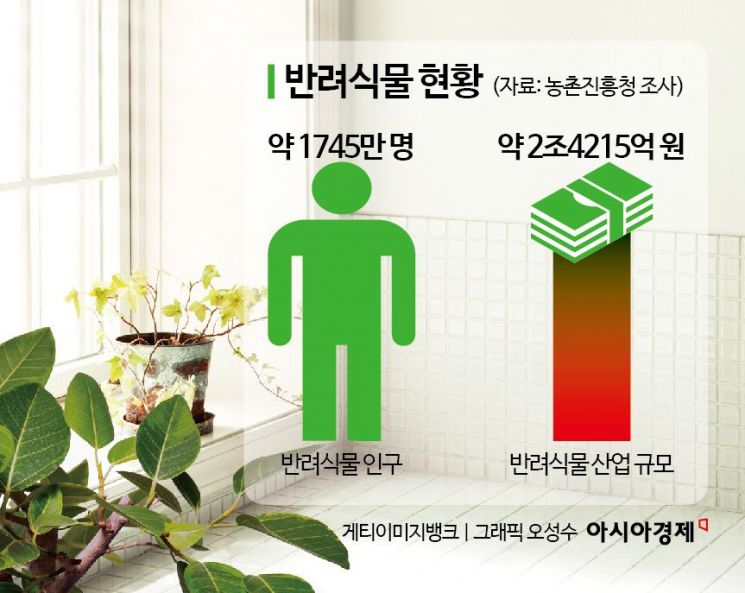
The term used by young people to refer to those who grow companion plants is "sikjipsa" (plant butler). As the number of sikjipsa increases, the companion plant industry is also growing. The RDA currently estimates the companion plant industry size to be about 2.4215 trillion won. With spring just around the corner, markets where trees and flowers can be purchased at wholesale prices, such as the Gwacheon Flower Market and Seoul Heoninreung Flower Market, are crowded with visitors and vehicles on weekends.
Kim Kwangjin, head of the Urban Agriculture Division at the RDA, said, "Growing companion plants seems to have become part of the national lifestyle culture beyond just a simple hobby," adding, "Since the emotional stability expected from growing companion plants is significant, the growth trend of the companion plant industry is likely to continue."
© The Asia Business Daily(www.asiae.co.kr). All rights reserved.














