First Among Metropolitan Cities to Specially Hire “AI Dangjigi” Last August
Responded to 8,272 Out of 9,853 Civil Complaint Calls in Seven Months
Abolished Staff Duty System... Greatly Improved Civil Complaint Convenience and Administrative Efficiency
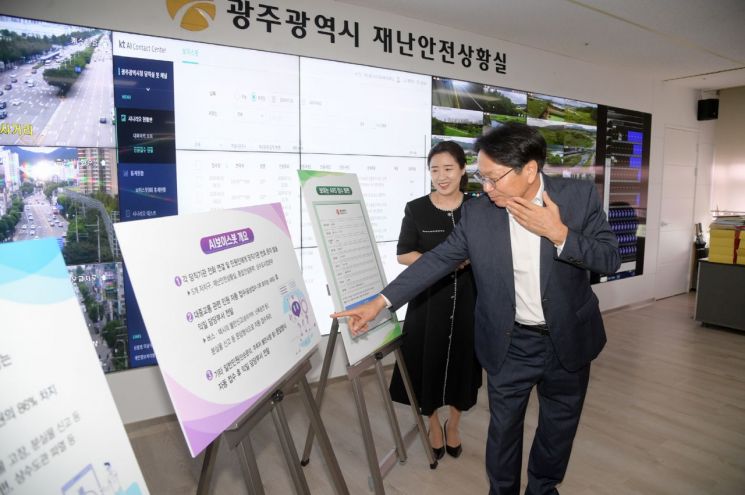 Kang Kijeong, mayor of Gwangju, visited the city's Disaster and Safety Situation Room on the morning of August 1 last year to check preparations for integrated duty, including a demonstration of the artificial intelligence (AI) voice bot. Provided by Gwangju City
The “AI Dangjigi,” which Gwangju City specially hired in August last year as the first among metropolitan cities, has been effectively fulfilling its role by handling 84% of duty-related civil complaints. Thanks to the impressive performance of the smart “AI Dangjigi,” Gwangju City is receiving praise for leading administrative innovation and improving citizen convenience.
Gwangju City announced on the 18th that the AI-based duty civil complaint processing system “AI Dangjigi,” which was specially introduced in August last year, received a total of 9,853 civil complaint calls over seven months until February this year and handled 84% of them.
The complaints handled by AI Dangjigi included 768 cases of civil complaint reception such as public transportation dissatisfaction reports, and 5,941 cases of simple responses, totaling 6,709 cases. In addition, the system directly connected 1,563 calls to the responsible duty agencies (962 to five district offices, 137 to the Waterworks Headquarters, 279 to the Disaster and Safety Situation Room, and 185 to the General Construction Headquarters).
“AI Dangjigi” improves convenience by responding to duty calls in real time (voice and visual ARS), automatically connecting to the relevant civil complaint handling agencies such as the five district offices and the General Construction Headquarters, or forwarding the call to the responsible department.
Previously, when citizens wanted to be connected to the duty agency for their complaint, they had to be informed of the agency’s duty phone number and call again, which was inconvenient. With the introduction of the system, citizens now receive the duty number by text message and can be connected automatically.
The city abolished the staff duty system and, instead, introduced “AI Dangjigi” and assigned additional dedicated personnel to the Disaster and Safety Situation Room, which operates 24 hours a day, enabling more professional responses to duty-related complaints through integrated operation.
In fact, the number of calls answered directly by staff was 1,581, and after the introduction of the “AI Dangjigi” system, the average number of daily calls handled by staff dropped from 20 to 8, a 60% reduction, making civil complaint response more efficient.
Notably, in the past, an average of 122 staff members per month had to take substitute leave after day or night duty, causing gaps in regular work. With the introduction of the AI-based civil complaint processing system and dedicated personnel, uninterrupted civil complaint service can now be provided.
Last August, the city became the first among metropolitan cities to abolish the staff duty system to alleviate staff fatigue and work gaps caused by duty-related leave. This is considered an innovative case in the AI era, as improvements were made through active and continuous communication with staff regarding traditionally practiced tasks.
Hwang Inchae, head of the General Affairs Division, said, “Since introducing the AI duty system, we have minimized gaps in civil complaint processing and greatly improved administrative efficiency. We will continue to achieve administrative innovation through system improvements and collaboration.”
© The Asia Business Daily(www.asiae.co.kr). All rights reserved.

















