The background behind the U.S. government adding South Korea to the 'sensitive countries' list was only understood two months later. The government explained that it was not due to emergency martial law situations or nuclear armament theories, but rather a security-related issue that occurred at a research institute under the U.S. Department of Energy. However, critics point out that the delayed response?only after domestic media reports emerged regarding the measure taken in January during the final days of the Biden administration?and the ensuing confusion over which ministry was responsible revealed a chaotic state of 'lack of normal leadership.'
On the 18th, the Ministry of Foreign Affairs announced through a press release around 9 p.m. the previous night, "As a result of contacting the U.S. side, it has been understood that the reason the Department of Energy included South Korea at the lowest level on the sensitive countries list was due to security-related issues at a research institute under the Department of Energy." Earlier, the Department of Energy's Office of Inspector General submitted a semiannual report to the U.S. Congress, which mentioned an incident where an employee of a contractor at the Idaho National Laboratory (INL) was caught attempting to board a plane to South Korea while in possession of information subject to export controls and was subsequently dismissed. It is presumed that this incident is related to the current matter. This incident occurred during the reporting period from October 2023 to March 2024.
Since the cause has been identified, albeit belatedly, the Ministry of Foreign Affairs stated that it will continue efforts to have South Korea removed from the sensitive countries list to prevent any impact on future Korea-U.S. cooperation in science, technology, and energy.
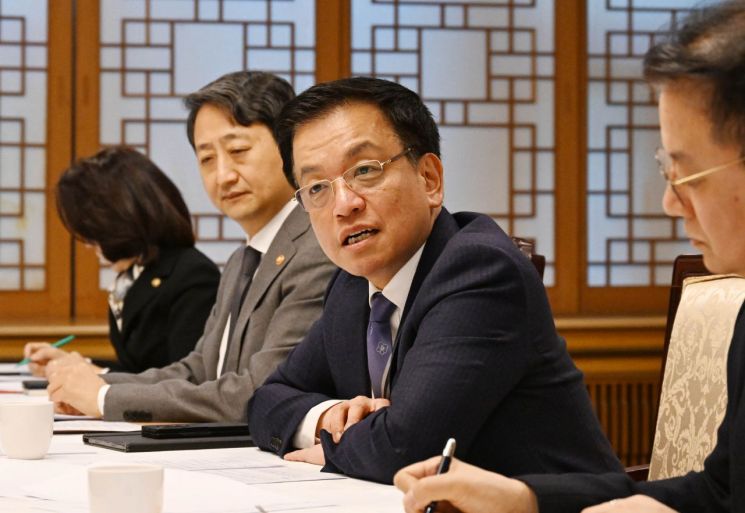 Choi Sang-mok, Acting President and Deputy Prime Minister as well as Minister of Economy and Finance (third from the left), is holding a meeting on external economic issues at the Government Seoul Office Building on the 17th. To the left of Acting President Choi is Ahn Deok-geun, Minister of Trade, Industry and Energy. Photo by Yonhap News.
However, since the issue was first reported by domestic media on the 10th, internal disputes over responsibility among government ministries have continued, and aftershocks are expected to persist. The domestic counterpart to the U.S. Department of Energy is the Ministry of Trade, Industry and Energy. Due to the delayed identification of the cause and lack of proper response, various speculations such as emergency martial law situations or nuclear armament theories arose, spreading responsibility concerns even to the Ministry of Foreign Affairs. Seemingly aware of this, the Ministry of Foreign Affairs emphasized in its press release that this is not a 'foreign policy issue.'
The sensitive countries list will take effect on the 15th of next month. Minister of Trade, Industry and Energy Andeok Geun is currently pushing for an urgent visit to the U.S. this week to resolve the situation. The Ministry of Foreign Affairs stated, "There is a precedent where South Korea was previously included on the sensitive countries list but was removed after consultations with the U.S. side."
© The Asia Business Daily(www.asiae.co.kr). All rights reserved.












