Leaping Forward as a Leading City in the Space and Aerospace Industry
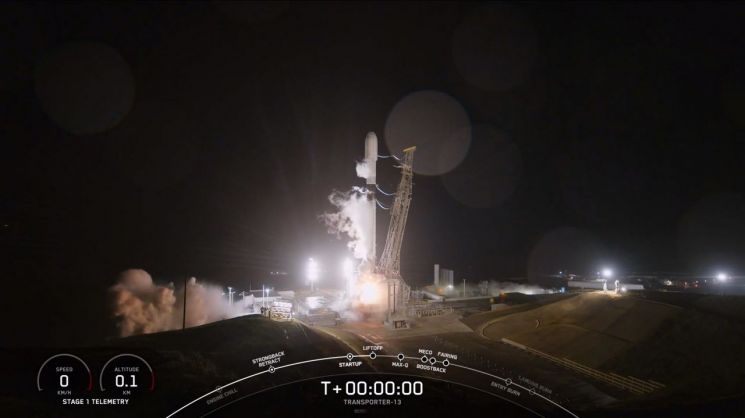
The city of Jinju, Gyeongnam, announced on the 17th that the ultra-small satellite 'JINJUSat-1B' (Jinjusat One B), developed for the first time by a local government in Korea, was successfully launched from the Vandenberg Space Force Base in California, USA, at 3:39 p.m. on the 15th (local time: 11:39 p.m. on the 14th), and achieved initial communication.
JINJUSat-1B was successfully separated from the Falcon 9 rocket at an altitude of about 520 km, approximately 54 minutes after launch. The first communication was established with the Space Component Test Center at the Korea Testing Laboratory (KTL) about 5 hours and 20 minutes after separation, around 10 p.m. The current status of the satellite is stable, and its attitude has been confirmed to be stabilized.
The ultra-small satellite JINJUSat-1B, launched this time, is a 2U-sized CubeSat (1U: a cube with each side measuring 10 cm) equipped with three cameras. Jinju plans to switch to normal operation mode and begin its Earth photography mission as soon as JINJUSat-1B is ready for operation, with an expected operational period of about three months.
Jinju began its ultra-small satellite development project in 2019 together with KTL and Gyeongsang National University, aiming to develop certification and launch models and foster specialized personnel in the space field through master's and doctoral programs at Gyeongsang National University. With this launch, Jinju has become the first local government in Korea to launch an ultra-small satellite.
The previously developed JINJUSat-1 (Jinjusat One) involved three master's students from Gyeongsang National University in its development process, all of whom found employment in space-related companies, contributing to the cultivation of specialized talent. The satellite was developed as a regionally customized ultra-small satellite, with the camera bracket, a camera mounting component, produced using Gyeongsang National University's 3D printing technology, thereby increasing the localization rate of components.
JINJUSat-1 (Jinjusat One) was launched on November 12, 2023, from the Vandenberg Space Force Base in California using SpaceX's Falcon 9 rocket, but was ultimately not deployed. As a result, JINJUSat-1B was rebuilt using the original design to reattempt orbital insertion, which was not achieved previously.
Starting with the launch of JINJUSat-1B, Jinju plans to actively pursue a leading position in the downstream (satellite utilization) sector, which is expected to create significant added value in the New Space era. Since last year, Jinju has been hosting the 'Satellite Utilization Expert Advisory Committee Seminar,' where key practitioners from major domestic satellite utilization organizations gather to discuss development strategies. This year, in celebration of the launch of JINJUSat-1B, the seminar will be held for two days from March 18 to 19.
Additionally, starting this year, the city will implement a pilot project to support the creation of an innovative ecosystem for the space industry in Gyeongnam, in cooperation with Gyeongnam Province and Sacheon City. The project will invite and discover administrative support systems for companies utilizing satellite information and provide opportunities for practical demonstrations. Through this, Jinju aims to lay the foundation for introducing advanced satellite utilization technologies and further promote industrial revitalization by strengthening collaboration with companies.
As a follow-up project, Jinju, together with Gyeongnam Province, KTL, and Gyeongsang National University, is also developing a 6U-class 'JINJUSat-2' (Jinjusat Two). Equipped with sensors capable of detecting sea surface temperature and color, it will carry out coastal monitoring missions for Gyeongnam Province. The goal is to launch in the second half of 2027, operate for one year, and contribute to the fostering of space companies and specialized personnel in the province.
Mayor Jo Kyu-il stated, "The successful launch of JINJUSat-1B marks an important moment as Jinju takes another step forward as a leading city in the space and aerospace industry. Going forward, our city will focus on fostering the downstream sector of satellite utilization and create synergy with upstream (satellite manufacturing) projects, such as the construction of space environment test facilities, to lay the foundation for building a space and aerospace city."
© The Asia Business Daily(www.asiae.co.kr). All rights reserved.
![Clutching a Stolen Dior Bag, Saying "I Hate Being Poor but Real"... The Grotesque Con of a "Human Knockoff" [Slate]](https://cwcontent.asiae.co.kr/asiaresize/183/2026021902243444107_1771435474.jpg)
















