Market Capitalization Plunges by 144 Trillion Won in Four Days After Martial Law
4 Out of 10 Self-Employed Individuals Consider Closing Their Businesses This Year
Mr. A, who runs a restaurant business in Yeouido, lamented, "Last year, we lost our year-end sales due to the emergency martial law, and now, with the (President Yoon Seok-yeol's) release, reservations are being canceled one after another." After President Yoon's release, the political circles moved en masse from the National Assembly in Yeouido to Gwanghwamun Square for outdoor protests, deepening the worries of merchants around the National Assembly. Mr. A said, "When the martial law was declared and ended in just one day, I never imagined the damage would be this severe," adding, "We are just waiting for this situation to end as soon as possible."

As of the 14th, one day after 100 days (December 3, 2024?March 13, 2025) since the declaration of the December 3 emergency martial law, the extreme division and chaos in Korean society surrounding President Yoon's impeachment remain ongoing. In particular, the impact of the martial law on the Korean economy has expanded across all sectors, from shaken external credibility to the contraction of domestic consumption affecting small-scale self-employed individuals.
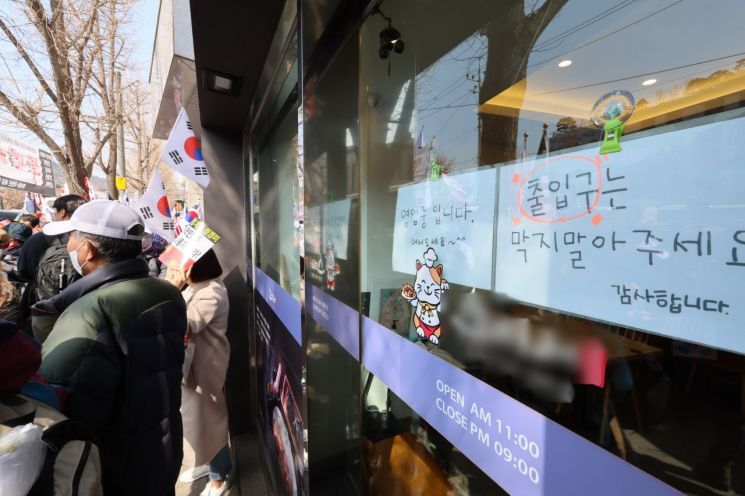 A notice of normal business hours is posted at a restaurant near the Constitutional Court in Jongno-gu, Seoul. Yonhap News
According to the evaluation report titled "The Cost of 100 Days of Insurrection," published the previous day by the Democratic Research Institute, the think tank of the Democratic Party of Korea, the domestic stock market capitalization evaporated by a total of 144 trillion won during the four days from the December 3 martial law declaration to the failure of the first presidential impeachment motion (December 9, 2024). The panic sell-off, which followed the sequence of "impeachment motion failure → increased uncertainty → foreign investor withdrawal," saw 113 trillion won withdrawn from the KOSPI and 31 trillion won from the KOSDAQ during this period.
From the day after the martial law declaration for three days (December 4?6, 2024), the cumulative net foreign selling of KOSPI stocks reached 1.0377 trillion won, and the USD/KRW exchange rate surged from 1,403 won per dollar before the martial law to 1,444 won as of 11 p.m. on the day of the declaration. The Consumer Confidence Index (CCSI) announced by the Bank of Korea fell from an average of 100.8 in the three months before the martial law to 88.2 in December of the same year, indicating an expansion of pessimism.
The disappearance of the year-end special demand was also confirmed by indicators. The average daily credit card usage amount dropped by 180 billion won, from 2.66 trillion won in November of last year to 2.48 trillion won in the first seven days of December of the same year, immediately after the martial law. Due to the shock of the emergency martial law, the Bank of Korea revised last year's annual economic growth rate downward from 2.2% to 2.0%. The Bank further lowered this year's growth forecast from 2.3% to 1.5% last month due to the prolonged economic shock. Although the urgent external credibility issues have been temporarily addressed as of this month, there is no room for complacency. International credit rating agencies have continuously warned that prolonged political uncertainty in Korea could have a negative impact on the country's credit rating.
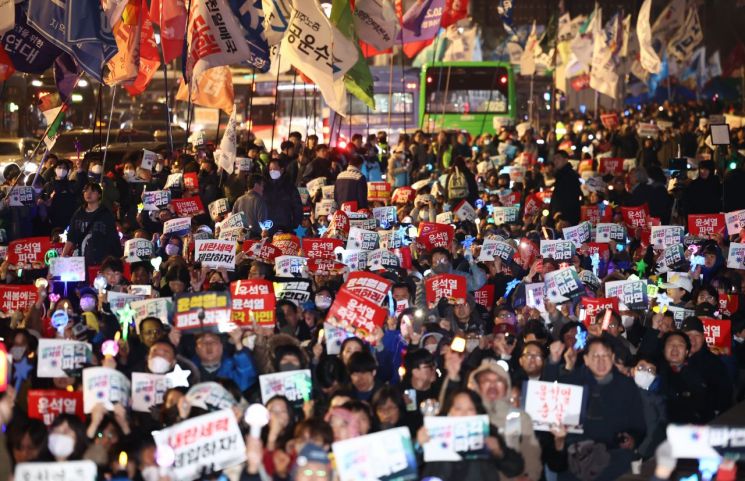
The research institute also assessed that the impeachment had a direct hit on the microeconomy. Citing data calculated by the Korea Economic Research Institute, the institute revealed that due to the consumption contraction shock after the impeachment, 4 out of 10 self-employed individuals were considering closing their businesses last month. 72.6% of self-employed people experienced a decrease in sales compared to the previous year, and 72.0% saw a decline in net profits. The problem is that 61.2% of them expect sales to decrease further this year.
More than half of small and medium-sized enterprises (SMEs) also anticipated worsening economic conditions this year. According to a survey conducted on March 6 by the Small and Medium Business Research Institute targeting 216 domestic SMEs with five or more employees, 55% expected business conditions to deteriorate this year. Youth employment also saw the largest decline since COVID-19. Statistics Korea reported that youth jobs decreased by 220,000 in both December last year and January this year compared to the same periods the previous year. Lee Han-joo, director of the Democratic Research Institute, said, "The economy has fallen into a black hole of uncertainty and low growth, and people's livelihoods have sunk into a swamp of despair."
© The Asia Business Daily(www.asiae.co.kr). All rights reserved.














