Pointing Out Parallels with the 2013 Dongyang Incident
Court Receivership Right After Bond Issuance, High Debt Ratio, Investor Losses
Amid Mounting Suspicions, FSS Launches Inspection... National Assembly Schedules Urgent Inquiry for the 18th
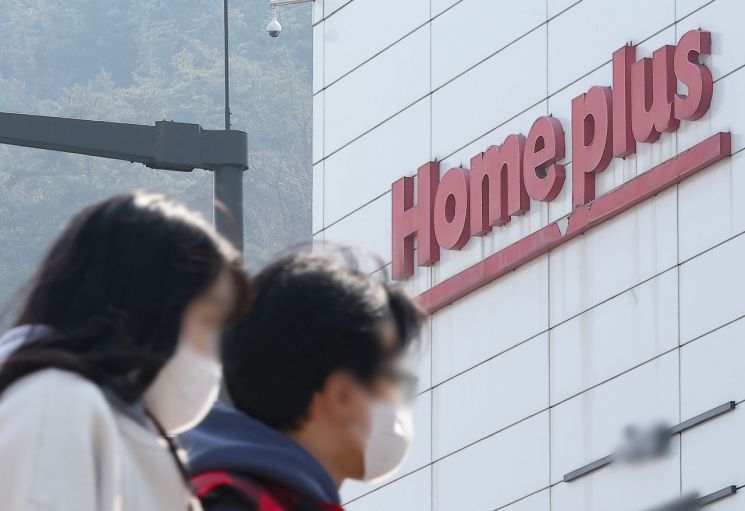
The so-called ‘Homeplus’ incident, which suddenly entered corporate rehabilitation procedures (court receivership) and caused aftershocks in the financial sector, is increasingly resembling the 2013 Dongyang Group incident. Similarities such as court receivership immediately following bond issuance, a financial crisis with a debt ratio exceeding 1000%, investor damages, and ensuing legal battles have been repeatedly confirmed, prompting the National Assembly and financial authorities to take action. The key issue to determine whether fraudulent transactions occurred is whether bonds were issued while a rehabilitation plan was already under discussion.
Kim Nam-geun, a member of the National Assembly’s Political Affairs Committee from the Democratic Party of Korea and a former legal professional, pointed out the similarity to the Dongyang Group incident in a phone interview with Asia Economy on the morning of the 14th, saying, "It takes about a month just to prepare around 50 rehabilitation documents, so it makes no sense that bonds were sold to general investors just a week before (court receivership)."
Ahead of a National Assembly urgent inquiry scheduled for the 18th, Representative Kim said, "Large-scale losses for investors are expected. If bonds were sold while preparing for court receivership, it would constitute fraudulent transactions like the Dongyang incident, and criminal charges would be inevitable." He added, "We will clearly scrutinize whether the major shareholder of Homeplus, MBK Partners, anticipated investors’ sacrifices solely for an exit and took only what they could." The Dongyang incident was a large-scale financial damage case that occurred in September-October 2013 when Dongyang Group intentionally concealed its financial crisis, sold a large volume of commercial papers (CP) and corporate bonds to investors, and then immediately applied for court receivership for major affiliates.
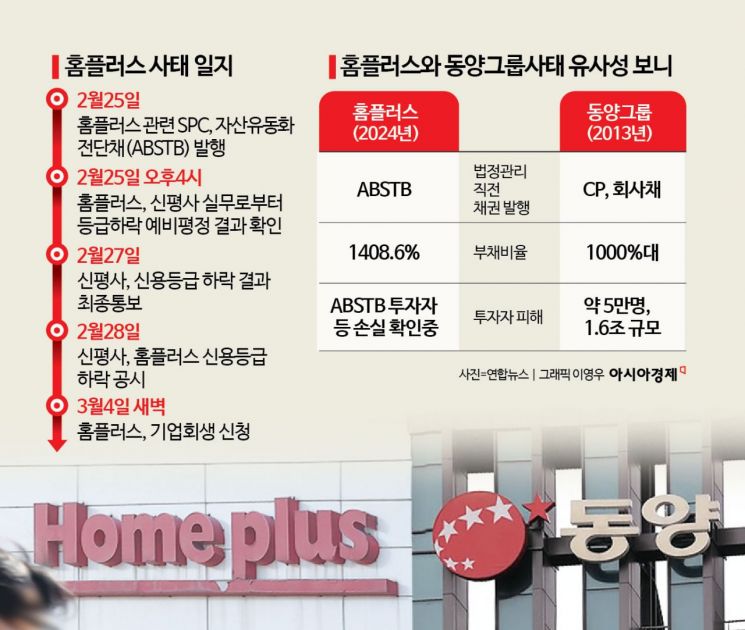
The reason the current Homeplus incident is being called the ‘Second Dongyang Incident’ is primarily because court receivership followed immediately after bond issuance. Homeplus filed for court receivership in the early hours of the 4th of this month after its short-term bond credit rating was downgraded from ‘A3’ to ‘A3-’ on the 28th of last month. Although Homeplus had claimed it was unaware of the credit rating downgrade beforehand, it revealed in a press release the day before that it had received preliminary rating results from a credit rating agency’s staff on the afternoon of the 25th of last month. The 25th was the last day the Homeplus-related special purpose company (SPC) issued asset-backed electronic short-term bonds (ABSTB).
The severity of the corporate financial crisis, to the extent that the major shareholder could not have been unaware of the credit rating downgrade, is another similarity. According to data submitted by Homeplus to Korea Credit Rating, the debt ratio as of the end of November last year was a staggering 1408.6%. This is nearly 14 times the average for listed companies in Korea (108% as of 2023) and comparable to the level of insolvent large corporations during the International Monetary Fund (IMF) foreign exchange crisis. Dongyang Group also faced a severe financial crisis with a debt ratio exceeding 1000% as of 2012.
Moreover, just as the Dongyang incident involved 50,000 victims and 1.6 trillion KRW in fraudulent CP investment damages reported to the Financial Supervisory Service (FSS), cases of individual investor damages are also being confirmed this time. Among the 401.9 billion KRW worth of Homeplus ABSTB whose repayments have been suspended, approximately 300 billion KRW is estimated to have been sold retail to individual and corporate investors. Representative Kim pointed out, "Although there are no damages yet in the commercial transactions sector, victims are inevitably going to emerge. It is a situation where Homeplus cannot be trusted." Naturally, legal battles are also expected to follow. An investor attending a victims’ rally held in front of the FSS on the 12th said, "We are also considering legal action." Shin Young Securities, the lead underwriter, is also reviewing criminal charges, claiming that Homeplus issued ABSTB knowing everything in advance.
Accordingly, the focus of the urgent inquiry by the National Assembly’s Political Affairs Committee next week will be to clarify when Homeplus and its major shareholder MBK Partners first discussed corporate rehabilitation, and whether they proceeded with bond issuance despite knowing about the rehabilitation plan and credit rating downgrade. If, as the market suspects, they raised funds while aware of the downgrade and rehabilitation plan, legal penalties for fraudulent transactions, similar to the Dongyang incident, would be possible.
Attorney Lee Byung-ho of the law firm Approach stated, "If Homeplus management or MBK Partners continued to issue bonds to general investors while knowing about the financial crisis, it could constitute fraud under criminal law." A former senior official of the FSS, who requested anonymity, also warned, "It could lead to fraud charges." Additionally, the leveraged buyout (LBO) method, which involves borrowing against the acquiring company’s assets rather than equity capital, is also expected to come under scrutiny.
The FSS began inspections of Shin Young Securities and two credit rating agencies yesterday afternoon and has announced plans to expand inspections to MBK Partners if necessary. An FSS official said, "We are prepared to start investigations at any time if evidence of fraudulent transactions or other criminal offenses emerges." According to the Capital Markets Act, the head of the FSS can inspect the operations and financial status of private collective investment schemes exclusively for institutions when necessary to maintain financial market stability or sound trading order.
© The Asia Business Daily(www.asiae.co.kr). All rights reserved.

![Clutching a Stolen Dior Bag, Saying "I Hate Being Poor but Real"... The Grotesque Con of a "Human Knockoff" [Slate]](https://cwcontent.asiae.co.kr/asiaresize/183/2026021902243444107_1771435474.jpg)















