Soaring Yen... Exchange Rate Nears 1,000 KRW
As Exchange Rate Rises, Yentech Investors Realize Profits
Yen Deposit Balance Falls Below 1 Trillion KRW for the First Time in 18 Months
180 Billion Yen Withdrawn in Just 40 Days... Lowest Level in 20 Months
As the era of 'Super Yen Weakness (低)' comes to an end, the exodus of 'Yentech' investors who manage their finances in yen is accelerating. The balance of yen deposits has decreased by 180 billion yen (approximately 1.7 trillion KRW) over the past three months, marking the lowest level in 21 months. With expectations of additional interest rate hikes by the Bank of Japan (BOJ), the yen has rapidly emerged as an alternative currency to the dollar, and the yen's strength is expected to continue until the end of this year.
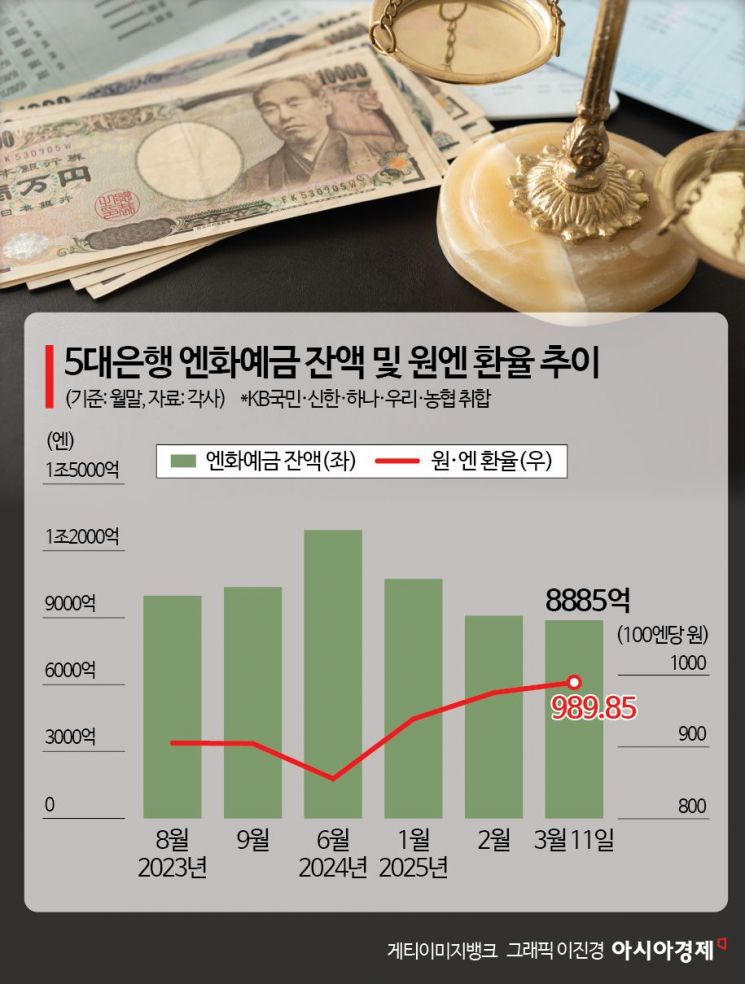
According to the financial sector on the 14th, the balance of yen deposits at the five major commercial banks (KB Kookmin, Shinhan, Hana, Woori, NH Nonghyup) stood at 888.48829 billion yen as of the 11th. This is the lowest level in 21 months since recording 725.9 billion yen in May 2023.
The balance of yen deposits had maintained a level above 1 trillion yen for 17 consecutive months since recording 1.0372 trillion yen in September 2023. However, the balance began to decline from the second half of last year, falling below 1 trillion yen at the beginning of last month, and dropped below 900 billion yen in March. It is estimated that 185 billion yen was withdrawn in just about 40 days since early February this year.
The balance of yen deposits is closely related to the KRW/JPY exchange rate trend.
In 2023, the exchange rate stayed in the early 900 KRW range per 100 yen for a long period, sparking a 'Yentech' craze among individual investors, and the balance of yen deposits increased rapidly. However, as the rate fell to the 850 KRW range, the funds of individual investors who had accumulated yen were tied up. On the other hand, due to the unusual yen weakness, more people bought yen, causing the balance of yen deposits to swell to 1.2929 trillion yen in June last year.
However, the KRW/JPY exchange rate has recently risen sharply. It increased from the 938 KRW range per 100 yen in January to the 975 KRW range in February, and as of the 11th, it rose to 989.85 KRW. It has reached the highest level in about 1 year and 10 months, approaching 1,000 KRW per 100 yen. As the yen strengthens, the so-called yen investors whose funds were tied up are reportedly rushing to realize profits one after another in the market.
Companies are repaying yen loans due to concerns over interest burdens. As of the 11th, the balance of yen loans at the five major banks totaled 72.3 billion yen. This marks six consecutive months of decline since the end of August last year.
The yen's strength is influenced by expectations of additional BOJ interest rate hikes and increased preference for safe assets amid concerns over the US economic downturn. The yen is considered the safest currency next to the dollar. Experts expect the yen's strength to continue until the end of the year. Jo Eun, a senior researcher at the International Finance Center, said, "The interest rate gap between the US and Japan is rapidly narrowing," adding, "If further signs of US economic slowdown are confirmed, the strength could increase even more."
© The Asia Business Daily(www.asiae.co.kr). All rights reserved.


















