10 Out of 30 Residents Have Died or Are Battling Illnesses Such as Lung Cancer
Chemicals Used Are Toxic Substances and Raw Materials for Poisonous Gas
Treatment Plant: "Chemical Usage Halved Since Last Year"
Ministry of Environment and Jeju Province to Conduct Full Investigation on Toxicity
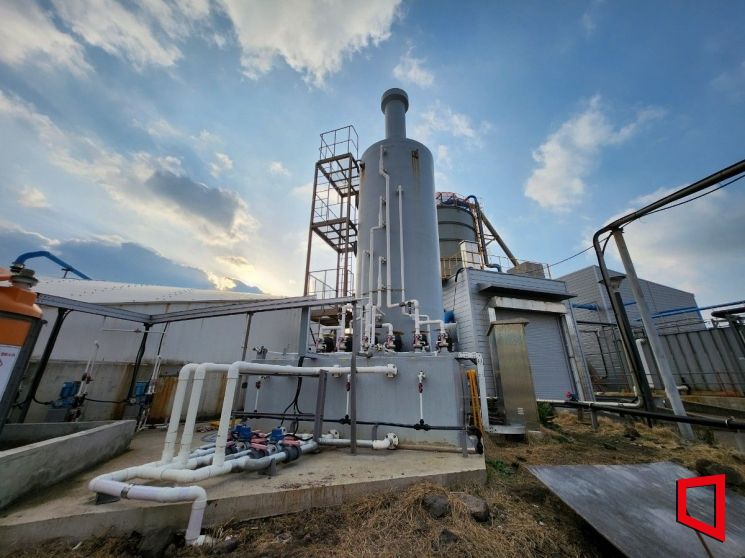 Large chemical washing deodorizer with a capacity of 350 liters per minute operated at Jeju Sewage Treatment Plant. Photo by Park Changwon
Recently, a group of severe respiratory disease cases has emerged in a village near the Jeju Sewage Treatment Plant, spreading fear among residents. This is due to a significant number of villagers developing illnesses such as lung cancer, laryngeal cancer, and asthma.
According to Jeju Province and residents near the Jeju Sewage Treatment Plant on the 14th, out of 30 residents in S Village located near the plant, 10 have either died from or are currently battling severe illnesses.
L (53), the head of S Village, said, "Currently, about 30 people live in the village, including around 20 native residents and 10 migrants. Over the past 10 years, 10 cases of severe illness have occurred, and 2 of them have died," adding, "Severe illnesses have mainly occurred among native residents."
L explained, "The severe illnesses included laryngeal cancer, lung cancer, and asthma, and they occurred in elderly people and housewives who spent a lot of time at home, without any specific pattern," adding, "It is difficult to disclose detailed information due to privacy concerns."
As the severity of the residents' suffering became known, the Jeju Provincial Council began an investigation. The council's findings raised concerns that the chemicals used in the deodorizer were toxic substances, and that if these chemicals were released into the air or sea, they could harm not only marine life but also haenyeo (female divers) and others, increasing anxiety over the safety of the sewage treatment plant's deodorizer.
The Environmental and Urban Affairs Committee of the Provincial Council, at its 435th extraordinary session, pointed out that sodium hypochlorite, a chemical used in the deodorizer, is a raw material for toxic gas and a harmful substance, and urged Jeju Province to come up with countermeasures. In response, a provincial official stated, "The chemicals used in the deodorizer are diluted 100 times, so they are safe."
The chemicals used in the deodorizer at the Jeju Sewage Treatment Plant are 4.5% sodium hydroxide (caustic soda) and 12% sodium hypochlorite, which are considered low-concentration compared to their undiluted forms. Among these, sodium hypochlorite is the main concern. It is the main ingredient in bleach and is widely used for its strong disinfecting and whitening effects in both industrial and household settings.
Some argue that although a chemical toxic gas can be produced if sodium hypochlorite and hydrochloric acid are combined, since hydrochloric acid is not used in the deodorizer, the likelihood of the two chemicals mixing is almost nonexistent, and that the fears are exaggerated.
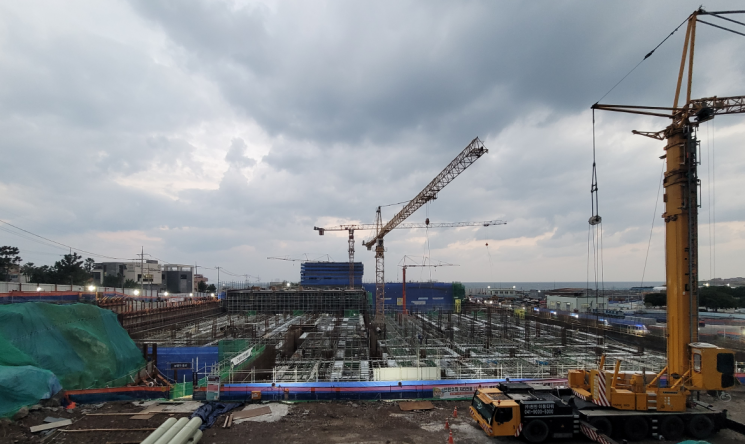 The Jeju Public Sewage Treatment Facility Modernization Project has a total budget of 430.9 billion KRW and began construction on April 28, 2023. Currently, it is 26% complete.
In fact, a review of deodorizer chemical usage at the Jeju Sewage Treatment Plant over the past five years (2020-2024) found that between 410 and 709 tons were used annually. From 2021 to 2023, an average of 1.1 tons of sodium hydroxide and 0.8 tons of sodium hypochlorite were used daily. This is two to three times higher than the amount used in other cities and provinces in Korea.
A chemical industry official emphasized, "Chemicals are beneficial when used in proper amounts, but excessive use or the combination of two or more substances causing a chemical reaction can lead to fatal consequences. Safe management and proper dosage are crucial."
Regarding this, a sewage treatment plant official explained, "Due to the open structure of the plant, rather than a closed one, a large amount of chemicals was used to remove odors that were concentrated during the digestion process. Since last year, the digestion process has been eliminated, reducing chemical usage by half."
The official added, "As complaints have been filed by residents of the affected village, we plan to collect and analyze the odors from the deodorizer outlet to determine their toxicity. The results of the safety analysis will be released as early as May."
The official also stated, "The most important factor in odor removal is collection. Once the ongoing modernization project is completed, all sewage processes will be moved underground, and all facilities will be housed within buildings inside the sewage treatment plant, separated by 13 layers of partitions, making odor removal much easier than now. Sewage odors will be completely eliminated once the modernization project is finished."
Meanwhile, the Ministry of Environment and Jeju Province plan to conduct a full-scale investigation by collecting air samples from the affected village and around the deodorizer to determine toxicity.
© The Asia Business Daily(www.asiae.co.kr). All rights reserved.

![Clutching a Stolen Dior Bag, Saying "I Hate Being Poor but Real"... The Grotesque Con of a "Human Knockoff" [Slate]](https://cwcontent.asiae.co.kr/asiaresize/183/2026021902243444107_1771435474.jpg)
















