'Economic Difficulties' Are the Top Cause of Stress
Most Effective Relief Method Is 'Sleep'
"Various Approaches Needed to Alleviate Stress"
 A bookstore displaying books related to stock investment and financial technology, unrelated to the specific content of the article.
A survey revealed that economic issues have the greatest impact on the stress experienced by modern people.
According to a recent survey conducted by data consulting firm PMI on 5,514 panelists, 36.6% (1,887 respondents) identified 'economic difficulties' as their biggest source of stress. This was followed by 'interpersonal relationships' (27.6%), 'health problems' (15.1%), 'work and studies' (10.0%), and 'commuting' (6.8%).
This result showed a similar trend to recently released economic indicators. According to the Consumer Confidence Index (CCSI) published by the Bank of Korea, public anxiety about household finances is steadily increasing, with high inflation and rising housing costs identified as key factors dampening consumer sentiment.
Regarding interpersonal relationships, the proportion of those not considering marriage was higher among women than men. Among unmarried men, 49.4% responded that they had no intention to marry; of these, 19.9% said, "I have no plans now, but there is a possibility in the future," while 29.5% said, "I have no plans to marry now or in the future."
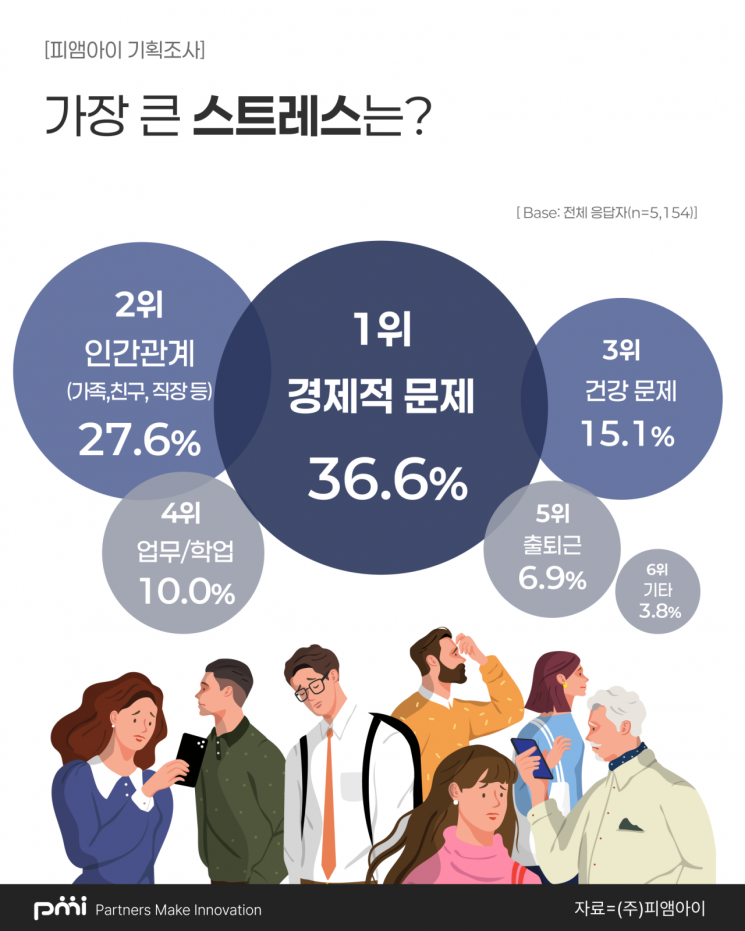
Health problems, ranked third, were analyzed to be influenced by aging, an increase in chronic diseases, and the spread of mental health issues. According to the 2024 National Mental Health Knowledge and Attitude Survey by the Ministry of Health and Welfare, 73.6% of respondents experienced mental health problems in the past year, an increase of 9.7 percentage points compared to 63.9% in 2022.
Meanwhile, 28.6% of respondents answered that the most effective way to relieve stress is 'sleep.' This was followed by 'meditation/rest' (19.9%), 'exercise' (19.4%), and 'food intake' (17.6%). The high proportions of exercise and meditation/rest are interpreted as reflecting the recent increased interest in health.
A PMI official stated, "While economic burdens act as major stress factors, it is an important time not only for personal stress management but also for policy support and strengthening social safety nets," adding, "In particular, various approaches are needed to alleviate health problems and mental stress."
© The Asia Business Daily(www.asiae.co.kr). All rights reserved.













