Hang Seng Index Surges Over 20% This Year
New York Stock Market Continues Downward Trend
Citigroup Adjusts Investment Ratings for U.S. and China Markets
Due to the erratic tariff policies of U.S. President Donald Trump, investors who left the United States are turning their attention to the Chinese market. While U.S. stocks are undergoing adjustments amid 'Trump risk,' the Chinese market is showing signs of recovering investor sentiment thanks to the authorities' proactive fiscal policies and the emergence of deep-sea tech companies. Domestic investors have also joined the buying frenzy for Chinese stocks, continuing a two-month streak of net purchases.
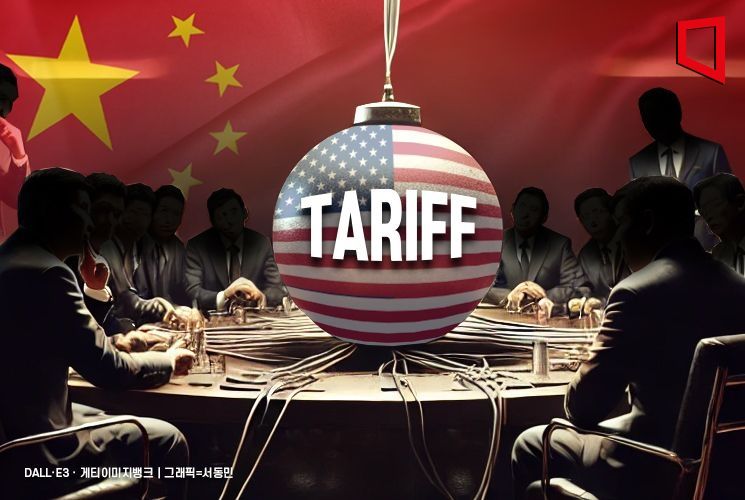
On the 13th, Chinese media Caixin reported that investors reaffirmed their confidence in China's economic growth through the recent government work report, highlighting the recently revived Chinese stock market. The background of this Chinese investment boom was attributed to the authorities' commitment to proactive fiscal policies.
At the Two Sessions held on the 5th, China set this year's economic growth target at around 5%, the same level as last year, despite negative forecasts from overseas institutions. Caixin stated, "Investors welcomed this as an important signal of economic recovery."
Optimism toward Chinese stocks is also evident in the market. Hong Kong's Hang Seng Index surged sharply after China's Spring Festival (Lunar New Year), briefly surpassing the 24,000 mark during intraday trading. The Hang Seng Index, along with the Hong Kong H-Share Index composed of mainland Chinese companies, has risen about 20% since the beginning of the year. Additionally, the 'Chinese Nasdaq,' the Hong Kong Hang Seng Tech Index, has surged more than 30%. In contrast, the U.S. stock market is struggling. Due to the impact of tariff policies, the New York Stock Exchange has continued to decline, with 73% of the S&P 500 index components already entering a correction phase. Typically, a 10% drop from a recent peak is considered the start of a correction phase.
Bloomberg News pointed out that the Hong Kong stock market has become one of the biggest beneficiaries during the first 50 chaotic days since Trump's inauguration. Bloomberg analyzed, "The Hang Seng Index surged 21%, recording the world's best performance, while the S&P 500 index plunged about 7%, lagging behind almost all global benchmarks," adding, "The gap between the two indices has become the most severe since the 2000 dot-com bubble."
Investment industry views on the U.S. and Chinese markets also diverge. Recently, Citigroup upgraded its investment rating on Chinese stocks from 'neutral' to 'overweight.' Conversely, its view on the U.S. was downgraded from 'overweight' to 'neutral.' Caixin interpreted this as "indicating that the era of American exceptionalism, where the U.S. economy continuously outpaces global markets, has at least temporarily paused."
Domestic investors are also actively entering the Hong Kong stock market. According to Bloomberg, in February, domestic investors made net purchases of Hong Kong stocks worth $189 million, the largest scale since March 2022. This trend continued into March, marking the largest two-month cumulative net purchase volume since early 2021.
© The Asia Business Daily(www.asiae.co.kr). All rights reserved.

















