The Health Functional Food War Begins, Convenience Stores Join the Battle
Domestic HFF Market Reaches 6 Trillion Won
High Growth Potential and Low Entry Barriers
Convenience Stores Sell Small Quantities of HFF... Demand Remains Uncertain
The distribution industry has entered fierce competition over the 6 trillion won health functional food (HFF) market. Following the increased consumer interest in health after COVID-19, lifestyle store Daiso attracted attention by launching cost-effective HFF products, and now convenience stores have jumped into the HFF market using accessibility as a weapon, following the Chinese e-commerce platform AliExpress.
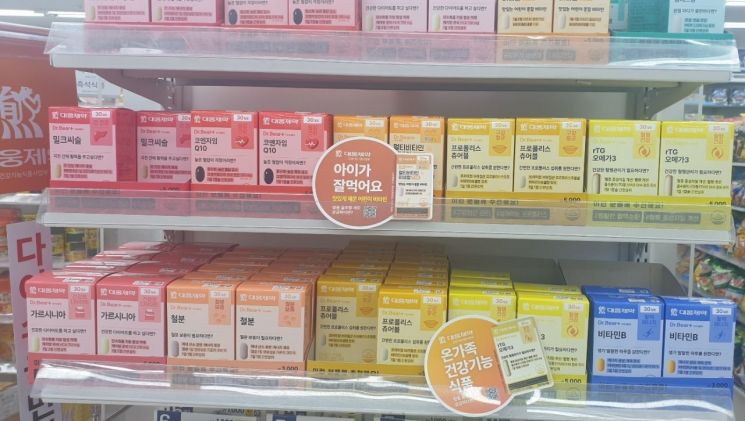
According to the industry on the 12th, CU, a convenience store operated by BGF Retail, will start selling four types of Dong-A Pharmaceutical's health supplements 'Vita Green' and one type of 'Ailo Kamut Enzyme' this month. CU plans to expand its health supplement specialty stores to 5,000 locations mainly focusing on directly managed stores in the first half of this year and to expand sales to nationwide franchise stores in the first half of next year.
CU began full-scale HFF sales last October by selecting 3,000 stores nationwide as health supplement display enhancement stores. This was due to the steady increase in demand for convenience store health supplements as health management trends spread after COVID-19. CU's HFF category sales growth rate continued double-digit growth, rising from 5.3% in 2021 to 27.1% the following year, and 18.6% in 2023. In particular, the daily health supplement sales at CU's health supplement display enhancement stores increased about threefold compared to regular stores. The 'CU Myeongdong Station Store,' a K-food specialty store opened last December, saw the daily average sales of health supplements quadruple compared to the initial introduction period last month, as health supplements such as vitamin chewables and liposomal glutathione gained attention.

Earlier, lifestyle store Daiso began selling health supplements at 200 stores nationwide from the 24th of last month. Large pharmaceutical companies such as Daewoong Pharmaceutical, Chong Kun Dang Health, and Ilyang Pharmaceutical entered the stores, offering affordable health supplements priced between 3,000 and 5,000 won, attracting significant attention. The C-commerce platform AliExpress also opened a food section in October last year, selling domestically produced health supplements from companies like Chong Kun Dang and Korea Eundan. AliExpress is reportedly considering a 'reverse direct purchase business' to sell domestic health supplements overseas using Alibaba Group's overseas distribution network. The cosmetics distribution channel Olive Young also launched its own health supplement private brand (PB) 'Tantan' at the end of last year.
The domestic health supplement market has grown rapidly through the COVID-19 pandemic. According to the Korea Health Supplements Association, the domestic HFF market size surpassed 6 trillion won in 2023, up from 5 trillion won in 2020. Although the market size slowed to 6.044 trillion won last year, the experience of purchasing health supplements continues to increase steadily. According to a survey conducted by the association on 6,700 households nationwide, more than 8 out of 10 households had purchased health supplements at least once last year. The number of households purchasing health supplements increased more than tenfold from 1,610 households in 2020 to 17,793 households last year.
Additionally, the fact that health supplements show a tendency for repeat purchases is another reason why the distribution industry is continuously launching related products. Domestic health supplement sales require approval from the Ministry of Food and Drug Safety (MFDS). According to the MFDS, the number of companies authorized to sell health supplements increased from 81,559 in 2019 to 126,804 in 2023.
However, opposition from pharmacies, which have been the main sales channels for health supplements, remains a hurdle for the distribution industry. Last month, the Korea Pharmaceutical Association issued a statement criticizing pharmaceutical companies' sales of health supplements, and in response, Ilyang Pharmaceutical withdrew its products from Daiso just five days after supplying them. The Fair Trade Commission is currently investigating whether the Korea Pharmaceutical Association violated any laws during this process.
CU plans to target the health supplement market by emphasizing accessibility. However, since consumers' health supplement purchasing channels are concentrated online and each store bears significant maintenance costs to obtain approval for selling health supplements, the outlook is not optimistic. According to the Korea Health Supplements Association, the distribution channel share of the health supplement market is 70% online, 5% pharmacies, and 25% marts and others. A convenience store industry official said, "Since health supplements are products taken consistently, most demand is for bulk purchases online," adding, "It is questionable how much demand there will be for selling small quantities at convenience stores."
© The Asia Business Daily(www.asiae.co.kr). All rights reserved.












