Renewed Allegations of Unfair Practices 10 Years After the 'JYJ Act'
"Remove All Our Artists" ? Broadcasters Remain Cautious
Mechanisms Needed to Guarantee Contract Structures and Freedom of Movement
SM Entertainment has been accused of obstructing the activities of artists who moved to other companies. Claims have emerged that the company pressured terrestrial broadcasters to block their appearances. Similar controversies arose in the past, leading to the enactment of the so-called ‘JYJ Act’ (Broadcasting Act Amendment), but similar issues continue to recur. Experts point out that unless the structural problems within the industry are resolved, similar controversies are likely to persist in the future.
Renewed Allegations of External Pressure... The 'JYJ Act' Proves Ineffective
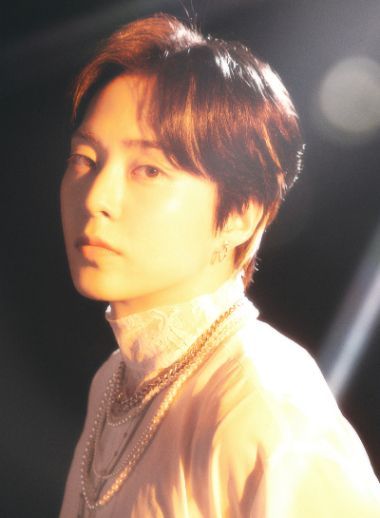
The idol group EXO’s exclusive contract with SM expired in 2022. In June 2023, when SM requested a renewal, members Baekhyun, Chen, and Xiumin (hereafter ‘ChenBaekXi’) resisted, leading to conflict. Subsequently, they agreed that individual activities and ChenBaekXi activities would be managed by One Hundred, while EXO activities would continue with SM. Xiumin released his solo album ‘INTERVIEW X’ on the 10th. For singers, appearing on music shows during the first week of a comeback is considered essential, but Xiumin was unable to appear on major music programs such as Music Bank (KBS2) and Inkigayo (SBS).
One Hundred Label INB100, Xiumin’s agency, stated in a press release, "We attempted multiple meetings with broadcasters ahead of the comeback, but KBS did not respond." They further claimed, "KBS unofficially conveyed that it was impossible for Xiumin to appear simultaneously on programs featuring SM Entertainment artists such as Music Bank." In response, One Hundred boycotted KBS. Their signed artists, Lee Mujin and the group The Boyz, did not participate in the recording of KBS web variety show Rebooting Service, and Lee Su-geun, a broadcaster under One Hundred’s subsidiary Big Planet Made Entertainment, also did not appear for the recording of KBS N variety show Ask Anything. Both shows halted recordings. As the controversy spread, KBS explained it was a "communication issue between production staff and the agency" and said, "If you wait, they will understand our sincerity."
In the past, SM Entertainment was accused of obstructing the appearances of JYJ members Kim Jaejoong, Kim Junsu, and Park Yoochun after they formed JYJ independently in 2009. In July 2013, the Fair Trade Commission issued an ‘Order to Cease Obstruction’ against SM and related business groups for sending official letters to broadcasters requesting them to refrain from featuring JYJ. However, JYJ’s appearances on music shows were still blocked without clear reasons.
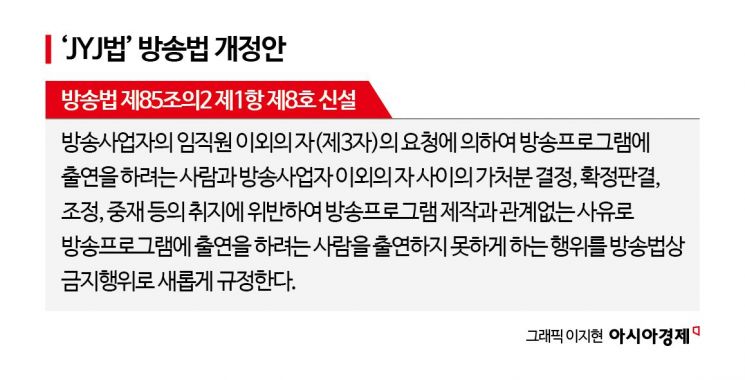
As these unfair practices became controversial, the political sphere also recognized the problem. In December 2015, the ‘JYJ Act’ was enacted, prohibiting broadcasters from banning specific individuals from appearing without just cause at the request of third parties. According to the law, if a broadcaster unjustly prohibits a specific performer’s appearance, the Korea Communications Commission can issue corrective measures. Additionally, the Act included in the Viewer Rights Protection Committee’s review scope matters where ‘external interference may compromise the fairness of broadcast planning, programming, or production,’ allowing the Commission to directly regulate unfair broadcaster practices. However, even after the law’s enactment, the problem was not resolved. It took 15 years for Kim Junsu and Kim Jaejoong to appear on KBS programs. They broke their long hiatus last year by appearing on the variety show New Release Pyeonstorang.
The ‘Invisible Shackles’ of the Entertainment Industry... The Dilemma of Changing Agencies
In the entertainment industry, conflicts involving sending certified letters to former agencies have been frequent for a long time. Due to the industry’s narrow nature, changing agencies is not easy. With tightly knit networks between companies and rapid information dissemination, artists can suffer unexpected disadvantages if they are not cautious. Conversely, rushing a transfer can lead to losses such as contract termination penalties or activity restrictions. When conflicts arise with agencies, artists sometimes face deliberate obstruction or retaliation. Some choose to refrain from activities for a certain period after contract termination or consider overseas activities first to avoid pressure from their former agencies. Especially for rookies or artists from small agencies, legal responses are difficult, often forcing them to comply with agency demands.
A member A of a mid-tier idol group said, "It’s true that there are more options than before, but unfair practices still haven’t disappeared." He added, "Nowadays, even small risks can quickly escalate into controversies, so we have to be careful. In many cases, we end up accepting unreasonable demands from companies." He lamented, "Some artists are held back by their companies’ leverage and cannot leave easily even after contracts end." Due to such realities, some artists establish one-person agencies to endure their agency’s tyranny. Actor B, formerly an idol, said, "My former agency strongly demanded a contract renewal. When I declared independence, they demanded a huge compensation, claiming the company suffered losses from incidental costs during fan meetings." He added, "It was an absurd demand, but I didn’t have the capacity for legal battles, so I paid a settlement and became independent." A CEO C of an agency said, "TV appearances are the exclusive prerogative of producers (PDs). It’s legally difficult to regulate. Large agencies have many stars, and if they say ‘If this person appears, we’ll pull our artists,’ PDs inevitably feel pressured." He continued, "That’s why power struggles happen on music shows, and it’s even worse during year-end music award ceremonies."
Industry experts point out that unless structural problems are resolved, such controversies will repeat. There is a need for mechanisms that guarantee artists’ contract structures and freedom of movement, and without improvements, unfair practices within the industry are likely to continue. Cultural critic Kim Heonsik said, "Ninety-nine percent of Korean agencies are small-scale, and large agencies dominate the market, forcing broadcasters to be cautious of them." He criticized, "This leads to acceptance of unfair demands and a structural contradiction where artists suffer." He added, "It is still difficult for artists from large agencies to become independent, and the JYJ Act has effectively failed." Kim emphasized that the biggest problem in K-pop is the arbitrary management style of agencies and stressed the need for the Ministry of Culture, Sports and Tourism to establish organizations that protect singers and human rights protection bodies in the music industry. He said, "Artists may look glamorous, but they are left unprotected in blind spots," and argued, "Artists should be recognized as workers, and measures for human rights protection must be established."
© The Asia Business Daily(www.asiae.co.kr). All rights reserved.


















