20% Opposition Rate, Mostly on Directors’ Remuneration
Meaningful Even Without Passage... Serves as a Warning to Companies
"Benchmark Portfolio Introduced This Year... Flexible Asset Allocation"
The National Pension Service (NPS) argued that even if it exercises its voting rights, it is difficult to enforce decisions properly because the controlling shareholders of domestic companies hold high equity stakes. Nevertheless, it explained that there is a warning effect on management.
Lee Dong-seop, Head of the Fiduciary Responsibility Office at the Fund Management Headquarters of the National Pension Service, explained this at a press briefing held on the 11th at the NPS Seoul Northern Regional Office in Seodaemun-gu, Seoul.
Lee said, "If the controlling shareholder’s equity ratio exceeds 30% (40% for special resolutions) based on a 60% shareholder meeting attendance rate, the agenda can be passed with the controlling shareholder’s approval alone. The average controlling shareholder equity ratio of domestic listed stocks held by the NPS reaches 43.6%," adding, "This is why there are few cases where proposals opposed by the NPS are rejected at shareholder meetings."
From 2016 to October 2024, the NPS exercised voting rights on 3,181 agenda items at an average of 786 shareholder meetings annually. Among these, the opposition rate was 17.2%. The opposition rate was only 10.1% in 2016 but has exceeded 20% since 2022. Over the past three years, the most opposed agenda items were approvals of directors’ and auditors’ remuneration limits, accounting for 40.5% (828 cases) of the total 2,044 agenda items.
It was emphasized that the NPS’s exercise of voting rights has significance even if it does not lead to the passage of agenda items. Lee said, "Even if shareholder meeting proposals are passed, there is an effect of making management pay attention to shareholders’ expressions of opinion," and explained, "One reason why the number of opposed proposals is not increasing is that companies are conscious of the NPS and avoid submitting proposals that would harm shareholder value from the outset."
The basic direction of the NPS’s shareholder activities is to enhance shareholder value and the fund’s long-term profitability. Generally, it selects target companies for focused management among domestic investee companies with an equity ratio of 5% or more or a holding ratio of 1% or more and conducts shareholder activities accordingly.
For companies subject to confidential dialogue, the NPS sends letters or holds meetings, and if no improvement occurs after about a year, it designates them as confidential focused management companies and expresses its opinions more actively. If there is still no improvement after about a year, the list is made public. If there is still no change, public activities are initiated. Along with publicly submitting shareholder proposals, voting rights are exercised more actively. Similar procedures are applied when unexpected issues arise in investee companies, but responses are faster.
Meanwhile, the NPS emphasized that starting this year, it will implement a benchmark portfolio policy that allows more flexible investment, beginning with alternative investment assets. It intends to actively invest in various new assets that were difficult to define under the existing asset policy. Seo Won-ju, Fund Director (Head of Fund Management Headquarters and CIO) of the NPS, emphasized, "We will quickly establish the benchmark portfolio system applied from alternative investments this year and prepare steadily for its expansion to stocks and bonds thereafter."
The benchmark portfolio reclassifies the previously divided five asset classes?domestic stocks, foreign stocks, domestic bonds, foreign bonds, and alternative investments?into two broad categories: stocks and bonds. Under the stock and bond classifications, it invests flexibly while maintaining a consistent risk level across various asset classes such as domestic stocks, foreign stocks, alternative stocks, domestic bonds, foreign bonds, and alternative bonds.
Director Seo said, "This year, the NPS plans to review overall improvements in decision-making systems, management organization, and investment infrastructure in line with the expansion of the fund size," adding, "We will also do our best to secure excellent personnel through increasing operational staff and improving treatment."
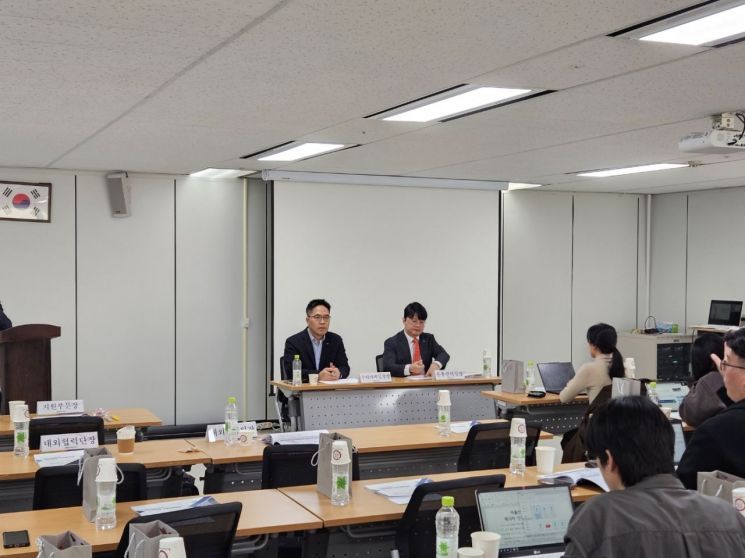 On the 11th, at the National Pension Service Seoul Northern Regional Headquarters in Seodaemun-gu, Seoul, Son Hyup, Head of the Operations Strategy Office (right), and Lee Dong-seop, Head of the Fiduciary Responsibility Office, are conducting a Q&A session during a press briefing.
© The Asia Business Daily(www.asiae.co.kr). All rights reserved.












