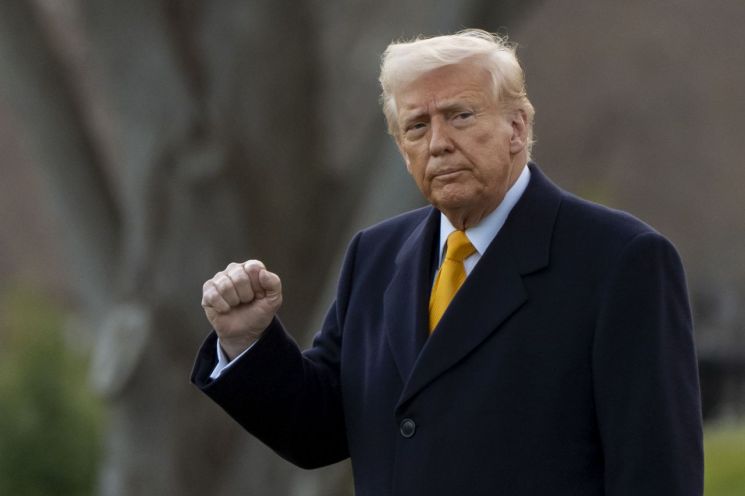
U.S. President Donald Trump took a tough stance by stating that, unlike during his first term's trade war, he would not allow exceptions or exemptions on tariffs. However, it is expected to be difficult to maintain this position, the New York Times (NYT) reported on the 10th (local time).
After imposing a 25% bomb tariff on Mexico and Canada, President Trump signed an executive order on the 6th, just two days later, exempting all goods subject to the United States-Mexico-Canada Agreement (USMCA) from tariffs until April 2. The day before this announcement, the Big Three U.S. automakers requested a tariff waiver, and a one-month exemption on tariffs for Mexican and Canadian automobiles was granted.
Voices demanding exemptions from steel and aluminum tariffs, which are set to take effect on the 12th, are also growing louder. Matt Blunt, chairman of the American Automotive Policy Council (AAPC), stated that Ford, General Motors (GM), and Stellantis purchase most of their steel in the U.S. or North America, and are therefore concerned about the impact of tariffs.
The Trump administration has repeatedly emphasized that, unlike during the first term, it does not intend to allow exceptions on tariffs. Allowing exceptions would weaken the power of tariffs. At that time, while imposing tariffs on steel from China and Russia, quotas limiting exports to the U.S. were imposed on some countries, including South Korea, and tariffs were exempted. The NYT predicted that President Trump is likely to keep the door open for personal deals in his second term but will not establish an official exemption system.
The NYT stated that it is still unclear whether President Trump will apply exceptions to steel and aluminum tariffs or the delayed tariffs on Mexico and Canada in April, but he prefers tariffs because they can have an immediate impact on industries and foreign governments. When threatening with tariffs or imposing and then lifting them, companies and countries under tariff influence tend to appease and praise President Trump. Foreign governments have offered to start trade negotiations with the U.S. and pledged to strengthen U.S. border security, supporting President Trump's promises.
Rick McGuire, an economist at New School, explained, "This is exactly what authoritarians do: manipulate public policy and control it through personal or seemingly capricious decisions, gaining political support in return."
In fact, when President Trump decided to impose tariffs on all imports from Mexico and Canada, executives of the Big Three U.S. automakers called him to explain that the tariffs would cause billions of dollars in costs and could lead to destructive outcomes that wipe out all profits. After President Trump announced the waiver, they issued a statement expressing gratitude to him.
On the 6th, the Trump administration announced tariff exemptions on all goods traded under the USMCA, including agricultural products, and reduced the tariff on Canadian potassium used in fertilizers from 25% to 10%. This was in response to concerns expressed by farmers, related organizations, and states. Subsequently, Republican Senator Charles E. Grassley (Iowa) and others issued statements thanking President Trump.
Meanwhile, according to sources, although opposition voices against tariffs within the Republican Party have quieted down, they are trying to send a message that they will not back down unless a plan to abolish tariffs becomes visible.
© The Asia Business Daily(www.asiae.co.kr). All rights reserved.












