Many AI Companies Participate in Job Fair
Entry-Level Monthly Salaries for Graduates Range from 6 Million to 10 Million KRW
Shortage of AI Talent in China Continues... Wages Keep Rising
Amid a surge of global investment flowing into China following the rise of Chinese AI (artificial intelligence) company DeepSeek, competition among Chinese AI companies to secure talent has intensified.

On the 10th, China's state-run media Global Times reported that at a recent job fair held in Shanghai, many companies gathered to recruit university graduates in the AI field, with some offering monthly salaries close to 10 million KRW to attract talent. Approximately 1,000 companies from industries such as semiconductors and automobile manufacturing participated in the job fair held on the 8th in Shanghai, offering about 20,000 jobs to university graduates and young job seekers. According to the event organizers, around 23,000 resumes were submitted, and among them, 6,200 job seekers signed preliminary hiring intention letters.
Thanks to leading Chinese technology companies such as DeepSeek, which recently caused a global sensation with its low-cost, high-efficiency AI models, and Unitree, famous for its humanoid robots, related companies offered jobs in algorithms, software, electronics, and machinery. Some AI-related companies proposed starting monthly salaries for university graduates ranging from 30,000 yuan (approximately 6 million KRW) to as high as 50,000 yuan (approximately 10 million KRW).
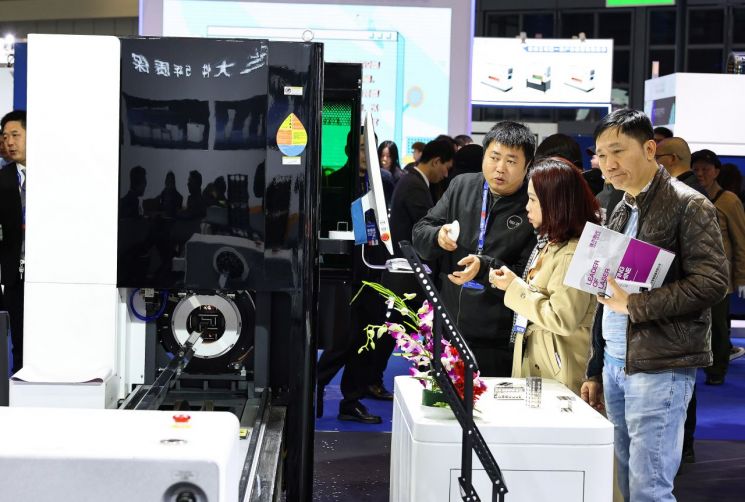 Amid a surge of global investment flowing into China following the rise of Chinese AI company DeepSeek, competition among Chinese AI companies to secure talent has intensified. On the 10th, the Chinese state media Global Times reported that at a recent job fair held in Shanghai, many companies gathered to recruit AI graduates, with some offering monthly salaries close to 10 million won to attract talent. Xinhua News Agency · Yonhap News Agency
China Central Television (CCTV) reported that job fairs focusing on AI-related positions were also held in other major cities such as Beijing, Hangzhou, and Shenzhen, in addition to Shanghai. CCTV also cited an executive from an online recruitment platform who said that demand for AI-related positions increased by 13% this year, and algorithm engineers, even with minimal experience, are receiving starting salaries of 35,000 yuan (approximately 7 million KRW) per month. Li Chang’an, a professor at the University of International Business and Economics in China, explained, "As demand for high-level technical talent surges, salaries are rising accordingly. Especially in China, AI-related talent is still scarce, so offering high wages is natural."
'Counterfeit, Cheap' Stigma Shed by China... Leaps to AI Powerhouse through Advanced Industry Investment
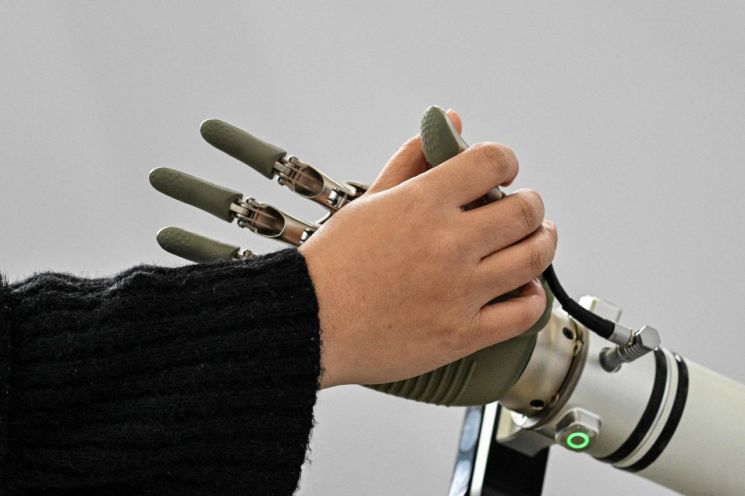 The new occupations introduced last year by China's Ministry of Human Resources and Social Security include many AI-related jobs such as generative AI application specialists, intelligent cloud network operation specialists, and intelligent manufacturing system maintenance specialists, indicating significant investment in advanced industries within China. Photo by AFP·Yonhap News
Among the new job categories introduced by China's Ministry of Human Resources and Social Security last year were many closely related to AI, such as generative AI application specialists, intelligent cloud network operation specialists, and intelligent manufacturing system maintenance specialists, indicating that investment in advanced industries is currently underway in China. The growth of China's AI-related industries is attributed to the R&D investments made since 2006 when China redrew its industrial map to focus on advanced technologies. At that time, China began its formal technology strategy through 16 major national science and technology projects, and from the 2010s, it focused on industrializing the technological development achievements accumulated so far under the banner of 'Made in China 2025.'
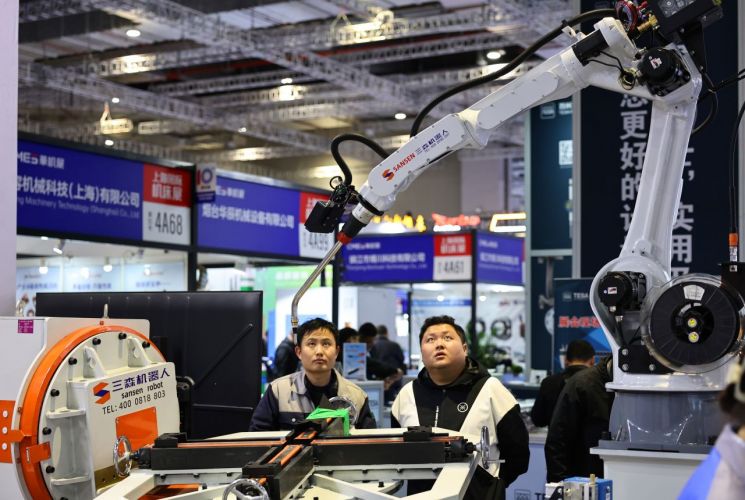 According to the National Bureau of Statistics of China, last year China's R&D investment reached $496.3 billion (approximately 716 trillion won), an 8.3% increase compared to the previous year. Despite challenging economic conditions such as domestic demand stagnation, R&D investment in advanced fields like AI, quantum computing, and biotechnology significantly increased. This amount is 4.6 times Korea's annual R&D investment of $107.5 billion. Among these, the stereotype that Chinese industries supply low-quality products at low prices is also changing. Xinhua News Agency · Yonhap News
According to the National Bureau of Statistics of China, last year China's R&D investment scale was recorded at $496.3 billion (approximately 716 trillion KRW), an 8.3% increase from the previous year. Despite difficult economic conditions such as domestic demand stagnation, R&D investment in advanced fields such as AI, quantum computing, and biotechnology increased significantly. This amount is 4.6 times the annual R&D investment of South Korea, which is $107.5 billion. Among this, the fixed stereotype that Chinese industries supply low-quality products at low prices is also changing.
Since 2014, China has established a government-led semiconductor industry development strategy and has been promoting localization and industrialization. Currently, China's NAND memory technology has caught up closely to South Korea, and some evaluations suggest that China has surpassed South Korea in high-density memory, AI semiconductors, power semiconductors, and next-generation sensing. In particular, China has made significant progress in semiconductor design. In the system semiconductor sector, there are about 3,500 semiconductor design (fabless) companies operating, which is more than 15 times the number in South Korea.
The number of papers by Chinese researchers accepted by the International Solid-State Circuits Conference also surpassed those of South Korea, Taiwan, and Japan, with 59 papers in 2023 compared to South Korea's 32, Taiwan's 23, and Japan's 10. Additionally, China is making concentrated investments in the AI field. According to data from the global market research firm AIPRM, if AI investments by countries continue at the 2023 level, by 2030, the technological gap with the United States will be 14 years for China and 183 years for South Korea.
© The Asia Business Daily(www.asiae.co.kr). All rights reserved.



















