Short-term Yields Fall on Expectations of Fed Rate Cuts
Wall Street Doubles Probability of Recession
Trump Does Not Rule Out Downturn... "Transition Period for Major Initiatives"
Concerns over a 'Trump recession (an economic downturn caused by the policies of U.S. President Donald Trump)' have grown, causing the yield on the 2-year U.S. Treasury note to fall back into the 3% range for the first time in four months. After the U.S. imposed a 25% tariff barrage on Canada and Mexico on the 4th and then granted a one-month reprieve, it has announced plans for item-specific tariffs and reciprocal tariffs, raising fears that this could lead to inflation and a recession. President Trump also did not completely rule out the possibility of a recession, spreading anxiety about the U.S. economy, which had maintained robust growth largely on its own.
According to the global bond market on the 9th (local time), the yield on the 2-year U.S. Treasury note recorded 3.99% on the 7th. It briefly dropped to the 3% range last October before rising to 4%, but then fell back to the 3% range again at the end of February, marking a downward trend in yields over four months.
The weakness in the 2-year U.S. Treasury yield, which is sensitive to monetary policy, is rooted in fears of a recession. President Trump's comprehensive tariff hikes have raised concerns that they will lead to rising prices, reduced consumption, decreased corporate investment, and layoffs. As recession fears intensified, expectations grew that the Federal Reserve (Fed) might resume cutting interest rates sooner, leading to a decline in the 2-year yield. According to the Chicago Mercantile Exchange (CME) FedWatch, the federal funds futures market raised the probability of the Fed cutting rates in the first half of the year from 52.5% a month ago to 82.1% as of this day. This marks a sharp reversal from last month, when tariff-induced inflation was expected to delay the Fed's resumption of monetary easing.
Jenaid Goldberg, Head of U.S. Interest Rate Strategy at TD Securities, said, "Just a few weeks ago, there was talk of the U.S. economy reaccelerating, but now the word 'R (Recession)' is being mentioned repeatedly," diagnosing that "market sentiment has shifted from enthusiasm about growth to complete despair."
Wall Street is raising the probability of a U.S. recession. JP Morgan recently estimated the chance of a U.S. recession at 31%, while Goldman Sachs put it at 23%. Previous estimates were 17% (November last year) and 14% (January this year), respectively, meaning the recession probability has doubled compared to late last year and early this year. The Atlanta Federal Reserve Bank's 'GDP Now,' which provides real-time forecasts of U.S. economic growth, projects a 2.4% quarter-on-quarter decline in growth for the first quarter of this year, indicating a possibility of negative growth. Investor anxiety over tariff policy uncertainty has spread, causing the New York stock market to plunge last week. The major indices, the S&P 500 and Nasdaq, fell by 3.1% and 3.45%, respectively.
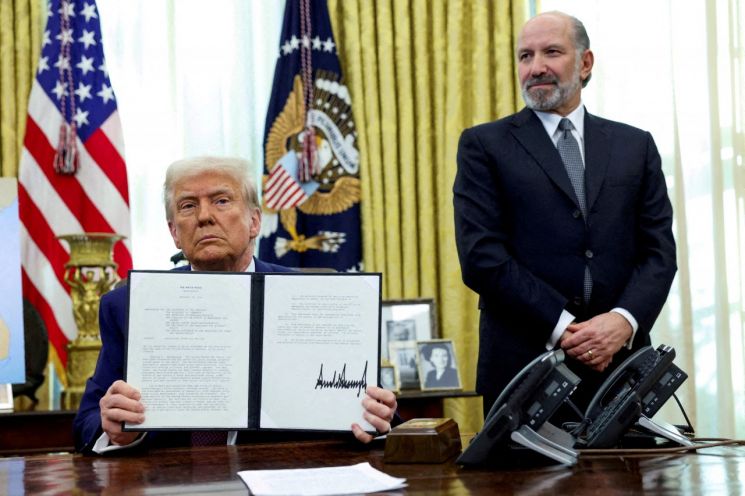
President Trump also made remarks on the day that seemed to not completely rule out the possibility of a recession. In an interview aired on Fox News, when asked about the possibility of a recession this year, he replied, "I don't want to predict that." He added, "We are doing something very big to bring wealth back to America, and there is a transition period in such efforts," suggesting that short-term economic disruption might occur. This contrasts with Commerce Secretary Wilbur Ross's comments to NBC News on the same day, where he said, "There will be no recession in the U.S.," attempting to calm market concerns.
President Trump reaffirmed his intention to impose reciprocal tariffs, stating, "On April 2, everything becomes reciprocal." Secretary Ross announced that starting from the 12th, a 25% tariff will be imposed on all steel and aluminum products entering the U.S. However, the 250% tariff on Canadian lumber and dairy products will not be enforced until April 2 for the time being.
© The Asia Business Daily(www.asiae.co.kr). All rights reserved.

















