An Era of Uncertainty Makes Securing Future Competitiveness Difficult
Major Industries Like Automobiles and Semiconductors Falter, Worsening the Impact
"Urgent Need for Government Policy Support Such as Deregulation"
As the Trump administration's protectionism intensifies, accelerating the restructuring of global supply chains, concerns are rising about crises in our key industries such as the automotive sector. Experts warn that if existing core industries collapse at a time when securing future competitiveness is crucial, small and medium-sized enterprises, regional economies, and ultimately the national economy will suffer significant damage.
On the afternoon of the 6th, Jeong Yeon-seung, Dean of the Graduate School of Business at Dankook University, analyzed at a seminar hosted by the Korea Economic Association at the FKI Tower Conference Center titled "Is There No Breakthrough for Korea's Core Industries in Crisis?" that "If core industries collapse, not only small and medium-sized enterprises but also regional economies will collapse one after another." He added, "Although the degree varies by industry, overall, they are showing a downtown (slump or recession) pattern."
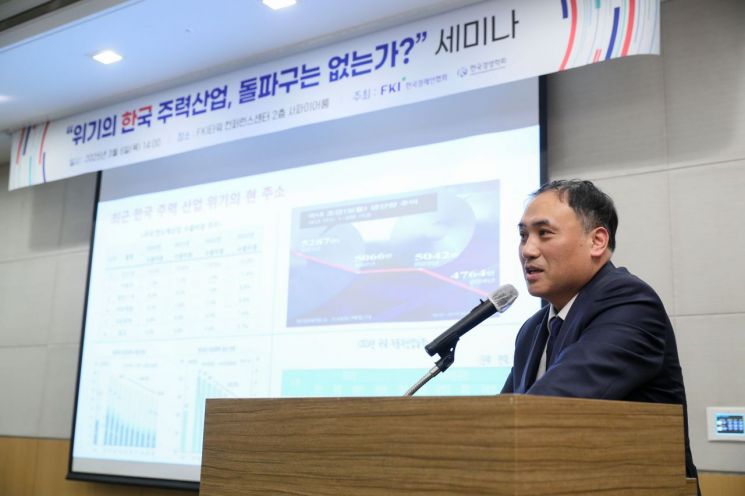 Jung Yeonseung, Dean of the Graduate School of Business at Dankook University, is giving a presentation at a seminar hosted by the Korea Economic Association on the theme "Is There No Breakthrough for Korea's Key Industries in Crisis?" at the FKI Tower Conference Center on the afternoon of the 6th. Photo by Korea Economic Association
The crisis factors presented by Dean Jeong for each industry are as follows. For the semiconductor industry, the issues identified were ▲ supply chain instability and supply-demand imbalance ▲ large-scale investment and research and development (R&D) burdens ▲ limitations in workforce and technological infrastructure. For the automotive industry, he cited ▲ sluggish domestic demand ▲ tariff increases by the United States ▲ slowdown in the transition to electric vehicles.
He emphasized, "For semiconductors, strengthening advanced technology competitiveness, and for automobiles, closely responding to changes in the trade environment to stimulate demand are key tasks," adding, "While companies strive for technological innovation and cost efficiency, the government must work on stabilizing global supply chains and improving regulations to ease the burden on businesses."
Um Su-hyung, partner at McKinsey & Company, advised that our companies should discover 'growth opportunities' amid the crisis. Despite increasing uncertainties in various areas with the launch of Trump's second term, he said that if the core industries successfully rebound and new growth engines are discovered, a third growth curve (S-curve) can be drawn.
Partner Um stated, "In times of uncertainty, strengthening basic capabilities and enhancing resilience are essential," and "Achieving sustainable financial performance requires operational innovation." He explained that this involves assessing maximum potential and setting clear goals accordingly.
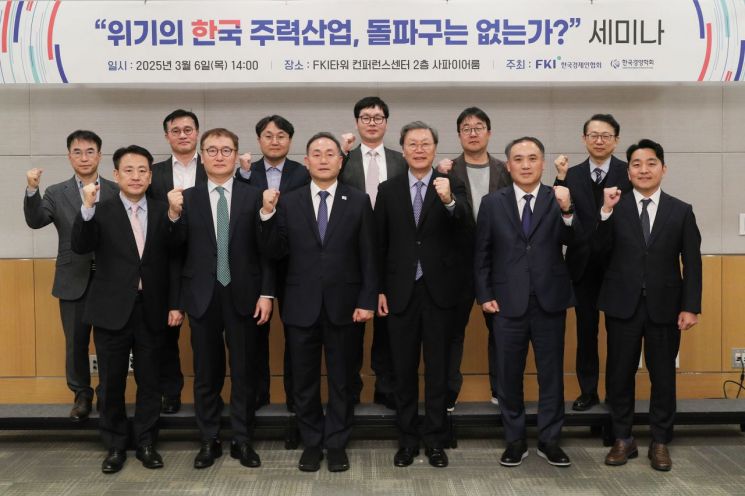 On the afternoon of the 6th, attendees are taking a commemorative photo at a seminar hosted by the Korea Economic Association at the FKI Tower Conference Center, themed "Is There a Breakthrough for Korea's Key Industries in Crisis?" From the front row, second from the left: Kim Won-i, member of the Democratic Party of Korea; Kim Chang-beom, Vice Chairman of the Korea Economic Association; Yang Hee-dong, President of the Korean Academic Society of Business Administration; and Jeong Yeon-seung, Dean of the Graduate School of Business at Dankook University. Provided by the Korea Economic Association
A discussion among industry experts representing core industry groups followed. The session was chaired by Professor Lee Seong-ho of the University of Seoul, with participants including Kim Ju-hong, Executive Director of the Korea Automobile Mobility Industry Association; Jeon Jae-min, Head of Industry Support at the Korea Semiconductor Industry Association; Hong Jeong-ui, Head of Industry Support at the Korea Iron & Steel Association; Choi Hong-jun, Head of External Cooperation at the Korea Chemical Industry Association; Jo Jae-han, Director of Industrial Policy Planning at the Korea Institute for Industrial Economics & Trade; and Lee Tae-gyu, Head of the Global Risk Team at the Korea Economic Research Institute.
Jeon Jae-min, Head of Industry Support at the Korea Semiconductor Industry Association, presented next-generation technology development and talent cultivation as core tasks. He suggested, "To maintain Korea's status as a semiconductor powerhouse, it is important to activate the semiconductor ecosystem and foster cooperation between upstream and downstream industries," adding, "Above all, developing next-generation technologies and nurturing talent to enhance global competitiveness is the most urgent task."
Kim Ju-hong, Executive Director of the Korea Automobile Mobility Industry Association, called for government policy support to revitalize the electric vehicle industry. Kim said, "To stabilize electric vehicle demand, incentives that consumers can feel, such as expanding subsidies and allowing dedicated highway lanes, should be provided for about the next three years," and added, "To address concerns about declining domestic production, drastic policies such as a 'domestic production promotion tax system' must be introduced."
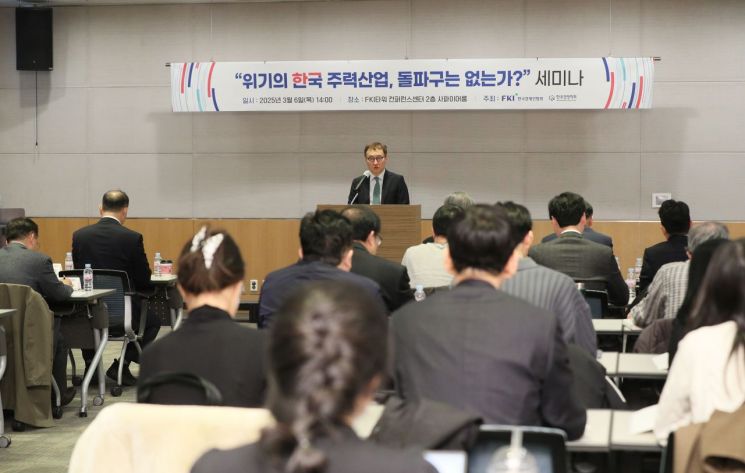 Yang Hee-dong, President of the Korean Academic Society of Business Administration, is delivering a greeting at a seminar hosted by the Korea Economic Association on the afternoon of the 6th at the FKI Tower Conference Center, with the theme "Is There No Breakthrough for Korea's Key Industries in Crisis?" Photo by Korea Economic Association
Trade experts urged the government to improve the regulatory environment and secure institutional competitiveness so that companies can maintain and develop the manufacturing ecosystem.
Jo Jae-han, Director of Industrial Policy Planning at the Korea Institute for Industrial Economics & Trade, said, "Major countries are actively implementing industrial policies to take the lead in advanced industries," and added, "Our country urgently needs to pursue comprehensive and bold support and improve the domestic regulatory environment to attract investments from global companies leading advanced industries."
Lee Tae-gyu, Head of the Global Risk Team at the Korea Economic Research Institute, stated, "Institutional competitiveness supporting manufacturing has not been improved over a long period across all areas such as taxation and the labor market," and said, "In a situation where we are at a disadvantage compared to overseas competitors, it is necessary to secure competitiveness so that companies can operate large-scale manufacturing."
Meanwhile, Kim Won-i, a member of the Democratic Party and opposition whip of the National Assembly's Industry, Trade, Energy, Small and Medium Enterprises Committee, also attended the seminar. Kim said, "Just as the Stone Age did not end because of a lack of stones, Korea's industry now needs 'multi' measures," and added, "Since advanced future industries such as semiconductors and secondary batteries require enormous power, we will focus on preparing for the era of energy transition."
© The Asia Business Daily(www.asiae.co.kr). All rights reserved.



















