Average Annual Increase of 2.7 Trillion Won Over the Past 3 Years
Domestic Sales Fell 7.3% Last Year
Tariff Uncertainties with the U.S. Growing
Large-Scale Investment Plan Expected This Month
Hyundai Motor's inventory assets, which recorded the highest-ever performance last year, are approaching 20 trillion won. This is the result of an average increase of 2.7 trillion won in inventory over the past three years. Although sales increased, it means that the planned production volume was not met. To make matters worse, the erratic moves by U.S. President Donald Trump have increased tariff uncertainties, potentially worsening exports to the U.S., raising warning signs for inventory management.
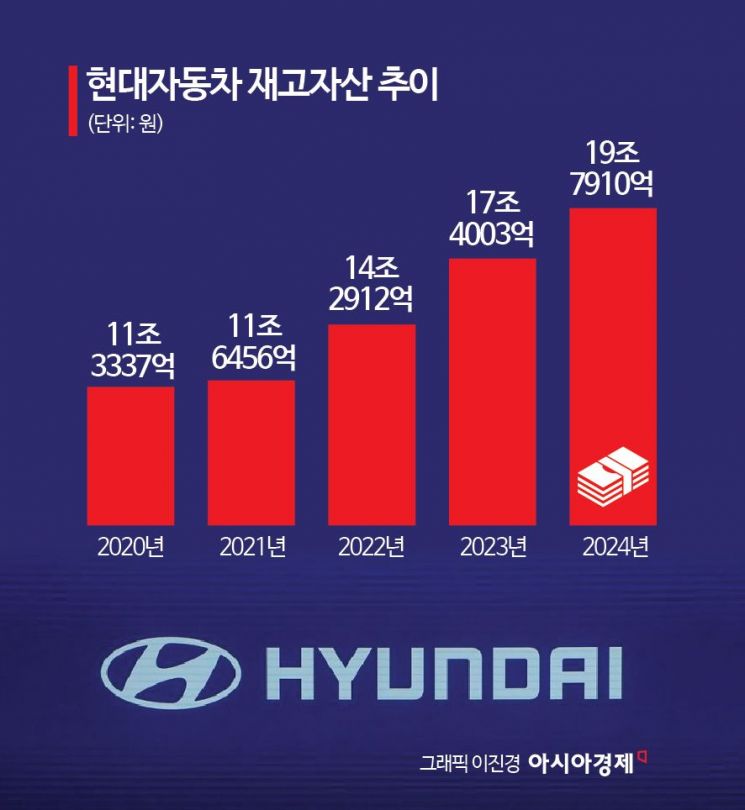
According to the industry on the 7th, Hyundai Motor's consolidated inventory assets reached 19.791 trillion won at the end of last year. This is an increase of 2.3907 trillion won compared to 17.4003 trillion won in 2023, representing a growth rate of 13.7%. Inventory has surged sharply since the end of the COVID-19 pandemic. Inventory assets, which were in the 11 trillion won range in 2020 and 2021, jumped to 14 trillion won in 2022 and have continued to increase steadily since then. Last year, 'product' inventory, including finished vehicles, increased by more than 800 billion won. Automobile factories produce cars according to predetermined production plans, and if they are not sold in the market, they remain as inventory.
The biggest reason for the sharp increase in Hyundai Motor's inventory is sluggish domestic demand. Last year, Hyundai Motor's finished vehicle sales totaled 4,141,791 units, a 1.8% decrease compared to the previous year (4,216,898 units). In particular, sales in the domestic market fell by 7.5%. As the economy contracted, sales of key models in the domestic market plummeted.
The 'cash cow' Grandeur, which sold over 110,000 units in 2023, dropped to 70,000 units, and the Palisade, which sold around 40,000 units, saw sales fall to 20,000 units due to overlapping waiting demand for the completely redesigned new model. As a result, older models remained as inventory. As Hyundai Motor's inventory volume surged, the delivery centers became saturated, causing delivery disruptions for some models.
Slower-than-expected electric vehicle sales are also believed to have contributed to the increase in inventory. Due to the chasm effect (temporary demand stagnation), Hyundai Motor suspended operations and took a week-long shutdown of Line 12 (producing Ioniq 5 and Kona EV) at Ulsan Plant 1 during the last week of last month.
Due to sluggish sales, Hyundai Motor has lowered its sales targets (guidance) for three consecutive years. Hyundai Motor set a guidance of 4,323,000 units in 2022, but actual sales were 3,944,579 units, achieving only 91.2%. The following year, a record high of 4,216,680 units was sold, achieving 97.6% of the guidance (4,321,000 units). However, the guidance was lowered consecutively to 4,243,000 units in 2024 and 4,174,000 units this year.
Kim Sung-rae, a researcher at Hanwha Investment & Securities, said, "The global uncertainties that have continued since the second half of last year are expected to affect finished vehicle demand through this year," and evaluated that Hyundai Motor's quantitative growth plans are conservative.
However, the early confirmation of electric vehicle subsidies this year has led to a rebound in electric vehicle sales, which is somewhat positive. Last month, Hyundai Motor sold 5,346 electric vehicles, more than seven times the 667 units sold in February last year. Kia also increased its electric vehicle sales from 1,273 units to 4,666 units.
With sluggish domestic demand and tariff uncertainties from the U.S. government overlapping, Hyundai Motor is in a situation where it must seek new opportunities through large-scale overseas investments rather than domestically. The industry expects that a large-scale local investment plan will be announced at the completion ceremony of the U.S. Georgia production plant, 'Hyundai Motor Group Meta Plant America (HMGMA),' scheduled for the end of this month.
© The Asia Business Daily(www.asiae.co.kr). All rights reserved.













