Operational Deployment Scheduled for First Half of Next Year After About One Year of Integration
Up to Four Hours of Flight... Capable of Long-Range Detection and Attack
The maritime operational helicopter capable of detecting and attacking North Korean submarines and surface ships from long distances, the MH-60R (Seahawk), has made its first flight in South Korea.
On the 6th, the Navy announced that the MH-60R conducted its first flight with the 62nd Maritime Air Squadron under the Naval Aviation Command at the Navy's 2nd Fleet. The MH-60R was contracted for purchase in 2020 through the U.S. government's Foreign Military Sales (FMS) program for a total of 12 units, which are currently being produced sequentially. The aircraft introduced this time was received in the U.S. last December and transported by sea to Pyeongtaek Port on the 25th of last month.
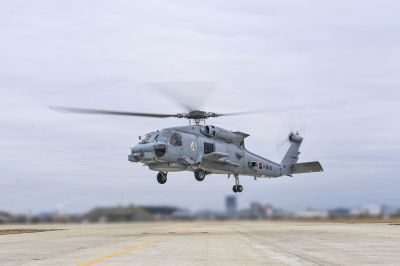
Introduced in conjunction with the Navy’s warship construction projects, the MH-60R operates at sea performing missions such as anti-submarine warfare, anti-surface warfare, surveillance and reconnaissance, and search and rescue. When equipped with auxiliary fuel tanks, it can fly for more than 4 hours.
The MH-60R is equipped with high-performance surveillance and reconnaissance equipment such as maritime radar, digital electro-optical (EO)/infrared (IR) devices, and electronic warfare equipment (ESM). It also carries a variable depth sonar (dipping sonar) and acoustic detection buoys (sonobuoys) that can detect, identify, and track submarine signals, enabling it to conduct anti-submarine operations over wide maritime areas.
Its armament includes Hellfire anti-ship guided missiles capable of precision strikes on maritime targets such as North Korean air-cushioned landing crafts and surface ships, as well as Mk-54 lightweight torpedoes for underwater submarine attacks. The system integration is underway to operate the domestically produced lightweight torpedo, Cheongsang-eo, alongside the Mk-54. Additionally, it can be equipped with and operate 12.7mm and 7.62mm machine guns capable of suppressing small targets.
Through the introduction of the MH-60R, the Navy has enhanced its aviation anti-submarine warfare capabilities to counter North Korea’s submarine threats, as well as improved long-range surveillance, reconnaissance, and rapid response capabilities in operational areas, enabling more advanced maritime air operations. Starting with this initial domestic introduction, the MH-60R will be sequentially introduced in line with the production schedule, and after about a year of operational integration, it is expected to be deployed for operations from the first half of next year.
Rear Admiral Ha Seong-wook, Commander of the Naval Aviation Command, stated, “The MH-60R will become the new wings of the Republic of Korea Navy and, together with the currently operational P-8A Poseidon, will stand at the forefront of naval aviation as a core force for a ‘Strong Navy and Maritime Power.’”
Meanwhile, Kang Jung-hee, Director of the Aviation Business Division at the Defense Acquisition Program Administration and an Air Force Brigadier General who oversaw this maritime operational helicopter project, said, “We expect the introduction of the MH-60R to significantly strengthen the Navy’s anti-submarine warfare capabilities and maritime operational capacity. Although there were various challenges and difficulties during the project, I am grateful to the Navy and related agencies for their cooperation in successfully completing it.”
© The Asia Business Daily(www.asiae.co.kr). All rights reserved.












