Governor Kim Yungrok Attends National Assembly Forum on Energy Basic Income
Proposes Alternatives for Low Birthrate, Local Extinction, and Balanced Development
Emphasizes the Need for Cooperation with Central Government and National Assembly
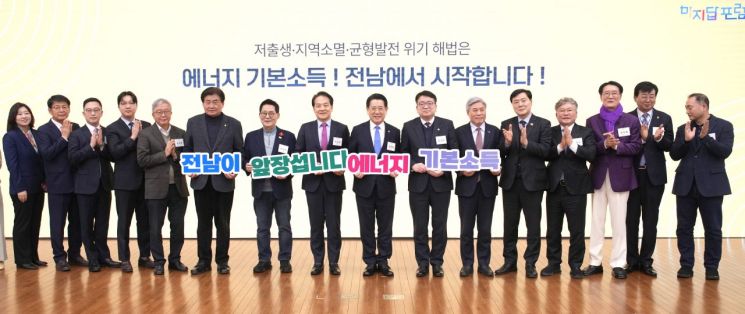 Jeollanam-do Governor Kim Youngrok is performing with key domestic and foreign guests and participants for the transition to renewable energy and the promotion of the introduction of energy basic income at the "Energy Basic Income, National Assembly Forum" held at the National Assembly Library on the afternoon of the 5th. Provided by Jeonnam Province
The energy basic income distribution policy currently being promoted in Jeonnam is being highlighted as an alternative to slow down local extinction caused by population decline.
On the 5th, Jeonnam Province held a National Assembly forum on energy basic income under the theme "Energy Basic Income Starts in Jeonnam" at the main auditorium of the National Assembly Library.
The forum was attended by about 350 participants, including National Assembly members from the Jeonnam and Gwangju regions, members of the Trade, Industry, Energy, SMEs and Startups Committee, members of the Basic Income Research Forum, the Vice Minister of the Ministry of Trade, Industry and Energy, heads of 22 cities and counties in Jeonnam, and representatives of energy companies. The event proceeded with an opening ceremony, followed by a keynote lecture, thematic presentations, and expert panel discussions.
In the keynote lecture on "Energy Transition and Shared Wealth Basic Income," Kang Namhoon, Chairman of the Basic Society Association, raised the necessity of introducing solar and wind pensions through renewable energy and expanding them nationwide in Korea.
During the thematic presentations, Lim Jaemin, Secretary General of the Energy Transition Forum, presented "Differentiated Strategies and Growth Plans for Energy Transition in Jeonnam Province," and Kang Sanggu, Director of the Energy Industry Bureau of Jeonnam Province, emphasized the necessity of energy basic income as a solution for overcoming local extinction and achieving balanced development in his presentation "Why Energy Basic Income?"
In the subsequent panel discussion, Nam Myungwoo, Director of Renewable Energy Policy at the Ministry of Trade, Industry and Energy, Lee Soonhyung, Professor at Dongshin University, Ji Hyunyoung, Deputy Director of the Green Transition Research Institute, and Yoon Taehwan, CEO of Root Energy, participated to present strategies for activating energy basic income and institutional improvements in various sectors.
During the event, Jeonnam Province and its 22 cities and counties also announced a "Joint Resolution for the Realization of Energy Basic Income," aiming to share the profits from renewable energy generation using Jeonnam's abundant solar and wind resources with all residents. This expressed their commitment for the central government and National Assembly to cooperate in fostering the renewable energy industry and making Jeonnam a leader in realizing energy basic income.
Energy basic income refers to sharing the profits generated from renewable energy sources such as solar and wind power with the residents. Jeonnam Province plans to usher in the "era of 1 trillion won in energy basic income" based on the 21.8GW of generation capacity approved by 2030.
Kim Yungrok, Governor of Jeonnam Province, said, "The era of the artificial intelligence (AI) revolution will bring many benefits to humanity, but at the same time, various jobs will disappear, and income inequality is expected to worsen." He emphasized, "As an alternative, it is more necessary than ever to realize energy basic income using Jeonnam's abundant sunlight and wind resources as one pillar of basic income." He added, "Renewable energy generation will also greatly contribute to balanced national development."
Meanwhile, on the 27th of last month, the "Special Act on Promotion of Offshore Wind Power Deployment and Industrial Development" and the "Special Act on Expansion of National Power Grid" were passed at the National Assembly plenary session to foster high-tech industries. With these groundbreaking systems in place for expanding renewable energy in Jeonnam, the creation of a 30GW offshore wind power complex by 2035 is expected to gain further momentum.
© The Asia Business Daily(www.asiae.co.kr). All rights reserved.
![User Who Sold Erroneously Deposited Bitcoins to Repay Debt and Fund Entertainment... What Did the Supreme Court Decide in 2021? [Legal Issue Check]](https://cwcontent.asiae.co.kr/asiaresize/183/2026020910431234020_1770601391.png)















