"Ocelot Expected to Accelerate Quantum Computer Development by Five Years"
The world's largest e-commerce company, Amazon, has unveiled its self-developed quantum computing chip, intensifying the competition among big tech companies in developing quantum chips.
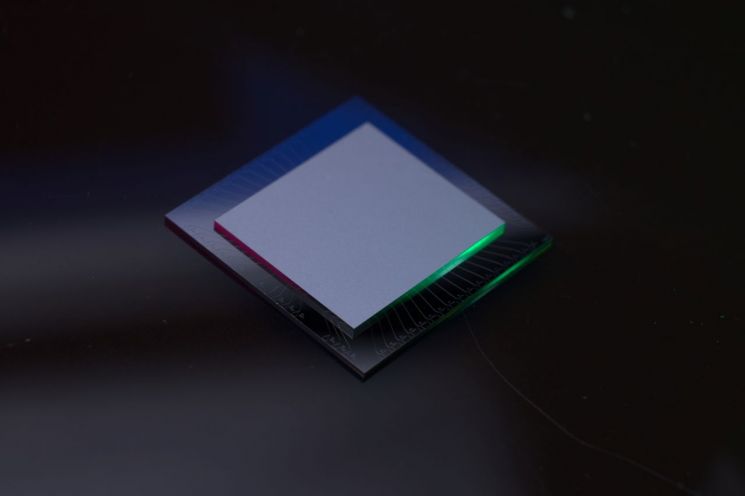
On the 27th (local time), Amazon introduced its first quantum computing chip named 'Ocelot,' calling it "a significant step toward the development of practical quantum computers."
Amazon, the leading cloud service provider, made this announcement amid cloud competitors Google and Microsoft (MS) having previously unveiled their own quantum computing chips. Google announced its quantum chip 'Willow' in December last year, and MS revealed 'Majorana 1' on the 19th, which uses a 'topological superconductor' that maintains its essence even when its shape changes.
Named after the oscillator, a device that produces electrical vibrations, Amazon's Ocelot was developed by a research team led by Professor Oscar Painter of the California Institute of Technology.
Unlike classical computers that process information in bits of 0 or 1, quantum computers use qubits that exploit superposition states where 0 and 1 coexist simultaneously. They also utilize quantum entanglement, a property where multiple qubits influence each other during computation. This enables quantum computers to perform many calculations faster than conventional computers.
One Ocelot chip consists of five qubits that store data, circuits that stabilize them, and four additional qubits that detect errors.
Amazon's Ocelot is based on 'cat qubits,' named after the 'Schr?dinger's cat' experiment, which assumes a cat can be in two states simultaneously. This experiment explains that until the box is opened to check whether the cat is alive, it exists in a superposition of being both dead and alive.
Professor Painter predicted, "In the future, quantum chips made with the Ocelot architecture will significantly reduce the energy required for error correction to about one-fifth. This will accelerate the development of practical quantum computers by up to five years."
© The Asia Business Daily(www.asiae.co.kr). All rights reserved.

















