"The Largest and Most Powerful Conversational Model Yet"
Improved Response Accuracy and Reduced Hallucinations Compared to Previous Models
Enhanced Ability to Empathize with Users

OpenAI, the operator of the generative artificial intelligence (AI) service ChatGPT, has unveiled its latest AI model, GPT-4.5. It features enhanced conversational capabilities, improved answer accuracy, and even empathy skills.
On the 27th (local time), OpenAI announced on its official website that GPT-4.5 would be released as a "research preview." A research preview is a stage where the model is selectively released to a limited number of users for testing and feedback collection.

GPT-4.5 is the successor to GPT-4o, which was released in May last year, and is OpenAI's final non-reasoning model. OpenAI is currently developing and servicing separate reasoning models in the o1 and o3 series.
Sam Altman, CEO of OpenAI, hinted in a post on X (formerly Twitter) in mid-June that "the GPT-4.5 model will be the last non-chain-of-thought model we develop." Chain-of-thought refers to intermediate reasoning steps AI takes to arrive at an answer. Being a non-chain-of-thought model means GPT-4.5 does not perform reasoning.
OpenAI emphasized that GPT-4.5 is "the largest and most powerful conversational model to date," highlighting its improved ability to recognize patterns, find associations, and generate creative insights without logical reasoning. Additionally, it has expanded knowledge coverage and enhanced its ability to understand user intent and emotional intelligence (EQ), enabling more natural, human-like conversations.
OpenAI stated that GPT-4.5 will be useful for practical problem-solving tasks such as editing text or writing programming code. It is expected to reduce hallucination phenomena. Hallucination refers to errors where generative AI produces factually incorrect or contextually irrelevant information.
GPT-4.5 supports uploading files and images and allows writing and coding tasks using a canvas. However, it does not support multimodal features such as voice mode, video, or screen sharing. Multimodal refers to AI models that learn and process relationships by considering various types of data (modalities) like images, audio, and video together.
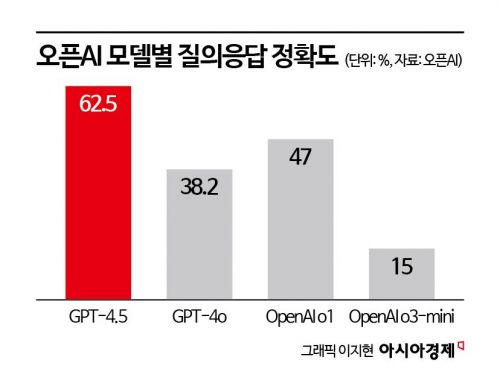
GPT-4.5 has demonstrated performance surpassing not only previous models but also some reasoning models. In an internal OpenAI test measuring answer accuracy to simple questions, GPT-4.5 achieved 62.5% accuracy. This is higher than the previous model GPT-4o (38.6%) as well as the reasoning models o1 (47%) and o3-mini (15%).
It also lowered the hallucination rate. GPT-4.5 recorded a hallucination rate of 37.1%, lower than GPT-4o (59.8%) and o3-mini (80.3%). The lower the hallucination rate, the more accurate the AI model's answers. In AI model benchmark tests, GPT-4.5 outperformed GPT-4o in all four categories, including math and science. Compared to o3-mini, it led in language and multimodal areas but lagged slightly in science and math.
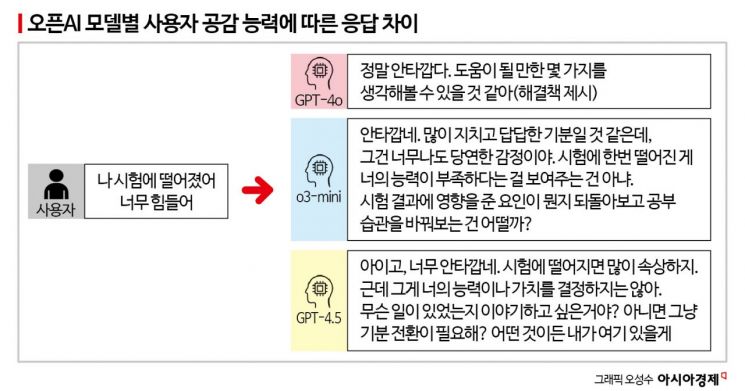
Another distinguishing feature from previous models is its enhanced EQ, improving its ability to empathize with users' emotions. According to an example provided by OpenAI, when a user inputs "I'm having a hard time after failing an exam," GPT-4o responds, "That's really unfortunate. Maybe I can think of some things that might help," offering solutions. In contrast, GPT-4.5 replies, "Oh no, that's so unfortunate. Failing an exam can be really upsetting. But that doesn't define your ability or worth. Do you want to talk about what happened? Or do you just need a distraction? Whatever it is, I'm here for you."
GPT-4.5 is initially available through the ChatGPT Pro plan, which costs $200 per month. OpenAI stated, "(GPT-4.5) currently requires significant computing resources and is costly," adding, "We are actively working to bring its unique strengths?broader knowledge, stronger intuition, and greater EQ?to all users of future models."
OpenAI plans to release a successor, GPT-5, later this year. GPT-5 will be offered as a unified model integrating both non-reasoning and reasoning capabilities. CEO Altman said, "(GPT-5) will be a system integrating various technologies, including o3," and added, "Going forward, 'o3' will no longer be offered as a standalone model."
© The Asia Business Daily(www.asiae.co.kr). All rights reserved.














