Purchasing About 160 Tons of Acacia Honey Annually
Honey Used in the Production of Kkulkkwabegi Snack
Nongshim held a fund transfer ceremony on the 27th with the Korea Beekeeping Cooperative to support the revitalization of domestic beekeeping farms. This ceremony follows the 'Together in Beekeeping' business agreement signed in 2022 between Nongshim, the National Institute of Agricultural Sciences, and the Korea Beekeeping Cooperative. It is a social contribution project that Nongshim has been conducting for three years to ensure stable farming activities for beekeeping farms and the development of related industries.
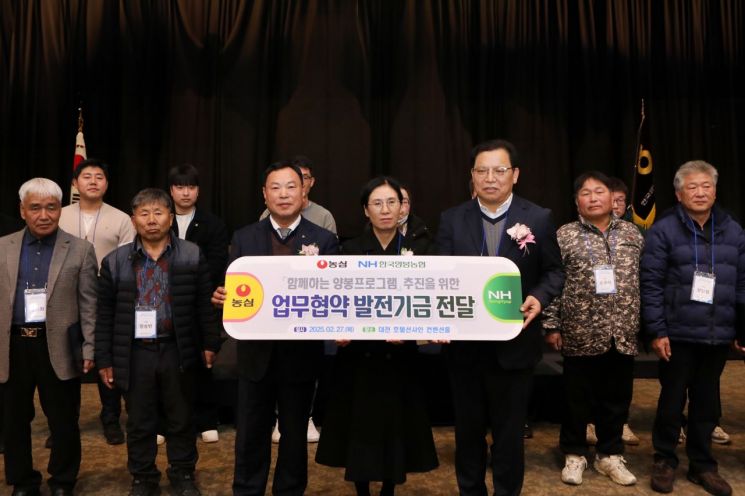 On the 27th, a grant presentation ceremony supported by Nongshim and the Korea Beekeeping Agricultural Cooperative was held at the Sunshine Hotel in Daejeon. In the front row from the left: Kim Yong-rae, Chairman of the Korea Beekeeping Agricultural Cooperative; Han Sang-mi, Director of the Agricultural Biology Division at the Rural Development Administration; Kim Bo-gyu, Director of Management Planning at Nongshim.
 [Photo by Nongshim]
The funds provided by Nongshim on this day will be used to support smart beekeeping equipment and bee disease diagnostic kits, plant nectar source trees for beekeeping, and mentoring activities to help young beekeepers settle early.
In particular, Nongshim plans to enhance understanding of the overall beekeeping industry by conducting a production site tour program of the snack 'Kkulkkwabegi,' which uses domestically produced acacia honey, targeting young beekeepers this year.
Meanwhile, Nongshim uses acacia honey purchased from the Korea Beekeeping Cooperative in the production of Kkulkkwabegi. One bag (90g) of Kkulkkwabegi contains about 3g of acacia honey. Nongshim purchases approximately 160 tons of honey annually for use in Kkulkkwabegi production.
© The Asia Business Daily(www.asiae.co.kr). All rights reserved.

















