"Drug Inflow Still at Unacceptable Levels"
Reciprocal Tariffs Confirmed for April 2 Implementation
U.S. President Donald Trump announced that starting March 4, an additional 10% tariff will be imposed on all imports from China. In addition to the 10% tariff increase that took effect earlier this month, he plans to raise it by another 10%, imposing a total of 20% additional tariffs just a month and a half into his second term. He also stated that the scheduled 25% tariff measures on Mexico and Canada will be implemented as planned on the same day.
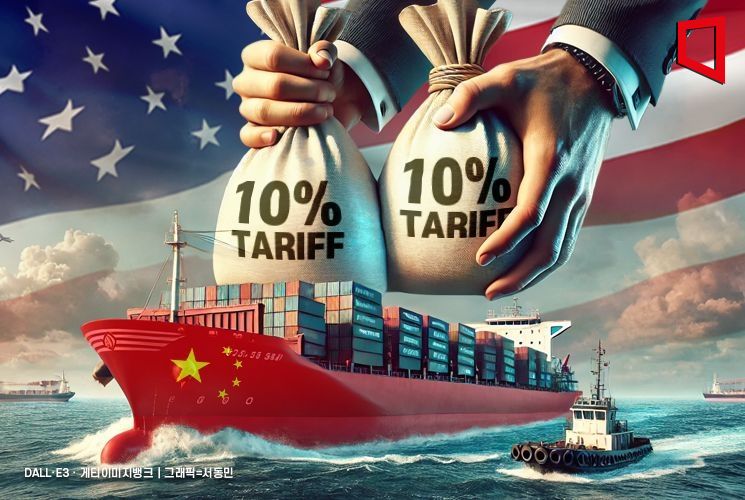
President Trump said on the 27th (local time) on his self-created social networking service (SNS) Truth Social that "the tariffs scheduled to take effect on March 4 for Mexico and Canada will indeed be implemented as planned," adding, "China will likewise face an additional 10% tariff on that day."
He raised concerns about the inadequate crackdown on the opioid fentanyl. President Trump explained, "Drugs are still pouring into our country from Mexico and Canada at very high and unacceptable levels," and "Much of these drugs are manufactured and supplied from China in the form of fentanyl." He continued, "More than 100,000 people died last year due to the distribution of these dangerous and highly addictive toxic substances, and millions have died over the past 20 years," adding, "We cannot allow this disaster to continue harming the United States."
Regarding the reciprocal tariff measures scheduled to take effect on April 2, he stated, "The date remains valid," indicating that the measures will be implemented as planned.
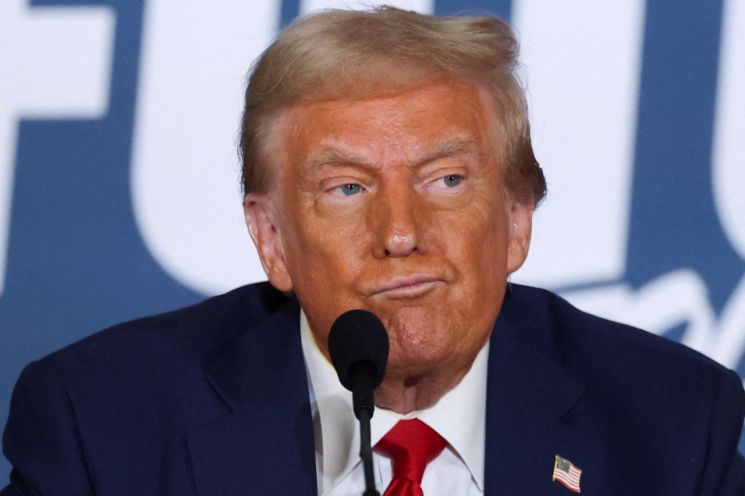
Earlier, President Trump announced on February 4 that he would impose a 25% tariff on Mexico and Canada and an additional 10% tariff on China due to issues with fentanyl and illegal immigration. After Mexico and Canada promised to strengthen border enforcement, the tariff implementation on these two countries was postponed for one month. The tariff measures on China were implemented as scheduled, and now he has expressed his intention to raise the additional tariff by another 10%, totaling 20%.
A Trump administration official said the White House has "not seen the desired progress" regarding fentanyl enforcement. The efforts by Mexico and Canada to crack down on fentanyl are insufficient, and China has not shown a strong willingness to enforce measures. The Wall Street Journal (WSJ) reported, "Beijing has not made any proposals that would demonstrate a strong commitment to reducing the export of chemicals necessary for fentanyl production," and "this is why direct talks between President Trump and Chinese President Xi Jinping have not yet taken place." President Trump said on the 3rd, the day before imposing additional tariffs on China, that he would speak with President Xi within 24 hours, but no communication between the U.S. and Chinese leaders has occurred yet.
China immediately protested the measures. Wang Wentao, China's Minister of Commerce, sent a letter to Jamie Goree, U.S. Trade Representative (USTR), opposing the new tariffs.
Meanwhile, President Trump's inconsistent statements on tariffs have caused confusion. The day before, he said the tariff measures on Mexico and Canada would be implemented on April 2, suggesting a possible one-month extension. Some interpret this as a calculated move by President Trump to conceal his true intentions and pressure the other parties into active cooperation.
By pre-announcing the 'tariff bomb' plan, there remains a possibility that negotiations could be concluded before the tariffs take effect. Especially for Mexico and Canada, where a 25% tariff on exports to the U.S. is expected to cause severe economic damage such as recession, both countries are likely to strive to reach an agreement with the U.S. to prevent tariff imposition.
Concerns about inflation due to tariff increases are also growing within the U.S. According to a poll conducted by Bloomberg News and Harris Poll from March 6 to 8 surveying 2,121 Americans, 59% of respondents said that President Trump's new tariffs would push prices up. Sixteen percent answered "don't know," 15% said "no impact," and only 11% believed "prices would actually decrease." The U.S. think tank Peterson Institute for International Economics (PIIE) predicted that President Trump's tariff measures on China, Mexico, and Canada would result in an additional annual expenditure of $1,200 (approximately 1.74 million KRW) per American household.
Bloomberg News reported, "Unless there is a last-minute exemption, tariffs on imports worth over $1 trillion (approximately 1,450 trillion KRW) will increase on March 4," adding, "Trump's brinkmanship is pushing North America back into a trade war crisis, which could hinder U.S. growth, worsen inflation, and trigger recessions in Mexico and Canada."
© The Asia Business Daily(www.asiae.co.kr). All rights reserved.
![Clutching a Stolen Dior Bag, Saying "I Hate Being Poor but Real"... The Grotesque Con of a "Human Knockoff" [Slate]](https://cwcontent.asiae.co.kr/asiaresize/183/2026021902243444107_1771435474.jpg)

















