Only 2 Years and 7 Months Since the First Procedure in June 2022
"Advanced Medical Technology Will Contribute to Improving Patients' Quality of Life"
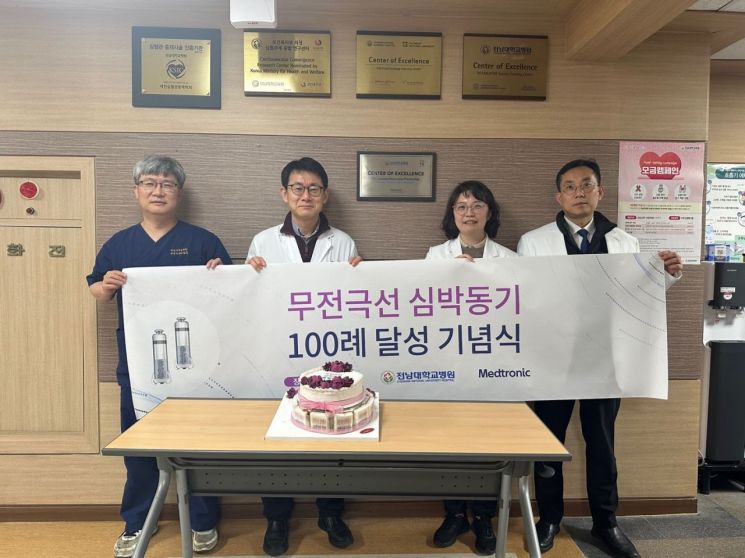 The Arrhythmia Team in the Department of Cardiology at Chonnam National University Hospital has recorded 100 cases of wireless leadless pacemaker implantation, the first among regional university hospitals. (From left) Professors NamSik Yoon, HyungWook Park, YuRi Kim, and KiHong Lee. Provided by Chonnam National University Hospital.
Chonnam National University Hospital (Director: Jung Shin) announced on the 27th that it has become the first local university hospital to achieve 100 cases of leadless pacemaker implantation, an implantable cardiac pacemaker.
The arrhythmia team of the Department of Cardiology at Chonnam National University Hospital (Professors Kim Yuri, Lee Gihong, Yoon Namsik, and Park Hyunguk) achieved 100 cases in just 2 years and 7 months since the first procedure in June 2022. This is the fifth highest record following Asan Medical Center in Seoul, Sinchon Severance Hospital, Bundang Seoul National University Hospital, and Samsung Medical Center in Seoul.
A pacemaker is a device that helps the heart beat normally in patients with bradyarrhythmia, a condition in which the heart cannot properly generate or transmit electrical impulses. There are two types of pacemakers: those with leads and leadless pacemakers.
In the case of pacemakers with leads, the leads are inserted into the heart through the veins of the shoulder, and the pacemaker body (battery) is implanted in the chest wall near the shoulder, under the clavicle.
The energy generated from the pacemaker body is delivered to the heart through the leads. The leadless pacemaker, which is an advanced type of pacemaker, is a small, integrated device about the size of a 100-won coin (2.6 cm long). It is inserted into the right ventricle of the heart through the femoral vein and helps maintain a stable heartbeat for the patient.
The leadless pacemaker can be implanted directly into the right ventricle via a catheter through the femoral vein, without the need for thoracic incision. Since the battery is not implanted in the clavicle area, it offers the advantage of not being visible externally. As no leads are required, it does not interfere with shoulder movement and significantly reduces the risk of complications such as infection.
Professor Kim Yuri of the Department of Cardiology said, "It is a very meaningful achievement that Chonnam National University Hospital has become the first local university hospital to reach 100 cases of leadless pacemaker implantation," and added, "This will greatly contribute to the spread of advanced medical technology in the region and to improving the quality of life for patients."
© The Asia Business Daily(www.asiae.co.kr). All rights reserved.