National Assembly Speaker Hints at Postponing Submission of Commercial Act Amendment Bill to Plenary Session
Myeong Taegyun Special Prosecutor Act to Be Submitted as Scheduled
Opposition Moves to Unilaterally Pass Semiconductor Special Act
'52-Hour Workweek Exception' Expected to Be Excluded
The submission of the 'Commercial Act Amendment Bill,' which aims to expand the fiduciary duties of directors to shareholders, to the National Assembly plenary session has been postponed. The Semiconductor Special Act, designated as a fast-track (rapid processing agenda), is expected to continue to be discussed in the National Assembly for the time being. Although there was speculation about the opposition party unilaterally passing the Commercial Act and Semiconductor Special Act, which were contentious issues between the ruling and opposition parties, it appears that the pace is being adjusted.
On the 27th, National Assembly Speaker Woo Won-shik hinted at postponing the submission of the Commercial Act Amendment Bill to the plenary session. This is reported to be in consideration of the ruling party-opposition-government policy consultation scheduled for the 28th. On the 27th, Jin Sung-jun, the Policy Committee Chair of the Democratic Party of Korea, said at a policy coordination meeting held at the National Assembly, "The Speaker of the National Assembly has expressed the position that he will not submit the Commercial Act Amendment Bill to today's plenary session."
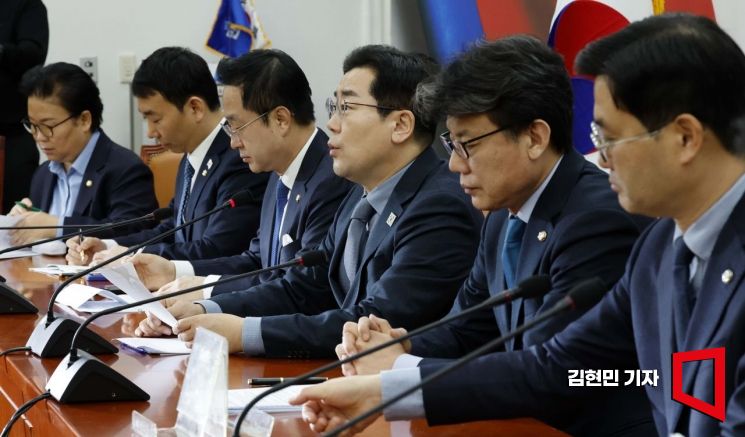 Park Chan-dae, floor leader of the Democratic Party of Korea, is speaking at the policy coordination meeting held at the National Assembly on the 27th. 2025.2.27 Photo by Kim Hyun-min
Chairman Jin said, "I regret very much that this is seen as siding with the obstinacy of the People Power Party," and added, "I respectfully request the Speaker to definitely submit and process the Commercial Act Amendment Bill in today's plenary session."
Originally, the opposition parties, including the Democratic Party, planned to pass the Commercial Act Amendment Bill at the plenary session at 2 p.m. that day. The ruling and opposition parties have continuously clashed over the Commercial Act Amendment Bill. The Democratic Party insists on passing it to normalize the capital market, but the People Power Party strongly opposes it, arguing that it is an anti-business bill that infringes on corporate autonomy and stifles management activities such as investment.
The 'Myeong Tae-gyun Special Prosecutor Act' is planned to be submitted to the plenary session as scheduled. The Democratic Party insists on passing the bill to uncover the truth behind the so-called 'Myeong Tae-gyun Gate,' while the People Power Party opposes it, calling it a targeted investigation bill aimed at the ruling party.
The ruling party has declared that it will request the exercise of veto power if the two bills are submitted to the plenary session. On the 25th, Park Soo-min, the floor spokesperson for the People Power Party, stated, "We will definitely request the right to demand reconsideration." The atmosphere is tense as the veto was unusually announced even before the plenary session's passage. There are concerns that a repetitive political conflict in the National Assembly will be repeated, involving the opposition's forced passage, the president's veto, and re-voting.
Confrontation is expected to continue over the Semiconductor Special Act as well. On the same day, the Democratic Party decided to designate the Semiconductor Special Act as a fast-track bill. The plan is to exclude the clause applying exceptions to the 52-hour workweek in the semiconductor research and development (R&D) sector and proceed with the fast-track procedure.
Excluding the exception clause for the 52-hour workweek is something the ruling party has persistently opposed. Chairman Jin explained, "There has been no progress due to the obstinacy of the People Power Party regarding the Semiconductor Special Act," and added, "The Democratic Party has decided to designate the Semiconductor Special Act as a rapid processing agenda and proceed accordingly."
According to the current National Assembly Act, a fast-track designated agenda must be reviewed by the standing committee within 180 days and then referred to the Legislation and Judiciary Committee, which must complete the system and wording review within 90 days before submitting it to the plenary session. Considering the maximum 60-day cooling-off period after submission to the plenary session before automatic submission, it can take up to 330 days until the plenary session.
© The Asia Business Daily(www.asiae.co.kr). All rights reserved.












