The European Union (EU) has taken a two-track approach in response to U.S. President Donald Trump's tariff threats. While engaging in persuasion efforts to avoid a trade dispute, it is also preparing countermeasures in case those efforts fail.
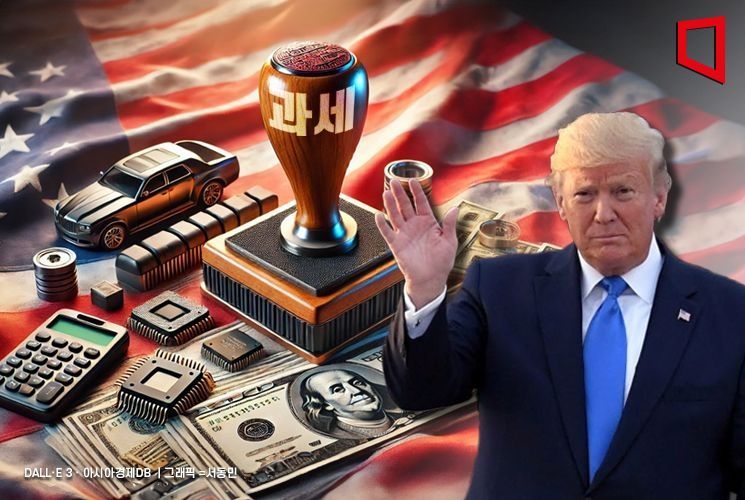
According to a recent report by Bloomberg News, the EU predicts that President Trump's imposition of high tariffs on steel and aluminum could result in export losses of up to 28 billion euros (approximately 42 trillion won). Earlier, President Trump announced plans to impose a 25% tariff on steel and aluminum products imported into the United States starting from the 12th of next month.
The steel industry is a core sector accounting for about 80 billion euros (approximately 120 trillion won) of the EU's total gross domestic product (GDP). Over 500 production facilities operate across 22 of the 27 member countries. Since 20% of production is exported to the U.S., high tariffs could deliver a direct blow to the European economy.
Another key European industry, the automobile sector, also shows signs of becoming a target of President Trump's tariffs. Recently, President Trump announced plans to impose tariffs of at least 25% on automobiles, semiconductors, and pharmaceuticals. In particular, he has criticized the EU's automobile tariff (10%) as being higher than the U.S. tariff (2.5%), calling it a violation of reciprocity. The automobile industry is also a core sector of the EU, accounting for 7% of the total GDP and reportedly creating about 14 million jobs.
As President Trump's tariff threats materialize, the EU has begun persuasion efforts. On the 19th, Maro? ?ef?ovi?, EU Commissioner for Trade and Economic Security, met with Kevin Hassett, Chairman of the White House National Economic Council (NEC), Commerce Secretary Wilbur Ross, and nominee for the United States Trade Representative (USTR) Katherine Tai to discuss tariff reductions in the automobile sector and to propose a joint front against global steel overproduction. The aim is to confront China, the world's largest steel producer, together.
French President Emmanuel Macron, in a recent interview after meeting with President Trump, urged not to impose new tariffs on Europe, stating, "The U.S. cannot wage trade wars against both China and Europe simultaneously," emphasizing that "the U.S. priority is to impose tariffs on China."
Alongside persuasion efforts, the EU has also begun considering countermeasures. First, it is preparing measures to protect the steel industry, which is facing imminent tariff imposition. Ursula von der Leyen, President of the European Commission, will chair the first meeting of the "Strategic Dialogue on Steel" on the 4th of next month to discuss the future of the European steel industry.
This meeting aims to bring together stakeholders including the domestic steel industry, raw material suppliers, and civil society organizations to discuss measures such as enhancing competitiveness, accelerating decarbonization, and ensuring fair trade relations. Based on the discussions, the European Commission plans to prepare a "Steel and Metals Action Plan" containing specific implementation plans. It is widely expected that this will result in higher import barriers to protect the steel industry.
Stricter regulations on imported agricultural products are also anticipated. The European Commission intends to apply the strict production standards that EU agricultural producers must follow to imports as well. In particular, plans include strengthening standards related to pesticides and animal welfare. Since U.S.-grown soybeans cultivated with pesticides banned in the EU could be targeted, some view this as a response tool to the Trump administration's new tariff policies.
Especially, the EU has stated that it will respond immediately if the U.S. applies reciprocal tariffs. There is a strong possibility that retaliatory tariffs will be imposed on key U.S. export products. In fact, during Trump's first term in 2018, when the U.S. imposed tariffs of 25% on imported steel and 10% on aluminum, the EU strongly opposed and retaliated by imposing tariffs on $6 billion (approximately 9 trillion won) worth of U.S. imports, including whiskey, jeans, and motorcycles.
© The Asia Business Daily(www.asiae.co.kr). All rights reserved.












