This Year’s Growth Target Expected to Be Around 5%
Focus on Large-Scale Stimulus Measures, Private Enterprise, and AI Development
China's largest political event, the Two Sessions (National People's Congress and Chinese People's Political Consultative Conference), will commence next month. The event will run for about a week, starting with the opening ceremony of the Chinese People's Political Consultative Conference (CPPCC), a national advisory body, on the 4th, followed by the opening ceremony of the National People's Congress (NPC), the equivalent of the national legislature, on the 5th. This year’s Two Sessions are expected to focus on economic policy and the development of advanced industries. Amid a continuing economic slowdown in China, the country's artificial intelligence (AI) 'DeepSeek' is causing a global sensation, raising interest in the 'rise of advanced industries.'
Premier Li Chang will announce the economic growth target in the government work report at the NPC opening ceremony. It is anticipated that the target will be set around '5%,' similar to last year. The growth target from provincial-level Two Sessions held prior to the national meetings averaged 5.3% for this year.
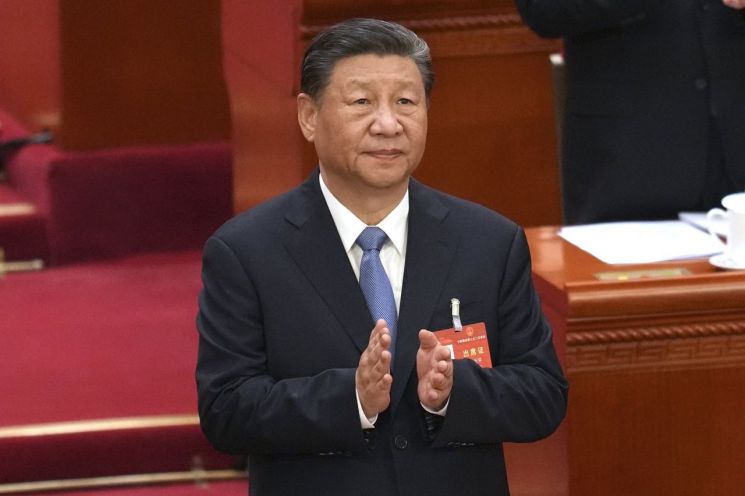 Chinese President Xi Jinping is applauding at the 2nd plenary session of the National People's Congress held at the Great Hall of the People in Beijing last March. Photo by Yonhap News
Local governments have set consumer price inflation targets around 2%, and the central government is also expected to set its target at 2%. If this holds, it will be the first time in 20 years that the target is lowered below 3%.
To achieve the economic growth target, large-scale stimulus measures are also expected. At the end of last year, foreign media reported that Chinese authorities plan to issue a record-breaking 3 trillion yuan (approximately 592 trillion won) in special government bonds this year. The plan is to boost domestic demand and expand industrial investment through this. However, the issuance scale may change following the inauguration of the Donald Trump administration in the United States.
In a situation where concerns about deflation are growing after the collapse of the real estate market, the authorities have tried to stimulate the economy through overproduction and exports, but this has become difficult with the Trump administration's rise to power. To achieve the growth target of around 5%, boosting domestic demand is essential. Bloomberg News expects an expansion of the domestic demand stimulus policy 'Igu Hwan Sin (以舊換新, replacing old items with new ones)' and measures to restore household confidence. According to the state-run Xinhua News Agency, Premier Li presided over the 12th special study session of the State Council on the 20th, focusing on vigorously promoting consumption by combining consumer promotion with benefits for people's livelihoods and expanding domestic demand.
Policies to foster private enterprises are also expected. Chinese President Xi Jinping recently held a private enterprise forum for the first time in over six years, stating, "The development of the private economy has great potential, and it is timely that many private enterprises and entrepreneurs are emerging," and added, "I hope that those who get rich first will promote common prosperity." At this event, Alibaba founder Ma Yun appeared publicly for the first time in five years, signaling strong government support for the private sector.
The Hong Kong South China Morning Post (SCMP) reported the day before that authorities plan to add a clause to the amendment of the Private Economy Promotion Law prohibiting the imposition of fines on private enterprises without legal grounds. The draft amendment is expected to be submitted as an agenda item at the NPC.
Riding the global DeepSeek craze, policies related to nurturing a second DeepSeek are also expected. China's research and development (R&D) investment last year increased by 8.3% year-on-year to 3.6 trillion yuan. This year, it is projected to reach 4 trillion yuan. Premier Li visited China's three major telecommunications companies the day before to urge strengthening R&D.
The annual press conference of Wang Yi, director of the Central Foreign Affairs Office of the Chinese Communist Party (also serving as foreign minister), is also attracting attention. Although the Trump administration has decided to impose a 10% tariff on all Chinese imports, China is responding in a measured manner. Clues are expected regarding China's strategy to respond to the Trump administration, China's role in ending the Russia-Ukraine war, and the China-Russia partnership.
© The Asia Business Daily(www.asiae.co.kr). All rights reserved.

![Clutching a Stolen Dior Bag, Saying "I Hate Being Poor but Real"... The Grotesque Con of a "Human Knockoff" [Slate]](https://cwcontent.asiae.co.kr/asiaresize/183/2026021902243444107_1771435474.jpg)















