Professor Kim Sinhyeon's Team at KAIST Develops High-Resolution Color Graphics Using Hemispherical Microstructures
Potential for Advancement as a Novel Artistic Expression Technique
Professor Kim Sinhyeon’s research team from the Department of Bio and Chemical Engineering at the Korea Advanced Institute of Science and Technology (KAIST) announced on the 26th that they have developed a technology to create high-resolution color graphics without using any chemical pigments by utilizing hemispherical microstructures.
Generally, chemical pigments that absorb light of specific wavelengths within the visible spectrum are required to express colors. However, the research team succeeded in reproducing the Joseon Dynasty’s 'Ilwol Obongdo' as an ultra-precise color graphic that is environmentally friendly due to the absence of chemical pigments and can permanently preserve color graphics without discoloration or fading.
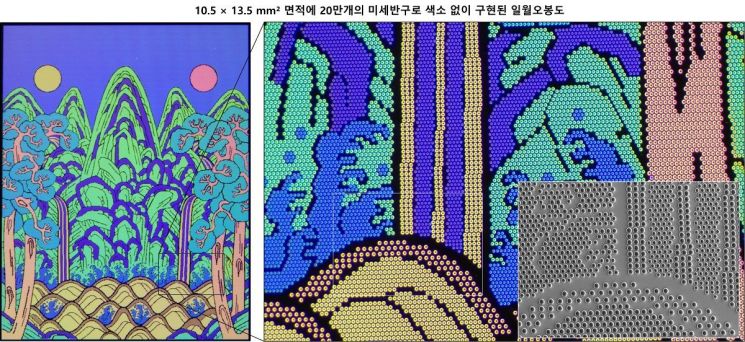 'Ilwol Obongdo' reproduced in the size of a fingernail without pigment using about 200,000 micro-hemispheres. Provided by KAIST
The Morpho butterfly, which exhibits a brilliant blue color, and the panther chameleon, which changes its skin color, display coloration without chemical pigments. This is due to the regular nanostructures that make up the material, which reflect visible light through the interference phenomenon of light, producing structural color. Since structural color depends on the structure rather than the material, a single material can display various colors.
However, regular nanostructures required for structural color are technically challenging to fabricate artificially, making it difficult to express a wide range of colors and to precisely pattern various colors.
The research team developed a new technology that can pattern various structural colors with high precision using only hemispherical microstructures with smooth surfaces instead of regular nanostructures.
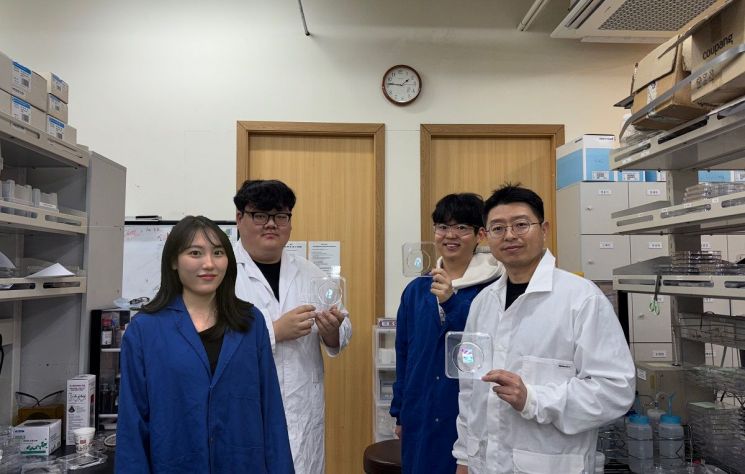 From the left, Son Chaerim (first author), master's graduate in the Department of Bio and Chemical Engineering, Dr. Nam Seonggyeong, Ph.D. graduate, Jiwoo Lee, doctoral candidate, and Professor Kim Sinhyeon. Provided by KAIST
When light is incident on an inverted hemispherical microstructure, light entering from the side undergoes total internal reflection along the curved surface, causing recursive reflection. When the diameter of the hemisphere is around 10 μm (one-tenth the thickness of a human hair), light traveling along different paths that undergo recursive reflection interferes within the visible light range, producing structural color.
The structural color can be controlled by the size of the hemisphere, and by arranging hemispheres of different sizes like mixing paints on a palette, the range of expressible colors can be infinitely expanded.
The research team precisely patterned hemispherical microstructures of various sizes into micro-pillar shapes using special materials employed in semiconductor processes, then raised the temperature to induce a photosensitive polymer to form a curved surface.
Through this method, hemispherical microstructures with desired sizes and colors can be formed at predetermined locations according to a pre-designed pattern, enabling the reproduction of arbitrary color graphics using only a single material without pigments.
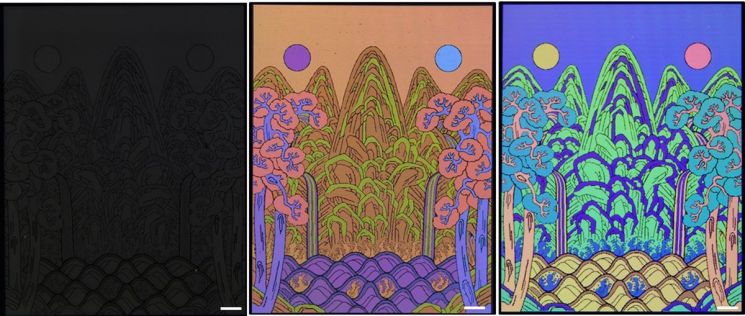 'Ilwol Obongdo' appears differently depending on the angle of light and the viewing direction. Provided by KAIST
The ultra-precise color graphic technology capable of permanent color preservation exhibits color changes depending on the angle of light incidence or viewing angle, shows color only on one side of the pattern, and is transparent on the opposite side, featuring a Janus-type characteristic.
This structural color graphic has a high resolution comparable to the latest LED displays, can contain complex color graphics the size of a fingernail, and can also be projected onto large-area screens.
Professor Kim, who led the research, said, "The newly developed pigment-free color graphic technology could become an innovative method for expressing new forms of artwork by combining with art in the future," and added, "It is expected to be applicable to a wide range of fields including optical devices and sensors, anti-counterfeiting materials, and aesthetically pleasing photo cards."
The research, with KAIST researcher Son Chaerim as the first author, was published in the February 5 issue of the prestigious international journal in the materials field, Advanced Materials.
© The Asia Business Daily(www.asiae.co.kr). All rights reserved.